Inequality in 20 Points

            Wealth Inequality                                Income Inequality

US map showing wealth inequalityUS Gini

This blog is heavily oriented toward inequality, which I believe to be the greatest challenge facing our country and the world. This post is intended to summarize some key elements for those who may not study it quite as much as I do, along with my opinions (of course).

We can’t talk about inequality too much. I welcome your feedback.

  1. Inequality in the US is very high. Both inequality of wealth and inequality of income are very high.
  2. Inequality has been steadily rising since the late 60s.
  3. According to the Huffington Post, we are now among the 5 most unequal countries in the world. Only Turkey, Mexico, and Chile are worse.
  4. Some of the reasons we should be very concerned: the human impact on health and happiness of the middle class and below; the transformation of a once egalitarian nation into a nation of elites and poor; a growing number of economists agree that above a certain level of rising inequality, economic growth is slowed; the threat of protests rising; our nation’s image in the world and the attendant loss of influence, increased resentment, terrorism and war (yes, war–inequality is a major factor in wars); the ultimate threat of revolution; the future of our children and grandchildren.
  5. Most politicians avoid directly addressing “inequality” because the wealthy (who have substantial influence on elections) insist on terms such as “poverty,” “opportunity” or “social mobility.” “Inequality” suggests something is unfair about the current state of outcomes, that I “should” do something to improve it, while other terms may allow me freedom to help only if I want to, not because I “should.”
  6. “Redistribution” is seldom seen in a political agenda either, for the same reason. There is objection to the suggestion of taking from those who have earned it and giving to those who might not have tried their best.
  7. But, “redistribution” does not necessarily mean taking from the wealthy and giving directly to the poor. That’s not even the best solution in many cases. Education and infrastructure are great choices for redistribution–and the outcomes would benefit both the wealthy and the poor. The poor will get to work faster on better roads and public transportation, and the wealthy will benefit from having more and better workers, and transportation for their products. Same for education. Better jobs and incomes and better workers, especially in our advanced service economy.
  8. Conservatives continue to argue that we should not be concerned with inequality. All we need is economic growth–that will generate jobs and increasing income for all.  This is the “trickle down” theory. But, there are now few economists who buy this theory. It simply has not worked. Since 1980, the US has increasingly strengthened neo-liberal (conservative) policies which have weakened unions, given corporations more power over employees and withdrawn social services to the underprivileged. During this time, under both Democratic and Republican administrations, during periods of both slower and faster growth, inequality has only steadily increased.
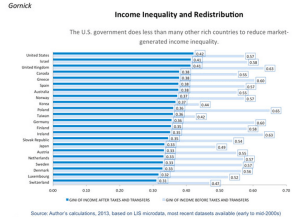
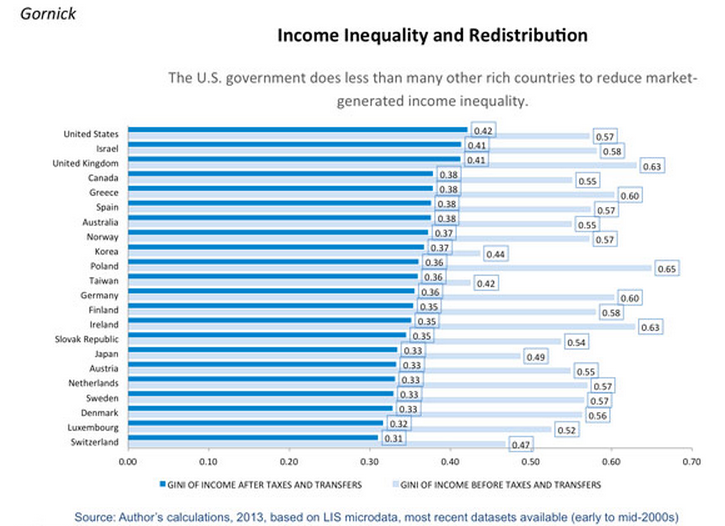
  9. In fact, one reason we are among the worst nations in inequality is that we redistribute less than many other nations:US does less redistribution
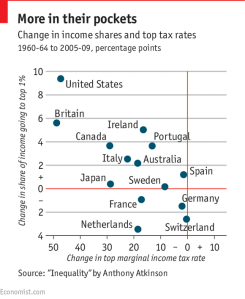
  10. And, no wonder there is less for the poor. We have significantly reduced tax rates on the wealthy and (of course) a greater share of national income has gone to the 1%:Shares and tax rates 60s to 2009
  11. Reduced tax rates and reduced social services are only part of the reason for increasing inequality. There are also structural factors. There is expanded globalization, which is promoted by conservatives (open borders, more trade, etc.). This means factories and jobs move without restriction to lowest wage locations, sometimes abroad, often leaving middle-aged workers suddenly adrift. Government protection for these workers existed under Lyndon Johnson, but no longer does.  Another factor is technology, robotics, etc., leading to the need for fewer workers in factories, grocery stores, and at toll booths.
  12. So, both our policies and these structural factors combine to drive this ominous acceleration in inequality.  No one wants to stop advances in technology, but we have to figure out a way to make the country (and the world) more equal. Reversing the trend takes time. We should use the policy levers we can, and do it now.
  13. Conservatives try to find fault with the comprehensive analysis of decades of data by Thomas Piketty, presented in his best seller of 2013, but his arguments are compelling. He shows that the rate of growth in wealth will exceed the rate of economic growth, globally, driven largely by demographics. He predicts inequality will inevitably increase over time, unless we take action.
  14. No critic has yet come forward to present a comprehensive argument backed by data, showing the opposite–that there is no reason for concern–that the trends will reverse themselves without any policy changes! No-one. If you’ve seen it, please bring it to my attention.
  15. Action involves some clear and indisputable steps, but also some very complex decisioning, which depends on different circumstances for different populations. Indisputable is the need for investment in infrastructure and education, which benefits both the wealthy and the poor. Why aren’t we at least doing that? No one has a good answer.
  16. However, much of the solution requires careful study and balancing. Immigration is an example. Certainly, immigrants do take some of the low paid jobs that some (few) Americans might want, but immigrants also bring enormous energy and talent to our economy, over time. Studies have shown they pay for themselves in taxes.  Immigrants may not be Americans yet, but our concern should be for all citizens of the world, not just our country. Our forefathers didn’t pull up the ladder, and neither should we. We cannot take all applicants at one time–even the capacity of the US is limited, but we can take more than we are taking.
  17. Free trade is another complex issue. It can be beneficial, but if some foreign countries subsidize industries which then compete unfairly, we lose business and jobs. Even when that is not the case, free trade finds low-cost labor in foreign locations, and jobs are lost. A big part of the solution is in government support to the displaced, including re-training for better service economy jobs–but the nature of our political system today does not tolerate expansion of government, even to re-train our citizens who are hard-working, tax paying, and want to work, but experience sudden loss of jobs to offshoring or technology.
  18. These complexities can be sorted out with a variety of specific solutions, but we must first agree we have a major problem that must be addressed. In the meantime, since we do not have Republican agreement that there is even a problem, all the more reason to at least deal with the obvious and indisputable, such as infrastructure and education. That benefits everyone. We should do that even if inequality is not seen as a major issue in our nation.
  19. I will close with this today–it’s always good to offer up a few “prescriptions,” in addition to pointing out the problems and the fault with present policies. I will borrow today from Timothy Smeeding of the University of Wisconsin. Here are his suggestions, which I endorse:
    1. “Tax appreciated assets when inherited or transferred inter-vivos.
    2. Raise income tax rates on capital income — capital gains and dividends — to levels just below labor, e.g. maximum rate at true current marginal tax rate or 30%. And curtail practices of defining earnings as capital income, e.g. “carried interest” provisions.
    3. Reduce political rents: close tax loopholes that benefit mainly the wealthy (e.g. cap on deductions for employer-provided health insurance); turn deductions that benefit the richest into credits, many refundable, to benefit lower and middle-income families; allow drug purchases at “best price” rates, not market rates, for Medicare; get rid of oil and gas exploration tax subsidies; limit and phase out agricultural subsidies.
    4. Use tax revenue to improve public infrastructure (including internet).
    5. Improve college prep classes and college counseling for students.
    6. More and better apprenticeships (get employers involved).
    7. Raise the minimum wage to $10 per hour, index it, and enforce labor laws (e.g. on scheduling).
    8. Universal child allowance at $2,500 per child, refundable if this is more than income taxes owed, and separate from the EITC.
    9. Profit sharing among all long-term (full year or more) employees.”
  20. A set of policies such as these would be a good start–then we can talk about how to spend the money raised by these changes. Note that Smeeding doesn’t recommend raising corporate income taxes or raising the statutory rate on earned income for the 1%. This is a reminder that rhetoric around tax changes for redistribution often becomes vehement. Changes such as these are decidedly modest, will not negatively impact motivation or capacity to invest, but they will make a significant difference in inequality!
What I Believe

June 8, 2015

Since returning from a year studying Development Economics in London in 2013, I have had spirited debates with some of my friends. Many of them are quite accomplished, successful financially, and most of them are more conservative than I. Much as I tried, I have not been able to change their views, and neither have they changed mine. I chalk this up to a small sample experiment confirming that we all have biases, and they’re really really hard to change.

It happens that I also recently read Daniel Kahneman’s Thinking Fast and Slow, filled with convincing proof of the power of biases in our decisioning. If you can find time, read it. You won’t regret the time spent.

Through much of my life before my return to school, I would say I was a Moderate, well maybe a Moderate Conservative, much as I now hate to admit it. My views were heavily influenced by the Wall Street Journal, The Economist, and from friends in business, where most views were conservative, mostly Republican. I was skeptical of government, unions, activists, and I thought the free market would solve most of the world’s problems. I thought free trade was always good. I thought capitalism was solving the poverty of the world–before I came to understand the data–showing that most of the alleviation in poverty has come from one country–China. Much of the developing world has undiminished poverty, and there is still way too much in developed countries, including the US.

My opportunity to get away to London was happenstance, but I had come to see across the last 30 years, that the neoliberal economic policies we were pursuing under both Republican and Democratic administrations, and which we were imposing on the World Bank and the IMF, were not resulting in better lives in the US for the average working man or woman, and not abroad either. Inequality was steadily rising, government services were being withdrawn, and capitalism was less and less restrained at its excesses. I suppose the opportunity to study came at the time I really needed a vigorous re-examination, with a body of serious scholarly work and study of real data. I guess I couldn’t justify this time expenditure before retirement. I was troubled. Things were not working out as I had hoped.

I’m now a Liberal. Now I believe that none of my previous views are universally true. The world is far more complex than I had understood before.

Thus, today I choose to set aside all explanations, arguments, and all the references I often search out to develop my message–or, perhaps just to support what I already think I know–my own biases.

Here is some of what I now believe–with my own personal 72 years of life as my source, enhanced by recent studies. The human part of it has been with me throughout my life, but has been reinforced by better understanding of the impact of poor policies, and the political part is very much to the left of where I was before.

I Believe2

I believe most people in this world are good. Trusting has been far more valuable to me than suspecting. Trust motivates good and distrust the opposite. Sure, I’ve been hurt occasionally with this approach, but I am confident that I’ve been hurt far less than had I operated with the other bias. I imagine the people of Russia and Iran are as good as the people of the US. I believe Muslims are just as good as Christians and Jews.

I believe I would not have made it as far as I have, without being born male and caucasian in the USA. That’s not as it should be, but that’s how it is. I’m talking health, happiness, career and financial accomplishment. I would not have made it as far as I have, without the help of two good parents, good teachers, people who encouraged and believed in me, and an uncle who was distinguished and wrote letters to his prominent friends, who interviewed me and recommended me for a scholarship, which I received.

My family was low income, parents were factory workers, never had savings, but both parents always had a job and we never went without food or decent clothing. If there was crime in my small town, I was never exposed to it.  Had my circumstance lacked one or both parents, had my neighborhood been very low income and had the kids in my neighborhood been involved with crime and drugs, I believe I probably wouldn’t have made it.

Thus, I believe many of those who have not had the natural birth benefits I had, need a little help from those of us who did. It’s not because they don’t care or don’t want to work. The vast majority of them have the same desires I have, are just as smart as I am, and would work as hard as I have, given a halfway decent opportunity.

I believe the trend of the last 30 years in steadily rising inequality is the greatest risk we face. This is true in San Francisco, the US, and the world. Had we found better solutions to inequality, we would simultaneously have solved problems of water, food, immigration, and war–at least a good portion of those–because I believe what is perceived as just plain unfair, leads to frustration, anger, and strife, and addressing it means solving many other problems.

I believe Bill Gates is right to observe that even the middle class is “better off” in some ways, due to technology, than 30 years ago. But, I also know that when stagnant wages are put up against the dramatic increase in costs of education, housing, and medical care, no amount of added internet connectivity is going to make up for the lost real income, the increasing worries about how to balance the budget and how to provide for the kids’ education.

I believe growth of economies is necessary but not sufficient to remedy the problems of inequality. I believe redistribution is necessary. It need not be dramatic. We should be debating only how we would spend the money. I’d start with infrastructure and education.

I believe raising taxes on those of higher income in our society will not reduce their incentive or reduce investment, provided only that the increases are moderate.

I believe elimination of most tax deductions would help and not hurt our economy. I’ll give up mine. I believe progressive flat tax rates would benefit our economy. We also need to re-design social security. I’m willing to have mine reduced, or even eliminated.

I believe there is a role for unions, and also for activists. We need this balance in our world.

I believe democracy is generally the best system of governance, but it is not without its flaws, and the US system needs an overhaul. I would be happy for us to revise our Constitution to provide better governance for today’s world, instead of treating our Constitution as gospel.  It was the work of a few good men a long time ago. We have a few good men (and women) at this time, who could make it much better.

I respect what China has accomplished without either democracy or our form of capitalism (e.g., with State owned companies and state controls). I believe that without their own forms of government and capitalism, they could not have brought 600 million people out of poverty across those thirty years and grown to equal the US economy.

I saw that the free trade policies we imposed (with our influence on the World Bank and the IMF) on Sub-Saharan African countries did not improve economies or lives there. We simply don’t have all the answers, and we should stop trying to impose or sell our system as the only answer. China’s dictatorship has worked well for the past, as it has been largely benevolent, but will probably benefit by gradual evolution to some form of democracy (not necessarily our form). We can criticize human rights, intellectual property protection, and other elements of China’s system, but we clearly deserve criticism for our  failures as well.

I believe capitalism is a better economic system than socialism, but capitalism should not be allowed to run unfettered. Capitalism cares not for the problems it creates for people, unless the remedying of those problems can be seen to translate into profits.

I believe immigration is a great solution to the problems of inequality throughout the world, and I believe that nations who take immigrants enjoy significant economic and cultural benefit from immigrants. No single nation can accept all who desire to come in one year, but closing the borders is not a good solution for the world or the receiving country.

While our government needs re-engineering and there is much waste that can be saved, I believe the answer is not in starving government. There are critical roles we are not fulfilling, and much of it should remain at the federal level.

I can be called a Pacifist. I don’t rule out military intervention to protect our country or to protect human rights around the world, but I think military action should be a last resort. Evidence of the last 40 years suggests that we usually create more bloodshed than we prevent when we use military action.

I am as stubborn as the next guy. I suppose no one influenced me much in the arguments I used to have about politics and economics before going back to school. However, the experience as a full time student at an excellent institution did change me. Was it my listening to some of the best professorial minds? Was it the required study of past works and vast amounts of data–which was certainly not part of my input before? Seems like change requires intense challenge and examination of beliefs and the support for contrary arguments.

A lifelong registered Democrat, I have voted for Democrats and for Republicans. I remain open to voting for a good Republican next time around. I know there are some. In a perverse sort of way, I wonder whether we might benefit from a period of Conservative control of all three branches of government. Would that provide sufficient proof that conservative policies of starving government and fighting more battles overseas will not fix the problems of America and the world?

Would that all of us could go back to school, maybe once every 10 years!

———————————————————————————————–

Acknowledgments: These beliefs are broad. This post does not attempt to include the many nuances of policy in specific places and times, nor does it attempt to offer specific prescriptions. For example, it does not address where more free trade is helpful and where it is harmful, or just how to assure it is helpful. I acknowledge it is much easier to see what is wrong or what does not work, than to specify just what I would recommend as solutions. I join all the Republicans who today are criticizing our President’s admitted incomplete strategy for Iraq. So far, I find none of them who have offered up their own complete strategy. That takes careful thought–and a lot of guts!

Baltimore–Is Poverty an Issue?

Baltimore–Is Poverty an Issue?

May 1, 2015

protesters in baltimore may 2015

We are in the aftermath of yet another young black man dying at the hands of police. First Ferguson, then New York, now Baltimore. Protestors are calling for fairness and transparency in policing, but also calling for jobs and higher incomes. In his NY Times opinion piece of today, David Brooks argues that the problem is not lack of money.  His piece can be read to argue that poverty is not a critical element of the problem. He says, “… the real barriers to mobility are matters of social psychology, the quality of relationships in a home and a neighborhood that either encourage or discourage responsibility, future-oriented thinking, and practical ambition.”

He’s right that the home and the support provided in the early years of a child’s growth are critical. But he’s wrong to suggest that continued poverty is not a critical part of the problem, or that we do not need to spend more money.  Creating the support he refers to costs money, and is simply beyond the capacity of most parents living in poverty.

In my previous post “Where Do You Stand,” March 2, 2015, I referenced the results of a local Northern California school dedicated to young people of color–Eastside College Preparatory in East Palo Alto, CA. Providing mentoring to provide encouragement, future oriented thinking, ambition, belief in oneself, Eastside boasts a 100% college acceptance and completion rate, when the national average for such first generation college students is only 11%. Almost all Eastside’s students are of color.

Eastside Graduates

But, this remarkable success for underprivileged kids doesn’t come cheap. Essentially, these kids are removed from poverty at home and lifted into a private, philanthropy funded school system which provides great facilities, dormitory home for those without a good parent, healthy food, and a place to play athletics and study late into the evening if they want to. Most importantly, it provides great teachers who are well paid, and enough of them to justify small class sizes and time for mentoring. Take a look at the reaction of the current Eastside class when all were accepted to four year colleges.

We are suffering a protracted period of economic stagnation for the middle class and below. The May 2, 2015 issue of The Economist reports that real wages in the US are now 1.2% lower than in 2009. Such was not the case between 1947 and 1960, when productivity in the US and wages moved relatively closely together. However, The Economist reports that since 1960, productivity has increased 220%, while wages have only increased 100%. Data from The Economic Policy Institute graphically revealed below, shows the dramatic disparity since the 70’s in wages for the lowest and highest paid: change in real wages 1973-2002

So, there can be no dispute that times are harder for poor people now than in 1973, and worse even than 5 years ago. But the top of the pyramid are enjoying growth in income and wealth far faster than in the 70s. Just today, as only one of many examples, the New York Times reported that the top 25 hedge fund managers took 11.62 Billion in compensation in 2014–and the hedge funds on average earned low single digits while the S&P 500 earned 13.64%. This is not meritocratic compensation. This is not rewarding for a job well done. Studies of Fortune 500 CEO’s also find little correlation between big salary increases and performance which can be attributed to their own work. See this report from Bloomberg.

What does this have to do with Baltimore and police shootings? I argue it has a lot to do with it. Young men of color have just cause to be resentful of a system which generates such results. And, results for these young men are worse than these statistics–many cannot or do not get an education and cannot or do not get a job. They’re not even getting the abysmal declining real wages.

Poverty, joblessness, and resentment add up to higher incidences of crime, which adds up to greater suspicion by police, sometimes resulting in people getting stopped, arrested, or mistreated (in the Baltimore police van) when unjustified. Can anyone really believe poverty is not a central issue in this persistent level of discrimination and abuse? Can anyone believe that the money David Brooks reports that has been poured into Baltimore has solved the poverty part of the problem?

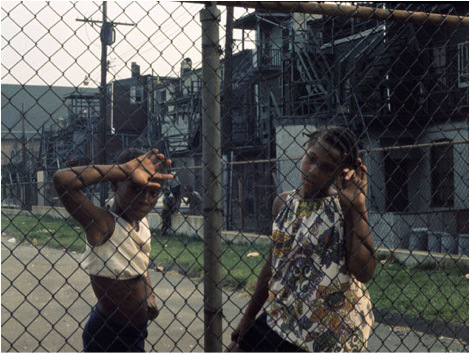
poverty in baltimore may 2015

Conservatives like to say that poor people do not care how much the top percentiles are earning–as long as they see their own job opportunities and incomes increasing some. I think inequality matters a lot, and people at the bottom do care, especially if those high incomes do not appear to be meritoriously earned. It’s demoralizing. It breeds resentment to our system, and for them, police are a daily representative of our system. But even if I concede this point for sake of discussion, we simply do not have even a modicum of increased job opportunities and wage increase for the lower income classes. We do not. How long can we wait for Conservative policies to provide this lift?

It’s a long time since Ronald Reagan and the increasing influence of neo-liberal economics, under both subsequent Republican and Democratic administrations. Added to the “flexibility” these policies gave to employers, we have experienced structural changes in the jobs market, such as the impacts of rapidly advancing globalization and technology, making the jobs market systemically more difficult and complex than before. We may not like it, but government involvement, making select investments in the housing, living conditions, education and job opportunities of the poor must go hand in hand with trying to influence “culture.”

Raj Chetty and colleagues did a study of the impact of tax credits to poor families, looking at test scores and future incomes (and taxes then paid) for the children of poor receiving the credits: “We find that a $1,000 increase in tax credits raises students ’ test scores by 6 % of a standard deviation, using our most conservative specification. We then examine the implications of these score gains for earnings using assignment to teachers as an instrument for score. We show that higher scores increase students ’ probability of college attendance, raise earnings, reduce teenage birth rates, and improve the quality of the neighborhood in which their students live in adulthood. Our results suggest that a substantial fraction of the cost of tax credits may be offset by earnings gains in the long run.”

Tax credits are just one of the many ways we can invest to reduce poverty and improve outcomes. It takes money, and it takes government. And, not all of the problem can be solved with tools that only help if you’re working–not when it is so increasingly difficult to get a job. It is unreasonable to assume that everyone who wants to work can find decent work. We have to change the culture of poverty, but changing that culture means spending money in the right ways to improve the neighborhoods of poverty and most especially enabling poor parents to have the resources to give their children a chance.

There are not enough Eastsides to rescue even a small fraction of poor children of color. Philanthropy is wonderful, but it represents only a drop in the bucket of need. Most poor parents and children will not have access to such special facilities. They will have to find opportunity in the home or the community. We have to help. There are dire consequences if we don’t.

Yes, we are going to have to spend more money, but spend it wisely, and there is a payback to society and the nation.

Avoiding “Inequality”

Avoiding “Inequality”

There is widespread discomfort with the word “inequality.” It’s OK in all quarters to use “poverty,” but not “inequality.” Why? Because poverty is something I can choose to alleviate a bit with my discretionary charity–it’s my choice, not my fault that it exists. But, “inequality” implies that something is unfair, maybe even implying that I have more than my fair share, and this means I “should” contribute to alleviating it because it is my obligation, not just my free choice. Inequality means it is my responsibility. People don’t like that.

That’s the essence of it. Most of us like feeling charitable of our own free will, but not feeling obligated to help others.

For example, it has long been clear in the West that the contribution employees of major companies make to United Way (usually the charity of choice for payroll deduction), is almost always entirely discretionary. That means the code of conduct around this is that no employee will ever be confronted by her boss asking why she didn’t commit a larger share of her income. However, not so long ago (e.g., in the 80s), it was common in the East (e.g., Cleveland) that a major employer would specify what percentage of income management felt should be given to United Way (usually 1-3%), and an employee would be challenged if he didn’t meet that target.  I know, because I was the chief of staff to the CEO of a major West Coast bank when he took his rotation to head the U Way campaign for a couple years. He wanted to know why the giving was so much higher in the East than in the West. I went there to find out.

My guess is that this is no longer the case, anywhere in the US. We have evolved to a society where it is almost impossible to find a sense of obligation associated with discretionary giving. It’s so much easier and more fun to give when one can view giving to be entirely charitable–“I do it because I want to–but certainly not because I have any obligation to do so. After all, this is my own hard earned money.”

And this attitude permeates the range of incomes. I think most lower paids also feel this way now. After all, due to what has transpired since 1980, they also have much less to charitably give away.

It is not surprising to find this attitude among Conservatives. For Conservatives, the common view is that those of lesser income, for the most part, simply didn’t apply themselves. That, or maybe those at the top are simply endowed with greater talent and that is just “God given,” not something to be tinkered with. This attitude is bolstered with a conservative economic argument that any kind of redistribution will reduce the incentive of people who are striving to rise–which takes both hard work and the willingness to take risk–the attributes characterizing our forefathers who drove their wagon trains across mountains and plains to earn their fortunes. And then another conservative argument–that if the wealthy are taxed, we won’t have sufficient savings going into investment to drive economic growth.

But it is confusing to find this attitude also common among many liberals Why is it that we also fall prey to this substitution of focus? Here are a few of the reasons that liberals fall into this trap:

  • America holds tight to the Horatio Alger theme across all spectrums–the belief that everyone can pull himself up by the bootstraps.
  • Those of lower income are vulnerable to a number of appealing elements of the complex Conservative agenda: Reducing taxes is highly appealing when real wages haven’t increased in 30 years, while costs such as housing and college tuition have gone through the roof. It’s easy to vote for tax reduction without realizing that after the politically unchangeable (entitlements and defense), the impact will be reduced funding of the public schools your children depend on for future “mobility” or “opportunity.”
  • Lawrence Mishel offers one more important explanation for Centrist Democrats adopting the mobility/opportunity preference over inequality in an April 9, 2015, article for The American Prospect: the top 1% are not only Republican donors, but also Democratic donors. Note Hilary Clinton’s cultivation of Wall Street. I could go on about the big money issue, but that’s not the point of this post.

To summarize, there are all these “appropriate” political terms being used–“poverty,” “mobility,” “opportunity,” “shared prosperity,” and others. There is a rather universal avoidance of the term “inequality.”

Part of the reason is that it’s just easier and more comfortable to view charity as a choice, not an obligation.

Part of the reason is the widespread continued adherence to the American ethic of being able to bootstrap oneself, notwithstanding the increasingly evident greater difficulty in doing so–especially without the right parenting and education. And who can argue those don’t cost money–yes, parenting too–parents working two jobs to get by cannot do the right parenting.

Part of the reason is the seemingly effective Conservative rhetoric, and the attendant loss of confidence in government, which leads to sympathy to just starving government–notwithstanding the impact on schools and support systems.

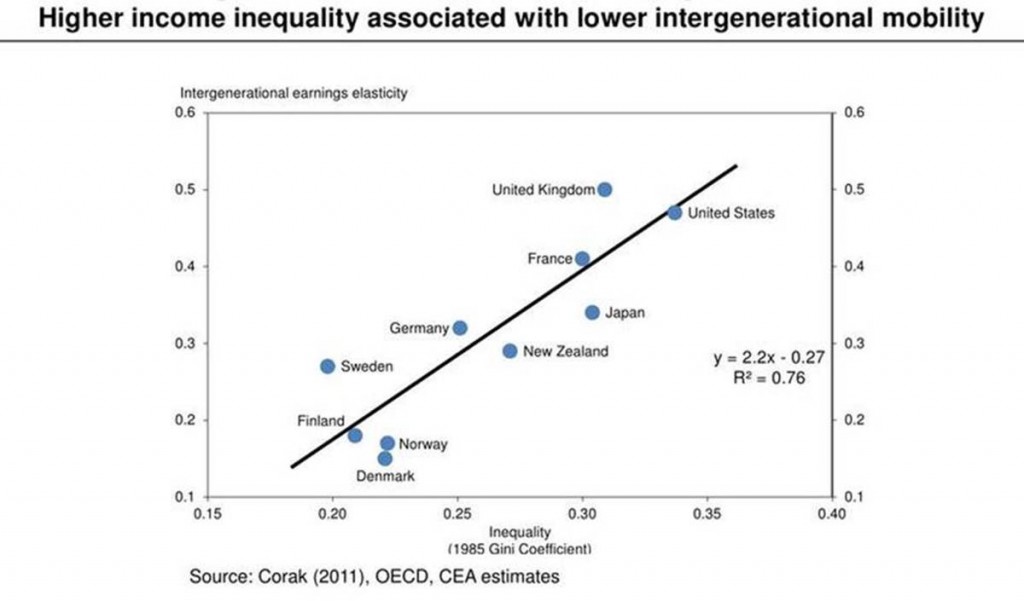
To make matters worse, it turns out that the US has not only a very high level of inequality compared to other countries, but also has a very high correlation of intergenerational income. Zero on the vertical axis means equality. A high number there (the US) means that our rich parents end up with rich kids. We can debate why this is true, but it is true–and this is NOT positive “mobility.”

inequalityvsmobility-1024x601

The reality is that inequality is real, getting worse, and fixing it is an obligation. For the critics, no, it doesn’t mean making everyone equal. It doesn’t mean destroying incentive or investment. Changes in taxation can be modest, and we should also take from defense and from entitlements.

The Crisis of the American Middle Class

In a January 29, 2015, article written for Stratfor, George Friedman provides a lucid summary of what has happened to our middle class across the last generation, along with a warning of the dire consequences of allowing the trends to continue. I recommend this article for clarifying what we have all been suspecting.

He starts by comparing the lifestyle opportunities for those of median income in 1989 vs 2011. Median income of 2011 ($49,103), adjusted for inflation, is below that of 1989. Making it even worse, today’s family at median income cannot live comfortably, which was possible in 1989. Friedman breaks it down in detail, but housing costs and college tuition increases in real terms make it far more difficult, without adding up all the rest.

Looking back to even earlier periods of better life for our middle class, Friedman attributes the feeling of great prosperity in the 60s to the GI Bill’s college tuition and attractive mortgage terms for vets returning, and to the interstate highway funding, which made the suburbs reachable and affordable. Thomas Piketty attributes much to Roosevelt’s New Deal and Lyndon Johnson’s Great Society and related programs. Both agree that these kinds of programs resulted from catastrophic events–the Great Depression and WWII. Without such external shocks to motivate something like that in present terms, it appears to both Piketty and to Friedman (and certainly to me) that we are caught in a trend of economic events that is increasingly negative for our middle class.

John Maynard Keynes forecasted in 1930 that by now we would be enjoying a 15 hour work week, due to anticipated advances, primarily in technology. No one will dispute that those came, along with globalization, and indeed brought great wealth. But Keynes failed to anticipate that the benefits of those advances would flow to the owners of capital, and not to the workers.

Friedman describes what happened to corporate America across this period, accelerating since 1980. Long term employment is all but gone. Disruptive innovation is abounding. Those who are not agile enough or too old get left by the wayside. Neither the company nor the government protects them. We are seeing a massive structural shift in the nature of our businesses and our work opportunities.

Friedman argues that our powerful American ideology was built on the idea of perpetually improving living conditions for our middle class. We are losing that, and with that loss we stand to lose a significant portion of our geopolitical power. I have argued in earlier posts that we have unintentionally caused some significant portion of growing terrorism, as young disadvantaged people of color look at our arrogant proselytizing of American ideology and do not find it working in reality–certainly not for them, and not even for us anymore.

My brother was one of the last single employer workers (now retired from Bell South). I had 7 employers. By the numbers shared in Friedman’s article, we both made it above the “medians” and, while not really wealthy, we have had good lives. We worry about our children and grandchildren, for whom the workplace offers little security and little wage growth, if you end up being “just a worker,” not making it to management or a critical skill (like “engineer”= coder, or something like that). And, regardless of your level, you better be agile–there is no net and there is no parachute these days. Disruptive business changes fast, and you have only your own resources with which to respond.

So, do we continue to advantage the wealthy in taxation so as to incent innovation and investment in order to promote more growth which might trickle down; or do we tax the rich, and redistribute into more equalizing programs such as infrastructure and schools?

Friedman summarizes the dilemma: “The left cannot be indifferent to the historical consequences of extreme redistribution of wealth. The right cannot be indifferent to the political consequences of a middle-class life undermined, nor can it be indifferent to half the population’s inability to buy the products and services that businesses sell.”

I agree entirely with his summary of the dilemma, and I respect Friedman’s acknowledgement that the solution is beyond him.

I would only add my opinion that the described challenges to redistribution (the solution proffered by the Left) through higher taxes on the wealthy (reduces investment by wealthy and reduces incentive) are applicable only at much higher levels of taxation than anyone has suggested. Much of profits accumulated to wealthy has not been going into jobs producing investment, and we have had stronger economic growth in periods of our past when taxes on the wealthy were much higher than any liberals are currently proposing.

I believe the pendulum has swung too far to the right. We don’t need to return to anything near past periods of peak taxation, but there is room to move to the left without harming investment or incentive. Would that we could concentrate our bi-partisan attention on just what programs would move us toward more balance–shared prosperity as we believed we could and should provide–a return to our beliefs as a nation, and set an example for the global community.

Inequality and Carbon Emissions

Inequality and Carbon Emissions

April 7, 2015

There is a likely correlation between these two, but that’s not what this is about. This is a plea for Conservatives (economists and politicians) to take a risk and state clearly their answers to three questions, and then back it up with solid research that everyone can comb through and evaluate.

Here are the three questions:

1.  Is it a problem? (and if not, why not?)

2. If it is, should we do anything about it? (and if not, why not?)

3. If we should, just what do you recommend we do?

Isn’t it infuriating when people criticize one who steps out and takes a position on one of these hot topics, but never even chooses to admit it is a problem and offer another solution to it? Critics are abundant. People who have figured out better solutions and can explain and defend them are few. Those are the ones I am looking for when voting time rolls around.

I watched two recognized economists on youtube yesterday, attacking Piketty’s Capital in the Twenty-First Century. I read the book, and I know that Piketty did not suggest specifics to his wealth tax, except in an illustrative manner. And, in doing even that, he suggested the rate of such tax could be very low (low single digits) and still be quite valuable. So, when one of yesterday’s critics used a 20% tax on grandma’s silver collections (when grandma was assumed to have no income), I was infuriated. Then, he went on to suggest Piketty would tax jobs creating capital investments. Piketty never suggested that. These liberties taken may not be caught by those who haven’t read the book.

Then, there was a long diatribe about how capital and wealth are not the same, that capital cannot be measured, but wealth can, and that it’s not appropriate to substitute wealth for capital. In economics terms, that may be true, but in the real world, that doesn’t really matter. Wealth is a reflection of capital. This is an example of obfuscation–attempting to take advantage of the average reader’s lack of an economics degree, when the particular argument doesn’t even matter.

The names of these economists don’t matter either, because you can google “criticisms of Piketty” and see dozens of them. I think much of the criticism is either professional jealousy against a young French economist who did years of painstaking research and provides it to whoever wants to question it; and to bias on the conservative side. For deep seated bias against doing anything about the rising wealth of the 1% while wages are stagnant for the middle class and below, facts don’t really matter.

So to those two and others of similar mentality: Have a field day with any criticisms you feel–that can be healthy; but, before you leave, answer these three questions.

My own opinion:

1.  It is a problem. Many of us DO care that some make 10’s of millions without giving back. We don’t need to take the majority of their income or wealth, but we should take a larger portion than we are now, not a lesser portion as many Conservatives argue.

2. While some may actually feel the gradual slide toward an oligarchic nation is not a problem, and others may feel it will somehow correct itself without government action, I feel we need action. If somehow economic forces begin to move in the other direction, we can reverse direction in taxation. But if they don’t, we are experiencing increasing social pain that is becoming enormous. This is no longer the egalitarian nation our forefathers envisioned.

3. Redistribution is the only answer. Even Conservatives will not cut major programs to fund measure to help resolve our impending crisis. Unless we can take from existing programs, such as health care (move to single payer system), defense, or social security, we have to have income to rectify our imbalance, and in that case, it can then only come from more taxes. While the US and other developed countries are similar in income distribution before government redistribution, we are among the most unequal when the amount of government redistribution is entered into the calculation–we simply do not provide as well as other developed countries, for health care, education and various social support programs. We can debate how to spend the new money (infrastructure and education would top my list), but we desperately need to get moving.

First, a modest increase in taxes will not dis-incent the super-wealthy. Second, we need the money to start to close the growing divide. Some of the uses can benefit both the wealthy and the poor–e.g., infrastructure.

If any of my readers can direct me to Conservative arguments which address these three questions on either Inequality or carbon emissions, I commit to reading carefully with an open mind. I can’t find them!

It’s so easy to say Piketty’s “wealth tax” won’t work. It’s not so easy to answer the three questions.

Let’s put it this way: If you don’t like my proposal, exactly what would you do?

Terrorism–Causes and Cures

Terrorism–Causes and Cures

Emotions and beliefs seem to be at the root of terrorism. Emotions: Frustration, anger, jealousy, fear, revenge. Beliefs: Radical differences of religious beliefs, beliefs that developed foreign powers should not be imposing their political and economic systems on underdeveloped countries; beliefs that the rhetoric and the behavior of western powers do not align; beliefs that certain countries discriminate against certain types of people; beliefs that certain developed countries are arrogant and that their systems really do not command respect in terms of how people are treated, the effectiveness of their political systems, and the outcomes for the underprivileged.

I’m told there has been terrorism since the beginning of mankind, but I certainly wasn’t aware of it, growing up in a small town in North Carolina. I didn’t really pay much attention to it until 9/11. Since then we have seen a steady escalation, with ISIS as the latest manifestation, and a particularly dangerous and troublesome one it is. For the purposes of what I want to say here, there isn’t much distinction between terrorism and war. Excluding wars that appeared to be entirely justified (such as the two World Wars), many of the other wars the world has experienced since WWII have questions of justification. Were we justified to fight in Vietnam? In Iraq? In Afghanistan? In Syria? Could those wars be seen by the citizens of those countries as forms of terrorism brought by developed countries? Whether or not we agree, it seems undeniably true from the local viewpoint. To a large segment of the populations of those countries, we (the US and allied western powers) were apparently seen as intruding. And doing so with great loss of life to both local combatants and also to civilians.

The main “solution” we seem to be pursuing in regard to growing terrorism around the world is to combat it with force. We use vast amounts of intelligence. special forces, drones, etc., to hunt down the perpetrators and kill them. Large organized terrorist groups like Boko Haram or Isis get air power, artillery, and infantry. Force against force. Is that working? Doesn’t seem to be, considering that terrorism is increasing. What can be done? Conservatives say more force, until we thoroughly extinguish the opponents. While force is undeniably necessary to protect, considering the danger to the innocent, it doesn’t address the root causes–mentioned above. If the terrorists feel aggrieved, somehow denied, discriminated against, we need to address these issues. Is it true that somehow our systems (in the US, the UK, France, and elsewhere) discriminate against young men of color? It appears so. How else can one explain the employment rates for young black men in the US vs young white men? I do not believe it is because young men of color do not want to work, lack motivation.

Something is wrong with the “system.” It’s not that such discrimination is legal or condoned by authority. But, it is there, underground, insidious, pervasive. If young men of color don’t get a decent education and don’t find jobs, if they feel trapped in a life of poverty, if they are don’t find their religion and dress accepted, they become vulnerable to jihadist recruiters who persuade them that all of this is the fault of the foreign powers. It’s not their fault that they are stuck in poverty–it’s the foreigner’s fault. It’s the fault of the “infidels” and their governments. And since civilians are being killed by airstrikes in their countries of origin, they may feel justified to kill innocent civilians participating in a marathon in Boston. And now, it appears young women are also drawn to the terrorist cause.

Personally, I don’t find this hard to believe. I don’t find it hard to understand. Not hard to believe that an unintended discrimination exists. Not hard to understand how we are held responsible. After all, we have jobs, cars, money, things. They don’t. And they don’t feel they have a chance to have those things.

Some Conservatives argue that there is vast opportunity. They always can find a small number of underprivileged men of color who have broken out and done well. They read this to mean that everyone can, and thus the lack of opportunity is not the problem. I argue we need to augment our use of force with our use of help. Help with educational opportunity, help with job training, help with counseling and mentoring, help with promoting inter-religious education and tolerance throughout our wealthier classes in our wealthier countries.

The other thing for us to focus on is our own system. Consider the US– does our nation of today really exemplify effective and fair political process (note the weight of money in our system)? Does it really offer opportunity to all–equal opportunity? Do we treat our underprivileged fairly? Does the homelessness on our streets and the populations in our prisons reflect the kinds of values we extol? Are we fair in our dealings with lesser developed nations in our trade and global economic policies? Why has our gini index of inequality now risen to where it was in the robber baron era, early in the 20th century?  We are failing in all of these. We don’t look very attractive now, to even the uneducated foreign observer. And yet, we continue to not only promote our system as the one and only system, but we also to try to force it upon others (e.g., China).

A broader sets of expanded policies permitting more immigration from lesser developed to more developed countries would enable reduced global inequality and more global opportunity, but the US and other developed nations of the world are tending to a more nationalist stance. Political parties opposing immigration are gaining strength–in England, in Germany, and in the US.

Of course, there are other issues involved in terrorism–issues such as religious sectarianism, as with some elements of the Shia and Sunni populations in the Middle East. But I argue we have unintentionally caused a lot of it with our arrogance, our intervention in other countries’ issues, our imposition of our values on others, and the failures to exemplify the ideals we try to sell abroad. Force alone only leads to revenge and then to more force. The ISIS fighters are a very young bunch, and they’re going to be around a long time. It is high time that we set about to work on the underpinnings of the problem.

Kudos to Koch Brothers

Kudos to Koch Brothers

March 23, 2015

Yes, that’s right. Bet you never thought you’d hear me say that. But I really want to give credit where it is due! This evening I watched a senior representative from the Koch Brothers along with a prominent African American liberal on Anderson Cooper 360.

They are completely in agreement, representing a large group of people on the extreme right along with a large group on the far left. They’re in complete agreement that our penal system is totally broken. America represents 5% of the people on this planet and has 25% of the incarcerated.

Why? Because our right and left (bipartisan again) together promulgated an escalating list of federal crimes across the last century in what can only be seen now as a failed attempt to take crimes off the street and punish offenders into not committing further crimes. Many of the crimes added, along with mandatory minimum sentences, were petty crimes like shoplifting and possession of illegal drugs.

Good intentions escalated into more and more crimes designated and more and more sentences. Much of the time, what has transpired is that the offenders end up with a criminal record which virtually prevents future employment. Drug users end up using again, getting put in jail again, and again, and again. We do not offer rehab to early offenders and we put mentally ill into prison instead of into hospitals, treatment and therapy.

All of this results in a growing and horrendous expense to the taxpayers. In the opinion of these wise bipartisan groups, we can fix this easily and quickly with appropriate agreement and legislation. After all, both sides of the aisle seem to now understand that fixing it is not going to cost–we will save money and reduce the draw on government resources if we reverse this trend and spend our resources toward getting people onto their feet and contributing to society and our economy.

I thank the Koch interests and encourage this bipartisan coalition in developing and presenting legislation.

This is another example of how we have escalated poverty and inequality in our own country with policies focused on punishment as opposed to help.

So nice to see Conservative interests demonstrating that they also want to provide support for the underprivileged. If the motivation is to reduce taxpayer expense and reduce government, that’s ok with me. See–there are things we can agree on, even if the underlying motivations are different!

When Conservatives are Criticized by Their Own Media

March 16, 2015

I studied economics and globalization at a unit of the University of London for the 2012-2013 term in an MSc. program there. Among my takeaways was a greater appreciation for academics and their research, which relies more on facts and data than most other sources of news.

Another takeaway was to see more clearly that certain popular sources of news are often more biased than academics, rely less on facts and data, and more on the political/economic stance of the publisher. On the conservative side, there is the Wall Street Journal and The Economist, both solidly supportive of the free and uninhibited private market and generally critical of government rules and regulations–usually lining up squarely with Republican agenda–at least that was true before ultra-Conservatives hijacked the Republican party and moved it to the outer edge of Conservatism. Along with this goes a hawkish stance on global conflicts and extreme austerity in government fiscal policy. We actually need another word for this sets of positions…lunacy?

Illustrating that dramatic movement to the right, it is striking to see more and more viewpoints coming from The Economist which are starkly in contrast with positions now taken by Conservatives in the US. The March 15 2015 issue includes the following challenges to Conservative positions:

  • A strong recommendation against Benyamin Netanyahu in his race against Yitzhak Herzog in the vote tomorrow for Prime Minister of Israel. “Bibi” Netanyahu has just returned from his controversial gleeful reception by Republican members of Congress who share his hawkish views on Iran and Palestine. The Economist recommends Herzog.
  • In a continued criticism of excessive austerity imposed on England by George Osborne, the Chancellor of the Exchequer, The Economist says, “The shabby truth […] is that the success of Mr Osborne stems from the goals he has abandoned, rather than the guns he has stuck to. And next week, unless his budget plans are more apt, Britain risks paying a heavy price.” The Economist favors less austerity.
  • A strong argument in favor of the US embracing its growing Latino population. I’m choosing this one to highlight below.

The Conservatives of the Republican party have moved their party well beyond even the neo-liberal political and economic positions of publications such as the above. Even more amazing is how oblivious the Conservative voice is to recognizing the vast gap, not even acknowledging it or defending why/how they can justify no hint of moderation. So, from today’s Conservative viewpoint, The Economist can no longer be seen as “conservative.”

The blindness of Conservatives regarding Latinos is particularly troubling. Latino growth is where most of their immigration resistance is centered–it’s mostly about Mexican illegals, and then about Mexican legals and then about immigration in general. The popular refrain is appealing to jobs lost to immigrants–legal and illegal. It would seem more consistent with liberal vs. conservative for Democrats to be worrying about jobs (including jobs taken by immigrants), but most of the noise now comes from Republicans.

Here are a few of the arguments for the US embracing the arrival of our Latino immigrants:

  • Face reality. Latinos number 57MM of our 321MM in the US today. Without immigration, the Latino share will rise, due to their higher birth rate.
  • Every year 900M Hispanics born in our country reach voting age. Republicans are way behind in popularity with Hispanics.
  • Reason # 1 is basic economics–hard to believe Conservatives don’t embrace it–Latinos are constantly reducing our population’s average age, giving our country an entirely different (much more optimistic) economic future than Japan, China, and many European countries without the strong Latino (or other immigrant) growth. This means more workers paying into social security, reducing the drain on scarce government resources to meet the burden of entitlements to the aging, like me. Take a look:

hispanicsThere are issues in dealing with this surge, both real and perceived, but much of it centers around the near poverty and often uncertain status of Hispanic families. This can be seen in somewhat higher crime rates, lower graduation rates, and higher teen pregnancy rates in some Latino communities, but the data shows these trends are improving for Hispanics. For example, a Pew study finds that US born Hispanics take a significantly more negative view of teen pregnancy than do their foreign born counterparts. We need to provide for more and better education opportunities for our young Hispanic population. We need their developed skills in our advanced workforce. They need not be destined to work in the kitchen, in cleaning, or in the garden, only.

There is no good reason to believe our Latino population brings with it less ability than our German or our Irish or Italian.  We are incredibly fortunate to have this younger population of hard working people joining our workforce and our communities. Republicans, of all people, should see the economic benefit of this huge and growing wave of potential for our culture and our economy.

We will need to aggressively embrace these entrants with support in education and rights to take advantage of the opportunity. If we do, we will all benefit. Instead of “taking our jobs,” they will be growing our economy with the young energy and we have all the more jobs to go around.

In my previous post, I highlight one example of success in supporting the underprivileged in the Latino population–a private school in East Palo Alto, where the majority of students come from poor Hispanic families, and where 100% of this high school’s graduates are going to college and graduating from college–vs. an 11% college graduation rate for first generation students nationwide.

Where Do You Stand?

March 2, 2015

On the matter of helping people, we stand divided. Conservatives argue people should help themselves, that too many people don’t, too many are happy to depend on the State, that opportunity abounds.

Liberals argue the obstacles to opportunity are great for many, it’s not that easy, that those of us who have been privileged to “succeed” economically, no matter the reason (deserved or good fortune), should help those who are not successful.

There is truth in both positions. Yes, there are some who are too lazy or for some reason just don’t apply themselves to take advantage of opportunity. For example, studying hard in school. And, yes, there are some who face obstacles far greater than you and I, which some of us are inclined to forget when we’re on top, tempted to think we did it all with our hard work and intellect.

All of us are frustrated to see that a few young children of poor parents of color somehow forge a path through the obstacles of that birth, with hard work and study, while so many others do not. A few succeed, while most end up in a life of poverty, with little or no fulfillment. It’s tempting to think the majority who do not, simply do not try hard enough. No one has successfully determined what distinguishes the winners.

There is one thing that can hardly be disputed: With a helping hand of the right sort, the odds can be turned around. One such example is Eastside College Preparatory School, right in our own backyard–East Palo Alto, a poor community of color.

98% of Eastside’s students are first generation college bound. A significant number are housed in dormitories on campus, because they do not have a satisfactory home in which to live and study. Often there is only one parent available, or in some cases, none, and the children are bounced around between relatives and friends. Crime and drugs are rampant in the community. 65% of students are Latino, 31% African American, and 4% Pacific Islander.

With all this, operating since 1996, with hundreds of graduates, Eastside boasts a 100% success in graduating its students and sending all of them to four year colleges. So far, all have either graduated from college or are on track to do so. All!

With a national college completion rate of only 11% for first generation students, Eastside is an example of what can be done.

Eastside has a faculty, campus, and program which will compete favorably with the best of the wealthy prep schools in Pacific Heights, my part of San Francisco, where parents pay $35,000 per year to send their teenagers to schools which are feeders to Ivy League Universities.

There are other organizations around the country doing similar work with underprivileged youngsters. The model usually involves close mentoring of students who can’t see the way forward without guidance and encouragement, which is not sufficiently available to them from their home or neighborhood. Many credit such opportunities as saving them from a life of crime and drugs or other ways of becoming a cost to the state. To the contrary, they become contributors to the economy!

So, as a nation, we can continue to be frustrated with those who don’t try hard enough on their own, if that relieves our sense of responsibility. Or, we can focus on what is indisputably the benefit to our nation of a lifetime differential, backed by indisputable statistics–11% vs. 100%. Can anyone find fault with that?

The tragedy is that the number of people helped by organizations like Eastside is tiny by comparison to the number who do not make it through the morass.

Government does not fund Eastside or the wealthy prep schools in my neighborhood. Private efforts have demonstrated results in both cases.

Isn’t it time for us to join together to get government properly involved in expanding these success stories?

http://www.eastside.org/_about/glance.html