Inherited Wealth–Is It a Problem?

June 21, 2014

Inherited Wealth–Is It a Problem?

Thomas Piketty’s new book Capitalism in the Twenty-First Century argues that inherited wealth is a problem for our future.  A number of journalists and economists are taking exception with this, as well as other of his well documented and analyzed conclusions. The impact of wealth inheritance is one of the most significant of the concerns Piketty addresses. He recommends stronger progressive taxes on inherited wealth, but would be happier with an annual tax on all owned capital.

One of his critics is the very conservative economist Gregory Mankiw, Chairman of the Economics Department at Harvard. His disagreement on wealth inheritance is found in the New York Times of today: http://www.nytimes.com/2014/06/22/upshot/how-inherited-wealth-helps-the-economy.html?hpw&rref=business

Here is my understanding of Mankiw’s arguments:

1. He reverts to the old argument that if we minimize tax on the wealthy, they will invest their tax savings (capital) in productive facilities, thus stimulating the economy and in the process, creating jobs for those who are not wealthy.  This is the conservative “trickle down” argument–the wealthy get richer and along the way, the rest of us get a little better off. Indeed, this has been a economic argument for sometime, and still has some adherents. It was promoted by Arthur Laffer with great aplomb during the Reagan era. However, this theory has lost a great deal of its support over time. For one thing, it fails to acknowledge that putting more money in the hands of the lesser privileged results in more consumption than putting more money in the hands of those who do not need more consumption (sometimes this is called the supply side vs. demand side argument). More consumption results in more investment and more jobs. For another, studies show that the choices of the wealthy do not now so clearly go to growth producing new companies and jobs. More often these days, the incremental savings of the wealthy seem to go into liquid investments.  It is not at all clear that an additional investment in the stock of a public company does anything for growing the economy or jobs.

2. He argues that increasing capital is subject to decreasing returns. This is true and Piketty devotes a great deal of study and attention to this issue in his book. Mankiw devotes one sentence to his statement of “fact,” as if that closes the issue, implying that the diminishing returns will be falling dramatically, thus implying that the whole Piketty argument r > g is overblown, where r is the rate of return on capital and g the growth rate of the economy.  No one is arguing with the truism that when r exceeds g by 2 or 3 percent annually, wealth grows, rather rapidly. So, argument centers around whether r will decline. Piketty convincingly argues that diminution of returns is likely to be very slow to occur, decades away, if not centuries, before significant in the context of reducing the impact of wealth on inequality.

3. Then, Mankiw makes a final one sentence proclamation–that increased capital increases labor productivity, which inevitably increases labor’s wages. This is an economic theory. But, if this is going to be true in the future, why hasn’t the vastly increased capital across the last 30 years resulted in increased wages to labor? Why should that be different in the future, absent any policies whatsoever to gradually provide for slightly reducing inequality?

I am not an economist. I do not have a Ph. D. I did not graduate from Harvard, much less Chair the Economics department anywhere. I don’t presume to say that I understand economics better than Gregory Mankiw.

But we can all understand issues when presented as Piketty explains. And, more indisputably, we can all see clearly what has happened to the US and the world since 1980.

Instead of defending the status quo, as inequality rises, why don’t the critics explain just exactly why the world would not be better off with some gradual adjustment via taxes and other policies to make the world a little more egalitarian? No one is arguing for socialism, just a little more fairness.

What would be wrong with a progressive estate tax scheme, which might look something like this:
For inheritance over $1 billion, 95 percent tax (that leaves $50 million for heirs); over $500 million, 90 percent; over $100 million 80 percent, etc…under $5 million no tax. Or, smooth out these percentages to avoid unduly penalizing those who barely fall into the next highest tax category.  Or lower all the percentages by 10 percent, etc.

What would be so wrong with such a plan?  Or, better still, a progressive annual tax on all wealth (capital)–and here we could be talking about single digits in percentages.

Of course, additional policy would have to deal with gifts before death–to family (through complex tax avoidance trusts and partnerships) and to foundations. Foundational charity from the wealthy is wonderful, but it comes with two problems if it is to be considered the substitute for the withdrawal of government support to the underprivileged: The amount of philanthropy falls woefully short of what has been withdrawn by government; and, what is philanthropically given, in aggregate (with exceptions) goes first to universities, churches, etc., and a relatively small portion goes to needs of the poor. Incidentally, that which goes to universities is much more likely to go to Harvard or Stanford than to community colleges, as an example. So, that kind of philanthropy probably tends to widen the gap in opportunity between the privileged and the underprivileged.

It’s hard to feel that most Piketty critics are objective. How much is professional jealousy, hoping for recognition by riding on the coattails of this amazing study, nitpicking or reminding of disputed theoretical arguments? And, of course, how much is simply the result of the prejudice of deeply committed neoliberal ideology?  How much of that is captive to the big money on the right, one way or the other?

San Francisco’s Inequality

June 18, 2014

San Francisco’s Inequality

The May 20 edition of Vanity Fair comments on the state of inequality in San Francisco, which is 2nd only to Atlanta in the height of its Gini coefficient at .523.  (http://www.vanityfair.com/online/daily/2014/05/san-francisco-income-inequality-developing-nations). If San Francisco were a country, it would rank with Rwanda in inequality at about the 20th most unequal country in the world.

Here in my favorite city, we have the abundance of wealth growth and what goes with it–a tech boom, which has produced a number of multi-millionaires and billionaires, and has created hundreds of thousands of jobs within an easy commute distance.  We have a growing number of upscale restaurants, merchants, and services catering to the growing number of wealthy. Preferring to live in the city, many of those working south of the city on the Peninsula, at one of the tech companies, have used their newfound wealth to bid up the price of homes in San Francisco. Why not, the city is more fun and the tech giants send busses to bring you and return you from pricey neighborhoods in San Francisco.

A Reuters article of June 9 reports that a UC Berkeley study finds that each tech job creates 5 other jobs in the Bay Area. Indeed, the unemployment rate in the City is down to 4.8 percent, far below the national average.

Yet, the poor segment of the population is being squeezed out of the city by rapidly rising apartment rents and very little new affordable housing being built. Mayor Ed Lee has just introduced legislation to target 30,000 new housing units to be built over the next six years, with half to be affordable–defined in this expensive city as for those whose incomes can be up to $146,000 for a family of four. If history is any guide, there will be very few that end up affordable to families whose incomes are $30,000, $50,000, or even $75,000. Officials offer an example of hope for townhomes to be built in Visitacion Valley, a rehabilitation area 30 minutes by car from toney neighborhoods, for $600,000 each. Most clerks, restaurant workers, and lower level support staff in government and industry cannot touch that price.  Rents for a studio with only 400 square feet are averaging $2,500 per month in Pacific Heights.

San Francisco’s Human Services agency reports that as of 2012, 15 percent of San Franciscans live in poverty. That’s up from 10.5 percent 5 years ago.

Something that can’t be good is also happening to San Francisco’s middle class, defined as those earning from 50 percent to 150 percent of San Francisco’s median income of $72,500. This middle class has declined from 45 percent of San Francisco’s population in 1990 to only 34 percent in 2012, according to the Brookings Institution.

Should we care about this? If we are among those who are at least reasonably secure financially, perhaps already own a home in the city, or have a job with a wage sufficient to live on, and upward potential possible, it’s hard to be concerned about it. After all, career and the family take the bulk of one’s energy and attention, and a little entertainment can take all the rest. That’s been true of my past, as well.

Some say, let’s just look at the good side of all this. Theoretically, we all have the opportunity in San Francisco and in the US to become multi-millionaires, so let’s not disturb a system which offers its citizens that chance.

Others, like me, say the capitalistic system is a good system, far better than any socialist system, but not without its faults and its excesses, and we must rein in certain of those in order to preserve it. Otherwise, given time, we subject our city and our nation to increasing social instability, possibly even revolution, followed by a dramatic redistribution of all wealth.  It has happened before in nations around the world and given time and likely worsening of inequality without policies to address it, it can happen here.

There are other reasons. A little more equality (without destroying incentives) makes the world a more pleasant, more enjoyable, and safer place for all. Furthermore, it’s just not fair–many of the wealthy inherited a good portion of that wealth, didn’t earn it themselves.  Many benefitted from privilege of the wealth or social status of their families or connections with people of power. Many benefitted from their skin color or their gender. Some were just in the right place at the right time.  It’s not all meritocratic!

Piketty’s Wealth Tax

June 16, 2014

This will be one of a series of articles focused on the findings of Capitalism in the Twenty-First Century by Thomas Piketty. By all means, if you can read the book, or listen to it on Audible, do so. It’s worth the investment. But since many will not be able to dedicate the time to it, I offer these observations, along with my own views, of course.

I’m starting in reverse, because many people may elect not to read the book because the policy recommendation is unrealistic. Please do read the book!

The Wealth Tax

Starting from the “policy prescriptions” part of the book, which is the final section of such scholarly works, let’s understand his proposal and why he proposes it.  Let’s begin with Piketty’s acknowledgment: “A global tax on capital is a utopian idea. It is hard to imagine the nations of the world agreeing on any such thing anytime soon. To achieve this goal, they would have to establish a tax schedule applicable to all wealth around the world and then decide how to apportion the revenues….Admittedly, a global tax on capital would require a very high and no doubt unrealistic level of international cooperation.”

His acknowledgment should dispense with the critics who have been proclaiming this prescription is impossible.  He says so himself. So, why has he bothered to develop an extensive argument for such a tax, if its unrealistic?  He explains: “…this ideal…can serve as a worthwhile reference point, a standard against which alternative proposals can be measured….[and] when looked at closely,…this solution turns out to be less dangerous than the alternatives.” That is the opinion which he supports with some of the following arguments, highly abbreviated, my interpretation:

  • First, it is helpful to stipulate just for this reading, that there is indeed a major problem in the trend of inequality in the world. If you can take that for granted for the moment, it will help. His first 514 pages offer the history, various explanations, and his prediction that it is highly likely the current trend will continue, if not addressed with policy. In other posts, I’ll try to summarize some of the preparation leading to the prescription.
  • It will also help to stipulate for now that the decline in inequality between 1945 and 1970 was not due to “natural” elements, but rather due to specific policy (e.g., tax) changes instituted in many nations in the aftermath of huge macro-economic events of the first half of the twentieth century–specifically the two World Wars and the Great Depression. Without these policy changes, inequality would not have declined, and the reversal of these policies (opposite policies) are driving the dramatic increase in inequality beginning about the time of Reagan in the US (1980). Without new policy changes, he argues, inequality is likely to continue to rise–perhaps to levels experienced in Europe in the 18th and 19th centuries.
  • The primary policy he recommends is the wealth tax. This tax would require disclosure of all assets we each own–stocks, cash, property, businesses, art and jewelry (within practical limits, I will add). This could be a one time tax or an annual tax (more likely), and most likely would be highly progressive. There would need to be international agreements on where/how the revenues are split up and spent. He doesn’t propose the wealth tax as a substitute for other taxes. Each major form of taxation has it’s own specific purpose in his view. The reason a wealth tax is important (vs income tax) is that inequality due to wealth differences is far greater than inequality due to income differences. The taxing would in itself reduce inequality, and the use of proceeds could drive further future reduction in inequality.  Amounts taken would not be sufficient to reduce incentives for hard work and talent, at least not significantly.
  • As to the size of the wealth tax, Piketty does not give specific recommendations, just hypothetical examples: One example is a tax of nothing on wealth below $1 million euros (about $1,350,000), 1 percent between 1 and 5 million, and 2 percent above 5 million, would result in an annual contribution of about 2 percent of Europe’s GDP, which is a very significant number, if it were to be applied to critical elements of equalization for the underprivileged–like schools, job training, better health care, etc.  2 percent for the US would be about $300 Billion, a very substantial number.
  • If one is not persuaded that high and rising inequality is a risk to the social stability and sustainability of  the capitalistic system (which he proposes to slightly constrain in one of its most egregious excesses by his proposal), one might be concerned about the level of national debt in the US and in many other countries. One might resonate with Piketty’s explanation of how a wealth tax could be the most effective way to eliminate or significantly reduce record government debt levels. For example, simplistically, Piketty calculates that the public debt of most countries, averaging about one full year of national income in size, could be eliminated entirely by a flat one time 15 percent tax on all private wealth. Can you imagine a world without government debt, without that burden and risk on future generations, without the necessity to dedicate a significant percentage of taxes to interest and debt repayment? Of course, Piketty does not propose this–a more progressive schedule could be developed and 5 to 10 years could be used to accomplish it–or longer.
  • Or, if eliminating debt does not attract one, what about the cost of repairing and preventing the damage from climate change, a cost which some estimate to be equal to 5 percent of global GDP per year, according to Piketty?
  • Furthermore, the tax is not so new as some first think. There are wealth taxes currently in existence. Most prominent is property tax, but there are other forms in various nations.
  • The information to effectively enable the collection of such a tax would come from government records (as with property taxes), and from banks and other financial institutions where traded assets are held. Taxes could be on gross value or net of debt. Some critics have focused on the question of valuation of certain types of capital–e.g., privately held companies, such as Koch Industries. Indeed, this is an example of a executional challenge, but not impossible. The world figured out how to value real property for taxation, at least well enough, and there were many who thought this an unsurmountable challenge at the time.
  • Also, the informative value of a wealth tax, with all global financial institutions reporting, is high.  Some will argue this risks personal privacy, but our property ownership is already recorded by local governments and our financial assets are already recorded by the financial institutions which hold them. If there was a secure and accurate international governmental record of all assets owned by each of us, we would have a far better understanding of inequality in the world–and incidentally, also perhaps then able to document the fortunes of criminals and drug dealers, etc., whose assets are at least in part held by financial institutions which would be obligated to report in such a scheme.  Escaping taxes by placing assets in tax havens would be impossible.
  • Piketty points out that while this proposal seems impossible, it may not be. After all, income taxes seemed impossible in the world until around 1910 and the following decade, when a number of developed nations struggled through the debate and complications and enacted such taxes. In fact, France imposed a 25 percent one time tax on capital (wealth) in 1945, to deal with war costs. It has been done elsewhere.

These are a few of the important observations of the final chapters of the book. Piketty’s book examines alternatives to the wealth tax–inflation, central bank actions, and other policies which could be used to address the issues he is concerned with–but he finds none remotely as effective as the wealth tax.

I’m in favor. I would be willing to pay 15 percent of my modest wealth to fully eliminate public debt, and I would be willing to pay annual percentages of a progressive wealth tax to reduce inequality and allow investment in opportunity building for the underprivileged.

Finished Capitalism in the Twenty-First Century by Thomas Piketty!

June 14, 2014

Finished Capitalism in the Twenty-First Century by Thomas Piketty

I am pleased to report that today I finished the new Piketty Book. Along with it, I also finished re-reading Jane Austen’s Pride and Prejudice and am now into Balzac’s Pere Goriot, which books Piketty and many other scholars concerned with rising inequality recommend reading, since they paint the real and graphic dismal picture of extreme inequality and misery for the lower classes as existed in the 18th and 19th centuries in Europe–where we may well be headed in the twenty-first century.

Having read a number of reviews of the Piketty book, I am doubtful that many have yet finished reading the 577 pages (not counting the index, etc). I see much to suggest many relied on someone else, which often results in misstatement.  For example, there are hundreds of instances in this book where Piketty reminds his audience that his view is based on his own analysis of data (tons of it) and that he has been forced to make some assumptions where the data was insufficient, and that therefore, there can be others who would not agree with his assumptions or his conclusion. He regularly describes alternate scenarios around a number of interpretations, and explains carefully why he thinks his proposals are probably (but not certainly) the most dependable. So, when his results are described as just his view and possibly wrong, I have been hoping to see a recognition that he acknowledges that in his book, and an explanation of the support for an alternate view. I’m not seeing much of recognition, and even less of an alternate explanation with compelling defense.

A frequent example is that some critics have been so cavalier as to say the wealth tax prescription is impractical, politically infeasible in today’s world, as if they were offering a profound criticism. But this is a clear indication they have not read the book, or simply do not choose to acknowledge that Piketty himself says this many times in the book. But he explains carefully why he feels strongly that it is nevertheless worth proposing and discussing–and in my opinion, it certainly is.

This is a fabulous book, full of well documented analysis, loaded with insights that explain our past, easy to read, and so broad as to look at the widest possible array of considerations, which other books on inequality (I have read quite a few) do not undertake to examine. I will be surprised if Piketty is not the recipient of the Nobel Prize for this work. I cannot recommend it too highly to all to read. If you have any concern for the economic and social stability and sustainability of the US and of the planet, you should read this book.

I will now set about to more slowly read it again, study, read more reviews, and try to understand better a few of the economic debates which surround its key principles.

Various elements of this book will be the subject of quite a few future posts on this nascent blog, as I seek to fully digest this commendable study.

My hat’s off to Thomas Piketty and the group of scholars who assisted him!

The Redistribution We Have Already Had

May 25, 2014

The Redistribution We Are Now Experiencing

Most of my friends don’t want to talk about re-distribution. If they’re concerned with inequality (some are and some aren’t), most want to talk about equality of opportunity. “Re-distribution” has taken on the connotation of taking money or property from wealthier people and giving it to poorer people, as if that happens right at this moment as a financial exchange–akin to stealing, violating property rights, etc.  Or, maybe akin to land reform, which has happened in many countries across time at points of maximum inequality–the land of the wealthy is expropriated, divided up, and given out to the poor, as in China in 1952.

But I don’t know anyone who recommends anything remotely like that as the solution to today’s inequality, so I can’t help thinking that the pejorative connotation to the word “redistribution” is just a part of the conservative scheme and rhetoric–i.e., making “redistribution” seem so extreme, horrible, illegal, unfair, that it just can’t be discussed.

I’m compelled to make a point which is not new, but has received less attention than it deserves: I’m fine on focusing on realizing more equality of opportunity, as this too has suffered significantly across the last 30 years, but I’m not willing to concede that there is no basis for a certain amount of redistribution, through progressive taxation, estate taxes, and the like.

Perhaps one of the best ways to re-format the discussion is to consider the redistribution that occurred from middle class and poor, upward, to the wealthy, across the last 30 years and is continuing. The facts are indisputable. See this chart from the new Piketty book:

The share of total national income taken by the top 10 percent has increased significantly from 30-35% in 1960 for all the above developed countries (for which there is adequate data), excepting Sweden, which has actually become more egalitarian, although Sweden is moving to rising inequality again now. All the others have seen the share taken by the wealthiest increase since 1960. The change is most dramatic for the US, where the share has risen to almost 50 percent of all national income going to the top 10 percent–taking us back and actually a bit beyond the excesses of the robber baron era!

If there is now no dispute that there has indeed been a redistribution upward during the last 30 years, and, of course, this has happened without the kind of dramatic expropriation which conservatives (and all of us) vehemently abhor, then (1) what were the influences or policies which caused this to happen, and (2) can’t we use some of the same or similar to gradually abate the continued rise of inequality?
In other words, if we can now agree that we have indeed experienced a form of redistribution upward across the last 30 years, whether or not we can agree on whose “fault” that is or whether this is just a cycle, can we not now agree that we need a similar form of redistribution downward across the next 30–one which does not destroy incentives, but simply moderates and restrains such as to maintain a society in which fairness is felt to exist?  Can we not agree that fairness in correcting this redistribution should not be limited to focus on opportunity alone, no matter how important that is also?  
If we don’t address the trend and reverse it to a degree, our children may indeed be part of the abhorrent form of redistribution sometime down the road. Millions of innocent people died in the chaos in China during the process, and many who did not deserve to have their entire life’s work expropriated, lost all their belongings, and many their lives also. This is not a legacy we want to bequeath to our children and grandchildren.
Let’s look at the factors which enabled this redistribution upward to occur. To be fair, these cannot all be fully ascribed to some kind of organized scheme by the wealthy to enhance their relative wealth at the expense of the underprivileged–but some can!
First, there was the period from 1940 to 1960 during which the US became more equal. Much of what happened was the result of the two world wars and the Great Depression. Policies enacted as a result of those monumental macro-economic events led us back to the more egalitarian US of the 60s, in which we returned to the kind of egalitarianism which was one of the hallmarks of the patriots who founded the US. Without the progressive taxation post-WWII, reaching up to a peak of 90 percent on marginal high incomes, and without the social programs of the New Deal, without the minimum wage laws of the middle of the century, and other such policies enacted, the return to a more equal society would not have happened.
If the two Wars and the Great Depression had not given the US a major shock, the period of greater equality would not have occurred. Left unrestrained, the wealthy of the robber baron era might well have advanced to even greater heights of super inequality than what exists today.  We might have experienced a revolution in the developed world, had we not these macro events and the policies which followed them. The correction came mainly as a result of those shocks and the policies installed in the aftermath.
But in the 80s, beginning with Reagan’s neo-liberal policies, this set of equalizing policies was reversed. The ethic of the US changed from one more supportive of equality and helping the underprivileged to one of sponsoring individual freedom, entrepreneurism, reducing government, reducing taxes (especially on the wealthy who were argued to be the investors who drive economic growth), and removing protections for workers so as to create more “flexibility” for employers, such as to further stimulate economic growth.  The theme gradually changed to believing that growth will solve all problems of poverty and inequality–that there would be a trickle down of wealth as the wealthy invest their tax savings in job creating enterprises. This theory did not prove to be true–see the chart again–the trickle was clearly up, not down.
Some of the growth in wealth for the wealthy was the result of honest attempts to improve the economies of the world. Privatization is an example. Beginning slowly in the 1970s and picking up steam in the 80s and 90s, governments in the developed world led the way in privatizing large sectors of the economy which had been government owned. British Telecom is a classic example. Energy, transport, telecom, minerals, water, and finance were at the top of the list. In some cases the process of selling off these assets to private ownership was fair and transparent, and market prices were obtained. But even in these cases, only those with the ability to purchase shares were the wealthy. And, in many cases, Russia and China being examples, opportunity went first to those of high social status or political connection to government officials, and the price was not fair, nor was the process. It remains to be debated, case by case, whether the privatized entity served the public better than the when publicly owned. Many seem to have performed well, and others not so well in terms of the public interest (e.g., privatization of water in Bolivia). Often the motivation of the government was primarily to monetize the asset to solve budget problems, rather than for better service to the public.
Asset price recovery: Some was the result of the unusual appreciation of asset values across the period since 1960, which added to the fortunes of those who had asset ownership to begin with.
Some was due to inheritance, with estate taxes put back to relatively low levels.
Some was due, according to Piketty, to the arrival of the era of the “Supermanager” who gets paid $10 million to run a major company, and his direct reports (the “C class”) get large percentages of such compensation. This phenomenon is found most strikingly in the US, and has confounded scholars who have sought to correlate such compensation to any reasonable measure of individual contribution or corporate performance, and have generally found that there is none–executives are rewarded by the Compensation Committees of their Boards, most often, for results which can be traced only to external events over which the executives had little control.
Joe Soss, Jacob S. Hacker, and Suzanne Mettler produced a collaborative study of the effect of a wide variety of policies on the rise of inequality in Remaking America: Democracy and Public Policy in an Age of Inequality.  Below are some of the relevant observations from this book:
The battle between supporters of an entrenched activist state of the 1950s and 1960s and the growing opposition of a rising force of conservatism seeking to roll back the welfare state and the role of government in general, was eventually won in large part by conservative forces, although certain of entrenched features of the welfare state survived to date–e.g., social security and medicare.
Conservative policy incubators were well funded and played a strong role in changing public opinion–such organizations as the Heritage Foundation, the Cato Institute, and the American Enterprise Institute. 
The movement away from pensions to individually managed 401K programs was sold as beneficial to the public (choice), but lost the advantages of pooling of risks, and many individuals lacked the investment knowledge of pension fund advisers. Tax benefits of such programs went largely to the wealthy, due to their higher marginal tax rates.
The main income maintenance program, Aid for Families With Dependent Children was replaced by Temporary Assistance for Needy Families, the latter being more work focused, thus less helpful to those who could not work. 
Less educated workers became less likely to have access to health insurance than they did a few decades back. The number without health insurance at all has increased. 
Unemployment benefits were reduced in many states, and legal protections for workers right gave way to more control by the corporation, and thus, less power and influence of labor unions.
The Soss et. al. authors show, as does the Piketty book, that the egalitarian US of the mid-twentieth century resulted largely from policies enacted–social and labor policies of the New Deal, the Fair Labor Standards Act of 1938 with its minimum wage guarantee, support provided GI’s returning from WWII, and other such policies.
So, any arguments that reduction in inequality since 1940 was simply natural (as Simon Kuznets argued in the 1950s), are simply wrong. Policy changes moved the US back to a more egalitarian society. Likewise, policies changed in the reverse direction beginning with Reagan facilitated the resurgence of the natural forces of capitalism, which left entirely unrestrained, will inexorably toward a more and more unequal society. See Piketty and Soss for extensive support for this argument.
Conclusion: There has been a redistribution, no matter whether one likes it or not. It continues in an upward direction at this time. There needs to be some moderating redistribution in the reverse direction. This upward redistribution did not happen naturally.  It was not largely the result of competence and merit.  It was caused by policy changes. Policies in the reverse are needed to enable a modest correction in the other direction. Let’s start talking about what those might be, and stop wasting time debating whether a redistribution from the underprivileged to the top 10 percent and especially the top 1 percent happened. It did, and dramatically so.
As Piketty so forcefully and compellingly argues in his new book, capitalism is a wonderful system, but it cannot be left unrestrained.

Thomas Piketty and Detractors

May 11, 2014

As it is hoped everyone now knows, the US has risen from an egalitarian country in the 1940s to 1960s, to one of the most unequal, rising steadily in inequality since around 1970.

Inequality is a subject around which there is heated debate. Most agree incentives are important for motivation and for progress–we want to reward those who succeed, so that they can count on the financial motivation for their hard work and risk in doing so. I vote for that. My life is benefitted by the advances of Amazon and Google, and I love my all-electric car.  The people who provide me these benefits deserve to be rewarded. But most of us do not want to see high unemployment, stagnant wages for the middle class, increased poverty, and for public services such as schools and roads to further deteriorate. We don’t want to see homelessness increasing on our streets. We certainly don’t want inequality to get worse, if there is any reasonable action we can take to prevent that.  The debate has come to involve whether government has a role, or whether everything should be left to the free market.

And, it ends up revolving around a word which has taken on a negative meaning, hardly ever being used by a politician on either side of the spectrum–“redistribution.”

I’ve been reading Thomas Piketty’s new book Capitalism in the Twenty-First Century, now a best seller and the subject of lots of op-eds, blogs, articles, reviews, talk shows and the like. I like it and I am impressed by his scholarship and his fair and objective manner, constantly reminding his reader that his work is not perfect–nothing is in economics.

Piketty provides a readable summary of years of analysis of tax records in a number of countries, along with his own forecast of the future based on history and what he finds as the factors driving inequality over time, and then makes suggestions for how to better equalize the world.

So far, even the harshest critics pour abundant praise on his research and historical findings.

Then, the criticism begins.  Much of the criticism is unfair, in my opinion. Here’s why:

One broad area of criticism argues that when he sets about to forecast in his second section, he’s venturing into the unknown. Arguments remind that seldom are forecasts accurate, that one really can’t know the critical variables of the future, likely different from those of the past, that forecasting is not the stuff of real economists. Essentially, economists should not forecast.  I’m still looking for critics who will reveal different forecasts, thus subjecting themselves to the same criticism, but haven’t found those yet. I’m sure eventually they will emerge, but the delay may be due to the sheer depth of Piketty’s well defended forecasts–a high bar to exceed.

In his book, Piketty repeatedly makes it understood by his readers that he is venturing into the unknown, that too much reliance should not be placed on his specifics, so the above criticism is one he has already cautioned about. But, I would ask those who take this position–are you saying you never use forecasts–in business, in investing, in sports, in personal affairs…?  Whether explicitly stated or simply intuitive, we are all using forecasts all the time. And, yes, they are often wrong, but often they are right, at least of a sufficient frequency and magnitude to make the end result reasonably successful.  When Apple launched the iPhone, they had some kind of forecast–and if they hadn’t, we’d be pretty amazed and the Board certainly wouldn’t have approved the investment. And, the forecast was probably wrong in the end, but certainly right to a sufficient magnitude. I’d be shocked to learn those forecasts were done without the input of any economics.

Most large businesses employ economists, and indeed the leaders do look to them to forecast the future, as best they can, with the usual caveats. In fact, they are hired to forecast various elements of the economy as these might affect the products and services the company is offering. Like it or not, economists do forecast. So, I discount this broad criticism and wait for those who want to provide their own forecasts and defend them half as thoroughly as Piketty has done his.

Maybe the real reason to discount economists’ forecasts is that the critics don’t like the Piketty forecast. Piketty forecasts that inequality will worsen if we don’t do something about it. There are still some who think it’s either ok if it gets worse, or that natural factors will reverse it–a set of theories popularized by Simon Kuznets in the 1950s, in which Piketty (and most other economists) find no merit.

The other major objection relates to policy suggestions from Piketty. These are his ideas of the very best ways to reduce inequality, to improve the nature of the world. Piketty’s first suggestion is a global tax on wealth. Detractors point out this is impractical, will never happen, politically impossible. This is tiring, because Piketty says the same thing, several times, thus there is no new insight from his critics on this point.

So, why is Piketty even bothering to provide such a policy prescription if it’s virtually impossible?  To me, the answer is perfectly clear.  It’s because this would be the fairest and best way to solve the problem–it goes directly to the essence of the cause and arrests its growth. The primary cause of the rising forecast is that returns to capital are likely to exceed the rate of economic growth–meaning that those with wealth today can expect it to grow, and those without will be left farther behind. Any other types of measures suffer from one or more flaws of being indirect, with side effects or other consequences which are less than ideal.  And, Piketty does address other measures–a critical one being assuring education of similar quality for wealthy and poor.

The Economist, a conservative publication, raises both of these criticisms in the current issue (http://www.economist.com/news/leaders/21601512-thomas-pikettys-blockbuster-book-great-piece-scholarship-poor-guide-policy): The Economist wants to know why Piketty didn’t focus prescriptions on increasing the rate of economic growth, so that wealth accumulation (capital) would be exceeded by economic growth. This is entirely unfair, as Piketty devotes a huge part of the impressive work to a study of the rate of economic growth, concluding that it’s highly likely to end up well below the rate of capital growth for most of the twenty-first century. I urge The Economist to provide or direct us to an equally well done study of capital growth, with prescriptions for getting even faster growh, and especially demonstrations of how that benefits all in a fair manner.

The neo-liberal suggestion to just focus on growth and that will solve all problems addresses inequality with the “trickle down” theory–sure, the rich get richer, but everyone else also gets a little richer as well. That has been the mainstream neo-liberal doctrine of the US and many other countries (China, for example) for the last 30 years, and that’s what got us to the high levels of inequality we are now experiencing. Why should we expect more of the same to resolve the problem?

The China Threat

May 8, 2014

Roger Cohen writes about the hegemonic threat of China in his NYT op-ed on May 8 (http://www.nytimes.com/2014/05/09/opinion/cohen-chinas-monroe-doctrine.html?hp&rref=opinion&_r=0). He seems to be influenced by the views of Charles Mearsheimer, who has been prognosticating trouble for the US from China, for years now.  These two are not alone in suggesting we should be worried and we should be doing something about it–right away!

This kind of concern is exacerbated by news that China’s economy is now measured to be about 87 percent of the US and is expected to surpass us later this year.

The primary problem with the raising of these concerns is this: The US is still clearly the strongest nation in the world, and is likely to be so for a few more decades. China is not a threat in this generation.

Why? There simply is no other nation or even group of nations (bloc or alliance) which comes remotely close to US power.

Global power is usually measured by looking at military power, economic strength, and soft power, the latter being the influence that a country has, based on its principles and its behavior–both at home and abroad.

Fearmongers are not wrong in noting that the US has lost relative standing in all three of these since its heyday at the time of the collapse of the Soviet Union, when Charles Krauthammer declared we were the undisputed unipolar world power and Francis Fukuyama wrote The End of History and the Last Man, proclaiming that democracy and capitalism represented the final stage of evolution for the planet.  Things have changed, such that these statements are no longer undisputed.

But notwithstanding the US’ relative decline since then, we are still the strongest by far. The gap has closed only to a degree, leaving us still far out in front. The gap has narrowed due both to our mismanagement of all three elements of power since 1992 (mistakes if you prefer–but all nations have made mistakes in their policies across that long period), and also the more rapid percentile economic growth of certain lesser developed countries since 1992–e.g., China, India, Brazil and others.  It’s well understood that developed countries cannot grow at 10% annually, as China has, but as China grows, its rate of growth must also slow. No one disputes that.

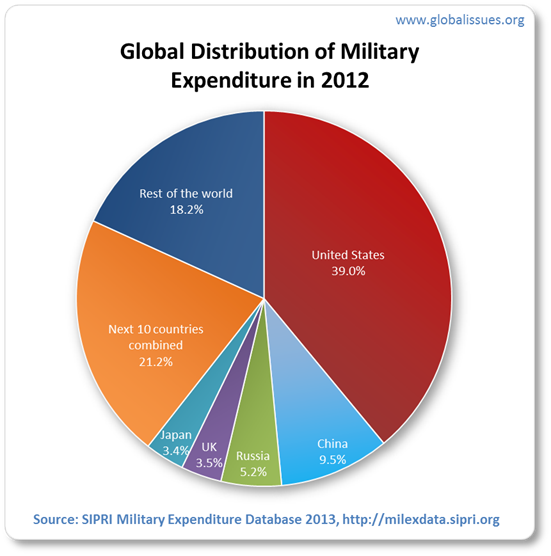
The three elements of power–#1 Military:

The above chart shows that the US remains a much bigger military power than China, or any combination of powers that can be imagined. The US has a formidable set of military and economic alliances which have been developed across decades, has friendly neighbors on two sides and oceans on the other two. China has little in the way of alliances and has 14 distrusting neighbors on its borders.

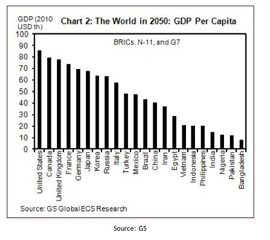
#2 Economic power: There is legitimate dispute over what is the best measure of economic power. The 87 percent comparison is based on GDP at purchasing power parity.  Many economists believe a much more relevant measure is GDP at international exchange rates, by which measure China’s economy is only 1/2 the size of the US economy.  I favor a third measure–GDP per capita, PPP. On this measure, the US is at about $52,000 per person and China is less than $10,000 per person.

Here is what Goldman Sachs and ECS Research forecast for this relative ranking in 2050, more than 30 years away-China is forecasted to be still back there–in about 13th place in the world:

GDP per capita is more important than raw country GDP or country GDP PPP adjusted. That’s because China has 1.3 billion citizens, while the US has 319 million. China may surpass the US this year in aggregate GDP, but China has a multitude of internal needs for spending before that economic power can be directed to all the political and military costs that would enable it to be a contender with the US for ranking leadership of the world.  These include raising the standard of living for all in China, bringing more than 300 million more out of poverty, the polluted environment, building cities, and a host of other problems and needs for money to be spent.

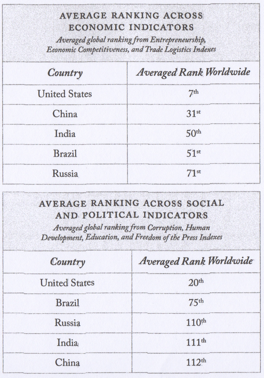
#3 Soft power: Does China rank higher in the world in regard to its lifestyle and behavior, at home and abroad? Neither country is free of deserved criticism. And, while the jury may still be out as to whether democracy or even capitalism are among the attributes of the last stage of global development, China is certainly capitalist today, and most scholars think that China must evolve to some gradual form of democracy to be able to sustain growth ahead. We’re not #1 in the rankings, but China is way below us:

Source: Brzezinski, Zbigniew. 2012. Strategic Vision: America and the Crisis of Global Power. New York: Basic Books, p 52.


Also, remember that trends are not usually long lasting. How many people know that China’s economy was the largest in the world in 1890? That did not sustain. Similarly, our weakness in military campaigns and particularly in (mis) managing our economy may have reached its low point around 2008/9 when we were still fighting two unfortunate wars, our economy seemed on the precipice of collapsing, and China’s success with a benevolent dictatorship seemed to offer some notable benefits over a gridlocked American congress. However, since then, our economy has rebounded nicely and there have been plenty of soft power issues on the negative side of the ledger in China–e.g., human rights, intellectual property, environment, legal system, as well as concerns about an investment driven economy.

China’s growth to even the level Goldman Sachs predicts by 2050 is by no means assured. I would argue that the risks faced by China across that period are greater even than those faced by the US–in terms of sustainable development.

So, while we should not rule out the possibility that China will rule or lead the world someday (as the US has done for decades), that opportunity appears to be at least 30 years away, if it occurs at all. There is time for India or Japan or others to take stronger roles across such a long time, or (my hope) that international governance will further develop to manage the problems of the world in collaboration. That’s where we should put the priority of our efforts during whatever time we have remaining in leadership.

Mearsheimer has argued that the US should take actions now to slow the growth of China’s strengths–economically, for example. We should create obstacles to Chinese success. I disagree. We should work cooperatively with China to best enable the successful economic growth of both countries, and for the most part, this is what we have been doing, notwithstanding Mitt Romney and Donald Trump.

I’ll go with Avery Goldstein who argues that China needs and wants the time to solve its problems and develop, under the protection of US unipolarity, and with Lee Kuan Yew who says Chinese leaders themselves estimate that they need 30-50 years to prepare themselves for a leadership role in the world. Right now, they just want a deserved seat at the table.

Let Corporate Leadership Handle It….if They Will

April 30, 2014

Some might interpret my recent posts as suggesting a preference for government solutions.

I’m equally happy with private solutions. Corporate pay, especially for CEO’s, is a good example. The Board of Directors and the shareholders are certainly the ideal bodies for determining appropriate CEO pay. However, the excesses under current practices have become so egregious that Directors should rightfully fear the government will step in, if they don’t do their jobs. There have been referenda in certain countries to limit the pay of CEO’s. The US has a higher ratio of CEO pay to median employee pay than almost any other country, and government controls could happen here.

A good example of egregious excess is the pay for Marissa Mayer, CEO of Yahoo.  See Steven Davidoff’s analysis of her pay: http://dealbook.nytimes.com/2014/04/29/yahoo-chiefs-pay-tied-to-another-companys-performance/?_php=true&_type=blogs&_r=0

Davidoff reports her base is $1 million. That’s OK. Her bonus is a minimum of $2 million, subject to meeting goals. That’s OK, too.  So, how is it that her compensation at the end of 2013 is estimated at $214 million? That’s not OK. That kind of compensation is way over the top, excessive, unnecessary to motivate or compensate any executive, and it is dilutive to the shareholder equity in the company. It adds to the ire of those concerned with inequality, the advantage of the 1%, and the lost decades to the working class.

Davidoff lays out a mixed record for her two years at Yahoo–revenue was down in 2013 and profits were down in the first quarter of 2014. She has made some promising changes, but it is too early to see how her term at Yahoo will add up.

What’s driving the big bucks is stock options. When Compensation Committees of Boards were faced with challenges over corporate pay, they gradually figured that putting the bulk of potential pay on stock performance was an easy way out of criticism: A CEO would only get the $1 million base and the $2 million bonus if the stock value didn’t go up, and if it did, the CEO would only get a piece of the increase in market value? Either way, the market determined the final amount, not the Board. Sound fair on the surface? Results can’t be blamed on the Board, they figured.

But what if the CEO had little to do with the appreciation in the stock value, as may well be the case with Mayer. She may turn out to be a fabulous CEO, but it’s too early to know that, based on mixed results across the two years. Yet, the stock of Yahoo has appreciated dramatically, primarily as a result of the stunning promise of Alibaba, a privately owned internet giant in China in which Yahoo holds a minority interest, and which may go public soon. Mayer did not negotiate that deal and has little, if anything, to do with the performance of Alibaba.

OK, this case is unusual, due to the unique driver of the stock price. But, there could easily have been a way around that, if the Board had done its job. Any there are many other examples of such stock option driven excesses, without an Alibaba in the mix.

I vote (again) for asking the private sector to do its job–for example, the Board should go back to making discretionary decisions on CEO performance and compensation–take the responsibility back that your role requires. Give Mayer $10 million if you think it right, but not $214 million! Don’t sidestep your responsibility, and don’t complain if you do, when the government or the public step in and compel limits.

Capitalism can work well for our society, but some elements of greed do need to be constrained by the private sector, or the public sector can and will rightfully do that for them.

We Could Use a Bit More Government Help, Please!

April 17, 2014

We Could Use a Bit More Government Help, Please!

I’m not a proponent of Marxism, socialism, or very big government. I acknowledge that our governments (local, state, and federal) are in great need of overhaul. There is waste and inefficiency, and there are many “pork barrel” projects resulting from “earmarks” which have been forced into our excessive budgets due to the inefficiencies of our current political system. We see evidence of waste all around us on a daily basis.

However, that reality does not get solved by simply squeezing down taxes of all sorts further and further, and starving government which has significant entitlements to limit opportunities to cut expenses, resulting in cuts starving critical social needs.

After coming to grips with the growing inequality of our nation across the last 30 years of neoliberal economic domination, I have started to give larger tips to coffee baristas, to parking attendants and others who serve me, realizing more than before, that these helpful members of our community are living with barely enough or not enough, and their wages are not increasing. We should all pitch in whenever we can in that way to ease the burden of these hard working people.

Similarly, I recently learned that there is a box on the tax return which invites us to volunteer extra tax payments which will go directly to pay down the federal debt. I learned that the amounts which have been voluntarily given in recent years have ranged for about $3 million to about $12 million at the peak in 2012, when there was peak noise about the federal debt.

Good for those citizens who ticked the box and wrote a bigger check. I did not, and it would appear that perhaps Warren Buffet did not either, as had he done so, his likely contribution would have been a great deal more than the peak annual total of $12 million.

Our total federal government debt is around $17 trillion, so these voluntary contributions are not going to reduce it by even a fraction of 1 percent. Neither will voluntary additional tipping to low wage workers significantly alleviate their financial distress.

There is an understandable reluctance on the part of citizens to try to pitch in to fix things, if others are not joining them in doing so. These are good examples of the value of collectivism, and policies voted in by elected legislatures. Once that is done, most of us feel it’s fair. For example, I would be willing to surrender some of my social security benefits, my home mortgage deduction, some of my medicare benefits, if we could only agree that we are all going to join in, in some rational way, so that we can then help to solve some of the problems of our nation. For example, I’d be delighted to do this if we could use half the savings to reduce government debt and the other half to improve the lot of the underprivileged–as with improved access to good schools, training programs, and also infrastructure–which helps everyone.

Without government, with only the market system to deal with these issues, and with no willingness to additionally tax, even for those making more than $1 million per year, the outlook is dismal.

I submit that we need a lot less government in many areas and a bit more in others. Net net, I am convinced we could significantly reduce the cost of governments, but we need to rebalance what they are doing.

The political feasibility of such as this is another thing altogether. Clearly, entitlements such as social security and medicare benefit the older of us, and the older have the time and the money to vote, to make noise, and to be active politically. We need government leadership to show our older population a way to just tighten our belts a little, spread over time, such as to enable our children and grandchildren to have a sustainable future.

CEO Compensation

April 16, 2014

Here are two recent surveys of 2013 CEO compensation. Take your choice. The major difference between the two is that GMI counts as compensation that which is realized by the executive from sale of stock options in the current year, regardless of when those options were granted. Equilar only counts the value of options granted this year–i.e., the difference between the market price of the stock and the grant price at time of option issue.

GMI:  http://www3.gmiratings.com/home/2013/10/gmi-ratings-2013-ceo-pay-survey-reveals-ceo-pay-is-still-on-the-rise/

Equilar:  http://www.equilar.com/nytimes/the-new-york-times-100-highest-paid-ceos

GMI is an independent research providing firm, which does not do consulting for the firms they evaluate. In the 2012 Independent Research in Responsible Investment (IRRI) Survey conducted by Thomson Reuters Extel and SRI-CONNECT.com, GMI Ratings was named “The Best Independent Corporate Governance Research Provider.”

Equilar is a privately held company focusing on providing information on executive compensation, frequently cited in Bloomberg, BusinessWeek, The New York Times, Financial Times, the Wall Street Journal, and other business publications.  

I stipulate that both of these analyses are probably correct. The difference is easy to understand, clearly explained in their respective assumptions or methodologies. To illustrate the difference in their respective tallies, take the case of Tim Cook of Apple. Equilar shows Cook’s total comp at $4.3 million. This was his salary and bonus, and included only $175,000 of currently issued stock options. Presumably, his 2013 option grants were extended at a price very close to current market–so there is little “equity” at the time issued. Of course, it is hoped that there will be substantial equity in those options as the Apple stock price advances in the future.

GMI Ratings shows Cook’s total 2013 compensation as $143.8 million. All of the difference between these two reports is the amount of gain Cook realized in 2013, for options granted in the past.

Personally, I vote for the GMI approach. It seems a more appropriate measure of total comp. Between the end of 2012 and the end of 2013, Cook’s wealth (before taxes) increased, due to Apple, not by $4.3 million, but by $143.8 million. If we never count as compensation, year to year as we follow executive comp, that portion of his/her total wealth that is accumulated from the sale of options granted in past years, then we are not really properly evaluating total executive comp. Those gains are part of total comp. In fact, for the majority of CEO’s, that is the largest portion of total comp across their term as CEO.

The reality that executive comp is now structured in most publicly traded companies, such as to put the majority of it in potential stock option gains, is a very troublesome development. It means that the primary motivation of the CEO and his top staff is to do whatever they can to raise the stock price.  The timing of those stock price increases is also important for the CEO who wishes to cash out some of his options–thus motivating results at certain dates, vs. for the long term. Other critical actions important to the long term sustainability of the enterprise often have little impact on stock price, or even a negative impact–such as spending more time and money to achieve diversity in the workforce, raising the pay of the workforce, etc. 

Take a look at the views of Graef Crystal, one of the long time experts on CEO compensation: “It’s a rigged game. When the company’s stock goes up, says Crystal, the chief executive views himself as a hero. And when it goes down, ‘it’s Janet Yellen’s or Barack Obama’s fault'” (http://www.nytimes.com/2014/04/15/opinion/ceo-pay-goes-up-up-and-away.html?hp&rref=opinion&_r=0).

For these reasons, I would personally much prefer the previous system. I would prefer the Directors have the authority to make discretionary bonus decisions. These options packages are often of outrageous value and they do dilute the per share value of the company to common shareholders.

But for the most important point about CEO compensation, I don’t care which of the two approaches you use–you can ask yourself–is it right that Larry Ellison of Oracle was paid $78.4 million, using the Equilar approach? Or, is it right that Mark Zuckerberg was paid $2.3 billion, using the GMI Ratings approach. It seems doubtful to me that either is right.

In my judgment, both awards are likely well beyond what is necessary to compensate a highly effective CEO for either of those companies. Perhaps both Ellison and Zuckerberg are good leaders. But can anyone really believe that it is necessary to pay these amounts in order to attract and retain excellent leadership? Is there no excellent leader in the whole business world, who would take either of those jobs for $10 million, or maybe even just $5 million in annual compensation?

What other consideration can be appropriate to justify such payments?