Observations on Trade Unions

Observations on Trade Unions

February 19, 2014

George Will, Pulitzer Prize winning conservative journalist, lambasts trade unions, particularly the UAW, which just lost an important vote in Tennessee, in today’s Washington Post (http://www.washingtonpost.com/opinions/george-f-will-breaking-the-grip-of-the-unions/2014/02/18/39beb794-98d4-11e3-b88d-f36c07223d88_story.html).

Steven Pearlstein, also a respected journalist for the Washington Post, presents a contrary argument in his February 14 column (http://www.washingtonpost.com/business/will-a-new-new-south-emerge-from-the-showdown-in-chattanooga/2014/02/14/9a1d4bd6-9362-11e3-83b9-1f024193bb84_story.html).

It’s certainly true that unionism in America has displayed a number of troublesome elements in the past, resulting in most business managers fearing the arrival of the union on their turf.  It’s understandable that there have been many aggressive tactics developed to counter the unions. Actually, on both sides of union votes, there have been inappropriate, illegal, and deadly behaviors used to try to secure the outcome opposing sides desire.

Among the past problems among some unions have been mafia connections, corruption, misspending of union dues, catering to the needs of only certain established segments of labor represented, and, most importantly, failure of the unions to focus on how to make the company more productive and more successful–i.e., focusing only on trying to get more wage and other benefits, sometimes resulting in the bankruptcy of the enterprise, if the enterprise’s costs are highly labor dependent.

So I don’t fault George Will for his concerns, due to the troublesome history we have experienced.
However, he misses several important points in his diatribe against unionism: First, he fails to recommend any approaches to unionism which might make it more palatable, even helpful to American capitalism. Thus, he essentially can be read to view any form of labor representation on a collective basis as inappropriate. He doesn’t say that, but his failure to call for any specific types of union reforms does suggest that.  In that, he chooses not to acknowledge the nature of this particular union vote, as explained by Pearlstein:  It is supported by Volkswagen management, who have been very successful in working with unions in Germany; the UAW has agreed to deep wage cuts which make its Volkswagen wages comparable to non-union foreign auto plants in the US; and the UAW has agreed to turn over future benefits decisions to a council including management.

Will and others on the conservative side fail to see that in certain other parts of the world, such as Germany and other countries in Europe, unions have joined with management to come up with ways to improve productivity–and have sometimes agreed to tie their wages to achievement of increases in productivity. After all, if engaged with management, doesn’t the input of labor add significantly to how to make the production line move faster? Who knows better than the workers?

The other point, perhaps the most important point overlooked by Will and others, is that a major element in the frightening development of high levels of inequality in the US across the last 30 years, is the loss of voice by labor.  If inequality is allowed to continue to increase, or even to sustain at today’s high levels, there are serious risks ahead for the US in sustainable economic development–a problem not only for the poor and the middle class, but also a big problem for the wealthy.

Take a look at Timothy Noah’s The Great Divergence, chapter 8 entitled “The Fall of Detroit.” Noah carefully explains how the Wagner Act and the subsequent Taft-Hartley Act, and especially the Presidency of Ronald Reagan and subsequent Republicans, have been major contributors to stagnating wages for the middle and lower classes across the last 30 years, and the attendant rapid increase in share of income and wealth of the highest earning classes.

Unionism has a ways to go to regain the confidence of Americans, but America needs to create a level playing field for collective bargaining by employees. Who can realistically argue that the power of a giant manufacturing company is equaled by the demands of a single employee acting alone?  That’s a ridiculous match–akin to a sumo wrestler facing off against a 6 year old–the employee will get crushed if she/he doesn’t have the power of collective bargaining–and this is especially true during times such as the last six years, when it was a buyers market for labor. Some argue it’s been a buyers market for the better part of 30-40 years, when offshoring and technological advances have so accelerated.

And, unionism needs to display more effectively just how it can work with management to improve productivity and results, so as to keep us competitive in an increasingly globalizing world.

The Measures of Inequality

The Measure of Inequality

February 16, 2014

To take a position on inequality, most people need a solid understanding of how unequal we are. The only ones who don’t are those who have already decided inequality is not an issue–let the invisible hand rule, let capitalism flourish without restraint, and it will all be ok, they argue. Some feel the theories of Simon Kuznets will recurrently prevail–in each long term cycle there will be an increase in inequality followed by a later decrease in inequality. Others just think property rights are to be honored at all costs, and that includes not imposing higher taxes on the wealthy, or any other form of redistribution (such as the Affordable Care Act)–these feel that the wealthy invest those extra gains, and thus create jobs for the others. This is the basis of the “trickle down” theory. With this theory, the argument goes that we’d be far worse off if we tried even a moderate degree of redistribution.

Well, it turns out there hasn’t been much trickle down in recent decades. Let’s start here:

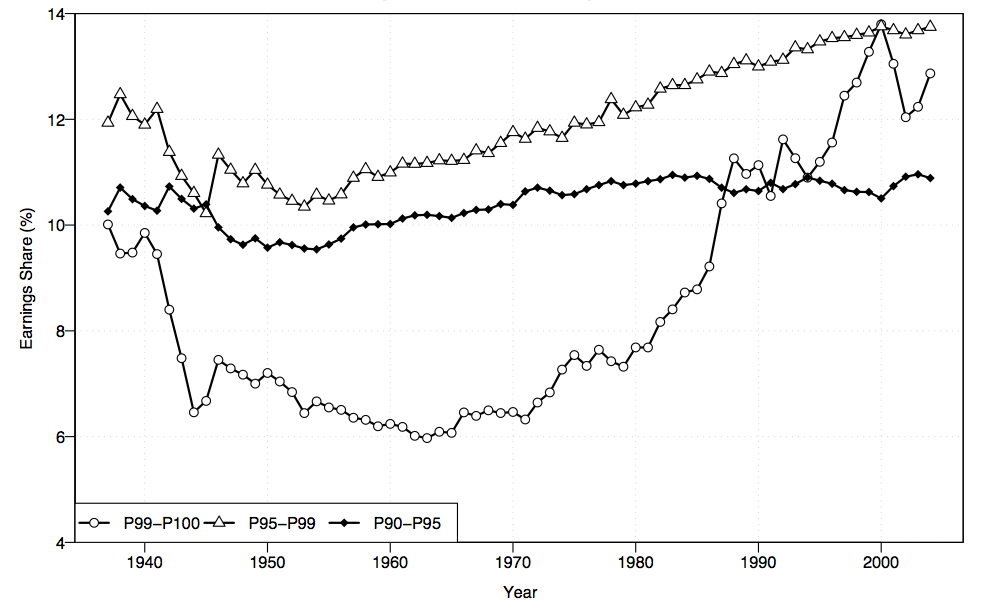
The two charts below tell the story. Chart 1: As measured by the Gini coefficient, inequality was high in the US before WWII, declined significantly across the period 1940-1960, and then began a steady climb to today’s very high level.

Chart 2 shows that those in the top 90-95%, those in the 95-99%, and especially those in the 99-100%, saw steady increase in their share of earnings. For example, those in the top 1% increased their share from about 6% in 1960, to about 13% in 2000.

Source of charts: UNCOVERING THE AMERICAN DREAM:INEQUALITY AND MOBILITY IN SOCIAL SECURITY EARNINGS DATA SINCE 1937

Wojciech Kopczuk, Emmanuel Saez, Jae Song,Working Paper 13345 http://www.nber.org/papers/w13345, NATIONAL BUREAU OF ECONOMIC RESEARCH 1050 Massachusetts Avenue, Cambridge, MA 02138, August 2007 

These are the facts.This is what has happened in America. Scholars like those referenced above have looked at inequality in many dimensions, finding similar results in most developed countries and many developing countries in the world: Since around 1960-70, inequality has accelerated.

As mentioned above and in previous posts, there are those who find no reason for concern with this trend–either feeling it will reverse itself without intervention, or that this is simply how capitalism works, and that it would not work without unrestrained inequality–and definitely no need for any form of redistribution. To those on the right, the word “redistribution” is a gross pejorative. So offensive is this word that it never appears in the political dialogue–not even from those on the left. It’s just too contrary to the Horatio Alger stories of American opportunity of pulling yourself up by your bootstraps.  

There are numerous explanations for what has caused this acceleration in inequality. One of the many attempts to explain it comes form Timothy Noah in his The Great Divergence. In his book, he thoroughly analyzes the many contenders for cause of the rise in inequality. He ultimately settles on four major causes: a shortage of better educated labor, resulting in the increasing value of a college degree, along with no effective pressure on the rising costs of higher education; increased globalization in the form of trade with lower wage nations; changes in government policy and finance (with special focus on Reagan and the Washington Consensus); and the decline of the labor movement. 

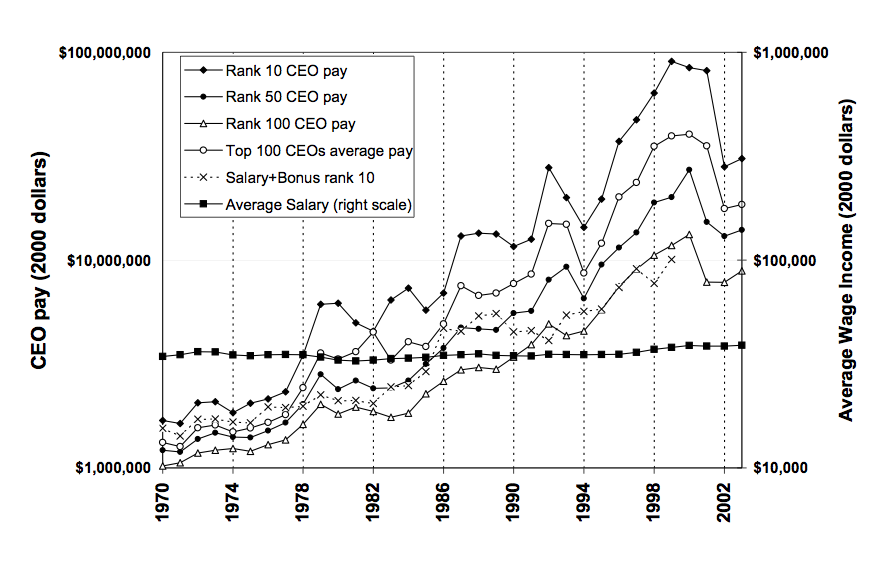
One facet of the rapid increase in inequality in the US has been the dramatic rise in CEO pay. See this chart:


Source:  INCOME INEQUALITY IN THE UNITED STATES, 1913-2002*

THOMAS PIKETTY, EHESS, Paris EMMANUEL SAEZ, UC Berkeley and NBER 2004, Fig. 11.


Regrettably, the modest downturn in the 2001-2002 period in the above chart did not signal a reduction in inequality. It simply reflected the smaller recession experienced in the US at that time due to the “tech bubble.” Since that time, CEO pay has continued to rise. Average wage income for the middle class did not rise. For example, Forbes reports that in 2012, the CEO of McKesson earned $131 million, Ralph Lauren $67 million, Vornado Realty $64 million. Forbes reports (June 27, 2013): “From 1978 to 2012, CEO compensation measured with options realized increased about 875 percent, a rise more than double stock market growth and substantially greater than the painfully slow 5.4 percent growth in a typical worker’s compensation over the same period.”


Inequality varies from city to city in the US. One of the least equal cities is San Francisco, where the earnings of those in the 95th-100th percentile are more than 16X those of the people in the 20th percentile.  During the 2007 to 2012 period, the earnings of those in the 20th percentile declined $4,000 while those in the 95% percentile increased $28,000 (Source: Brookings Institution).a

And, while the above is mostly about US inequality, a similar story is true throughout much of the world since around 1980, thus causing many to question whether this period of economic policy imposed by the IMF and the World Bank, reliant on the neoliberal Washington Consensus, is a significant causal factor in this development.  I believe it is. Most of the wealthy OECD displays similar results, although the US is near the most unequal. And, some developing countries have even higher levels of inequality than the US–e.g., Brazil and S. Africa. A particularly troublesome example is China, one of the most egalitarian countries in 1950. Inequality there has risen rapidly since 1980 and 1990, reaching about the same level as that of the US today.  Today, China has the 2nd largest number of billionaires in the world, and concerns with inequality are now ranked among the most troublesome to Chinese, where a growing number of protests allegedly reaching more than 600,000 annually, focus on inequality, pollution, corruption, and inflation, among other lesser concerns.

This is a short sketch of the reality of today’s level of high inequality. It is something everyone should be concerned about–for both moral reasons and the economic peril it may portend for the future.


Opinions of the Wealthy

February 15, 2014

Understandably, many of the wealthy feel no concern to address growing inequality. Many feel that whatever they earn or have amassed is solely due to their great competence.

Tom Perkins may be one of those. He is an ultra-wealthy private equity investor. He may well have amassed his entire fortune, estimated at $8 billion, in a moral and legitimate way. He is undoubtedly of greater competence than many of us. He has also been philanthropic with his wealth, and the corporations to which he has contributed governance, advice, and capital have been among those which have improved our lives.

So, in all those respects, he is one to be appreciated and admired.

On February 13, at the Commonwealth Club in San Francisco, he had some things to say about inequality, which captured the attention of the media. He reportedly suggested that our American system should be modified such that there is one vote for every dollar of tax paid. He apparently went on to argue against any methods of trying to create more equality (http://money.cnn.com/2014/02/14/investing/tom-perkins-vote/index.html?iid=Lead&hpt=hp_t3).

It’s not surprising. If I had $8 billion, perhaps I would be thinking this way. Perhaps I’d be thinking I am solely responsible for this accumulation, not my heritage, not my parents, not my skin color or religion, not the financial or social connections of my family, not my educational opportunity, not my career and other opportunities, not my timing, not my birth country, not circumstance, not luck, not the mentors who coached me, not even my genetic disposition to good health, not even the support given me by my wife, friends and family. Just me. I did it.

And, to those who want to redistribute my wealth, I might say they simply didn’t take advantage of the talents, hard work, and opportunity which abounds for people of all birth situations in this great country. I can’t be held responsible for that. Indeed, if we were to think that way, we’d be dis-incenting the essence of American capitalism, which is the essence of America.

Of course, I don’t want to accuse Tom Perkins of this thinking. I am not privileged to know him, and I imagine him to be a very decent human being.

But, he must know when talking this way that he will ignite a reaction among those of who who feel that all the elements mentioned above contribute to or provide obstacles to the achievement of many of us who do not achieve great wealth.

But even if this set of contributing factors is dismissed by the wealthy, even if there is no moral feeling of obligation to the lesser privileged, there remain these factors mentioned in the previous post here:

1. There is no argument here to change America to an entirely equal or socialist country. There is no argument with the value of incentives–you should indeed get to keep most of what you earn honestly. There is not even an argument with inequality–up to a point. The argument is with allowing inequality to rise to the present very high level and do nothing to arrest its possible continued rise.

2.  There are many ways to gradually re-distribute, most of them not involving taking anything from what one has earned and accumulated to this point. To mention only one–supporting a system of equal education for all–not just for those who can afford private and Ivy League schools from kindergarden through graduate programs.

3. It is likely that economic growth, GDP, will not grow as fast under conditions of high inequality (as is the case today), as it will under conditions of moderate inequality.  Just consider the additional worker talent available to capitalists like Tom Perkins if we substantially enhance the skills of our educationally motivated youth–and the additional productivity and profit contribution of those skills.

4. Finally, there is the ultimate result to consider–gated communities, guards, vigilantes protecting the wealthy, and potentially, eventually, revolution.

Why not share a little of the wealth?

Part One: Inequality–My Starting Biases

Feb 8, 2014

Inequality

This will begin a new series of articles about inequality. I’d like to start by confessing my biases:

I’m a Democrat, although I have occasionally voted for Republicans. I come from a long line of North Carolina farm folks, relatively poor, and clearly of a Democratic persuasion.

I do not pretend to be an expert on these matters, but I recently (2013) completed a Masters degree at the University of London, in which a great deal of focus was on the world economy since about 1950, looking at such issues as economic growth, poverty, inequality, and policies and endowments which led to the success or failure of nations. I’ve been assiduously studying these issues since.

I believe the problems of poverty and inequality (and others) are complex. In most cases, there are no effective universal solutions. Best recommendations usually consider local history, culture, endowments, institutions, and politics. What works for China will be different from what works for the US. Both countries’ leaders have made bold promises to reduce inequality.

Also, there are many forms of inequality–income, wealth, racial, gender, and many other ways in which some people feel and find themselves inferior to others.  For example, people who speak only Cantonese find themselves feeling unequal in the US, whereas those speaking only English may find themselves feeling unequal in Hong Kong.  All of these are worthy of attention. Top of my list will be income and wealth inequality, but that’s not intended to diminish the importance of the many other ways inequality is experienced.

I acknowledge that it is not yet clearly determined that the rise in income and wealth inequality in many countries since about 1970, will continue rising (if unchecked), or will level out or reverse without policy change. There are some who argue that it will reverse direction and should be left alone. Inequality improved (moved toward greater equality) in the US between 1925 and 1970. Some think this could happen again.

Nevertheless, I believe that in virtually all cases (and in the case of the improvement between 1925 and 1970), the improvement was not “automatic,” a factor of nothing other than the natural evolution of economics. It was also and largely the product of policy changes. For example, Lyndon Johnson’s “Great Society” program was a major factor during that period of improvement.

I also believe we should be concerned. Very concerned. There are many negative impacts to the high levels of inequality currently experienced in the US, China, most OECD countries, and many other countries in the world. I will discuss these in future articles here.

I applaud the growing array of philanthropic efforts by those in the upper echelons of income and wealth, devoted to a very wide variety of social improvements, many seeking to improve one or another of the many facets of inequality. For example, reducing poverty, improving access to health care, and improving access to quality education for children of lower incomes, all result in improved equality. I do respect that many of these are very well intended and some are effective in improving the lot of many. However, I feel that in the aggregate, they lack the impact of a cohesive set of policies and focus which can only be provided by IGO’s, NGO’s, and by national governments.  With few exceptions, most are a drop in the bucket.  Nevertheless, considering the difficulty of motivating effective government action and adjusting the basics of capitalism, we should aggressively pursue best philanthropic efforts, of course!

But, I hold the view that it is simply not enough for us to allow the continuance of the income and wealth aggregation at the top, and hope that the philanthropy of the ultra wealthy will result in sufficient re-allocation, poverty reduction, and improvement in inequality, etc.  That is good work on the part of the wealthy, to be applauded, but it simply is not remotely sufficient.

For one, I am willing to pay more in taxes. More later on the whole issue of the inefficiency of government, democratic government in particular, in addressing these problems.  There are two major issues here which trouble many–getting agreement on effective policies, and then getting cost efficient administration of those policies. Regrettably, many Americans have lost confidence in both these elements of government.

Nevertheless, I feel government has to be a big part of the solution, both in the host country and also in terms of foreign aid to lesser developed countries. I recognize that the US governmental process is gridlocked at this time, but that doesn’t mean we can allow it to stay that way. Changing government anywhere is tiring and slow, but it is the major element in significant change, I believe.

I also believe that private enterprise is part of the solution. It would be great to somehow motivate and accelerate corporate leadership to take the longer view, to re-set guiding principles around objectives other than only the bottom line–such as providing a living wage, minimizing lay-offs, more emphasis on environment, ethics, morality and corruption, and taking a longer than quarterly view. But these kinds of adjustments expose leaders who would like to make these major adjustments to price competition from those who do not choose to participate. Thus, I place somewhat less emphasis on the practicality of the private industry solution.  I don’t fault our corporate leaders for their focus on the short term bottom line–it’s indigenous to the pure capitalistic system which we are committed to–and I don’t have a better system to recommend.

I do not believe that the current version of the neo-liberal Washington Consensus (open borders, reduced regulation, smaller government, flexible labor policies, etc.), is the solution to worsening inequality and poverty reduction in the world. Simply increasing free foreign trade is not going to solve the problem. It didn’t accomplish that in Sub-Saharan Africa in the 80’s and 90’s. Economic growth is necessary for the alleviation of poverty, but foreign trade is not the only way for economies to continue growing. One evidence of this is the fact that virtually all developed economies protected their infant industries for decades in periods of early development, grew rapidly while doing so, and even now there are substantial protective measures in place in most developed economies. How can the US argue for open borders and free trade, when we subsidize the cotton growers in the US?

I believe that even if there is a possibility of some element of natural correction ahead, we cannot afford to wait for the possibility of that happening.  As Keynes said once, we may all be dead by that time.

I believe we cannot just look at our city, our State, and our country. There are almost 200 countries out there, and another 5.7 billion people or so. I believe we have a moral obligation to concern ourselves with inequality in South Africa and Brazil, as well as in the US.

I believe high levels of inequality, such as we have come to experience in the US and many countries, does restrain economic growth. Thus, inequality actually inures to the disadvantage of the wealthy, who benefit most from economic growth, as well as to the middle class and the poor. This should be a rationale for the conservative right to address the issue. They should remember that the middle and lower classes spend more of their income, thus powering economic growth. Unfortunately, many of the wealthy do not invest their greater savings in job promoting growth, but set it aside in liquid assets or possessions such as art. This is one of the problem with persistent conservative arguments for more tax reduction.

Fundamental to this whole issue is the concept of incentives. Everyone agrees that incentives are important, critical to motivate all of us to try harder to better ourselves. There are many on the right who feel what they have gained is due only to their superior talent and/or hard work, and thus it is only right that they should enjoy it. There should be no obligation to share. Let the “invisible hand” of the market determine each person’s outcome. This view, in my opinion, fails to consider luck, inheritance, and the privilege of social standing and opportunity afforded by parents who pay for private schools and ivy league universities, leaving the remainder of public education with only the “exit voice” (Albert Hirschman, 1970) of the poor, unable to motivate political focus.

I do not dispute the value of incentives. I have enjoyed some of the benefits. I dispute that what I have gained (modest as it is) is entirely the fruits of my own talents and labor. It is also the product of the times we baby boomers grew up in, the totality of national and global policies and developments across that period.  It is the product of my providentially being born a WASP during they heyday of WASPism. It is certainly (and most) a product of my being born in the USA. Branko Milanovic, noted World Bank scholar, has determined statistically that 80% of one’s economic destiny is determined by the country in which one was born and the income class of one’s parents (Milanovic, The Haves and the Haves Not). Furthermore, I believe that if we share, there will be greater good for all, and if we do not, there is a risk of revolution and disaster, eventually.

Finally, I acknowledge that in terms of the language, the term “inequality” has been rejected in most circles, with “opportunity” substituted. I am equally concerned with equality of opportunity, but I do not choose to shy away from inequality. The objection is that when “inequality” is used, it fails to motivate those of wealth. It may imply that their acquisition of wealth may have been illicit or unfairly obtained, or if honestly gained, that they nevertheless have an obligation to share it–none of which is welcomed by the wealthy, who would prefer to consider their philanthropy to be motivated entirely by generosity, preferring to focus on poverty alleviation than on reducing inequality. Focus on equality of opportunity resonates well with both Democrats and Republicans. Even the Conservative Right promotes the Horatio Alger motif.

That’s about it in terms of biases to which I readily admit. I acknowledge that many of the beliefs I have admitted above remain in dispute among respected economists. I will make my own attempt to defend some of them in later posts.

However, I honestly hold that I am open to solid argument and proof, to change any of the above beliefs.  Please post your arguments to the contrary.

The Other "Nuclear Option"

November 24, 2013

This week, the Senate passed a bill so labelled by some. It simply reduced the number of Senators required to prevent filibusters, or to require an “up-down” vote without delay, from 60 to 51. At the present time, this assures the Democratic majority in the 100 member Senate, that if the Democratic party holds together on such matters as appointments to judgeships, there will be a positive vote–i.e. Democrats will be able to fill critically important judgeships with judges of their liking–presumably of a more liberal persuasion.

This is a proper bill to pass. It is a proper step toward reducing partisan gridlock in our Congress.

There can be little doubt about its value–both parties have argued for such a measure when in majority and both have argued against it when in minority position. It simply cannot be imagined that the Republicans would not have done the same, had they the Senate majority at this time–and similarly, it cannot be imagined they have such “principle” around this rule of order that they will reverse it when they next have the majority.

The main argument is that this allows the majority (in the Senate) to decide, that this will result in a swing, like a pendulum, for whichever party has the majority. That is true, but isn’t that the way many other democracies in the world work–essentially a government is “formed” after election, such that there is a majority of votes to enact most important legislation around which this elected and “formed” majority can reach agreement. This enables action to be taken, movement, hopefully progress, and if not, the next government can change it.

For example, many of us did not agree with the austerity measures enacted by the the combined majority of David Cameron’s Conservatives and Nick Klegg’s Liberal Democrats. This may have been a pendulum swing to the right, and it may be swung back by the next majority party or combined formed majority. However, it is not gridlock, as we have seen in the US, where it seems nothing can be done. Our Federal Reserve has been the main engine of the economic recovery here, with fiscal policy (after a few crisis measures–bailouts and one stimulus program) being sidelined over inability to agree on tax reductions and spending reductions.  The debate between the Keynesians and the Friedmans, et. al., has resulted in no action.

So, this bill is both fair and is good.

What’s most interesting about the aftermath of it is that the politicians on the right have reacted vehemently, as if some capital crime has been created, as if they forget they wanted this when last in power, but couldn’t get it done. The have threatened retaliation.

This is both insulting to the intelligence of the American people, and disgusting. Insulting because we are smart enough to know both parties want this if they have the power to get it. It’s not some kind of sacrosanct rule. Filibustering? How can that be defended? Ted Cruz would want this bill if he had a majority in the Senate–God forbid!

Disgusting because the threats issued by some of the most senior Republicans exposes the worst element of our political system–if I can’t have it my way, I’ll do everything I can to prevent any progress. This attitude has been consistently apparent in the attack on “Obamacare.” Why not join with Democrats in constructive ways to alter and fix the health care system? The answer appears to be that you’d rather see it fail than be fixed–you’d rather avoid being somehow “tarnished” by joining in to support something. And/or you’re just too beholden to the ultraconservative factions that have arisen in the Republican party.

John McCain, who deserves great appreciation for his service to our country, lowers himself when he threatens “a heavy, heavy price” to be levied as punishment to the Democrats for exercising this privilege of their majority vote. And, he insults us by saying “I don’t think Americans understand it very well.”

We understand this very well. It’s abundantly clear.

Nuclear Deal with Iran

November 24, 2013

Late last night, an interim nuclear deal was signed between the P5+1 (US, Britain, Russia, China and France, plus Germany) and Iran. The build-up to it, and now the announcement, has been met with polar opinions. Some claim Iran has deceived the West, falsely claiming they never intended a nuclear weapon capability (just nuclear power), cleverly buying time without much conceded, and that Iran will determinedly continue to use any means to develop nuclear weapon capability. They argue that while Ahmadinajed was clearly a threat to world order, Iran is simply putting forward Rouhani (a wolf in sheeps clothing) to try an opposite end-run.

Others feel this deal is a major positive development in the pursuit of peace in the Middle East and the world, and has strong potential to result in resolution of the Iranian nuclear threat in six months when the target date is reached for full resolution.

An opinion highly critical of the deal comes from the respected political commentator Charles Krauthammer, writing in the Washington Post on November 21, “Sucker’s Deal.” His argument makes sense, as does most of what Krauthammer says: Sanctions have brought Iran to the table, but what Iran concedes in the interim deal is little (as it relates to ultimate nuclear capability) and it would be far more effective to just double down with more sanctions until they concede every element of nuclear weapon capability–now–do not trust them to keep their word, and definitely do not give them an extra six months with relaxed sanctions.

An opposite view comes from Fareed Zakaria, in his “GPS” program of today. His best argument is that sanctions imposed on Iran across the last decade have done little to stymie the nation’s nuclear development. The number of centrifuges to process nuclear material has grown from 164 in 2003 to 19,000 today, as more and more sanctions have been imposed. Zakaria asks, “what would have happened without a deal?”

As an aside before continuing, wouldn’t it be great if all Americans, all world citizens, could take a little time and examine the issues and take a stand on such major world issues as this? Wouldn’t that make democracy and world governance work better? Our American legislators are supposed to be responsive to our wishes, but too often we don’t take the time to develop and express opinions clearly and thus, legislators are left to operate on their own prejudices and convictions or to hedge. Former Senators Scott Brown and Evan Bayh were interviewed this morning on TV, and honestly, while they are very competent politicians, I felt they both hedged their positions–seemingly to accommodate the supporters of Israel’s concerns, stated well by Krauthammer.

And this is one where the outcome can perhaps be judged in a relatively short period of time–six months, unlike the matter of climate change or world population growth. So, it will be an interesting test–like betting on the winner of the Superbowl, something many Americans take the time to understand and predict–but far more important to the world.

In setting about to take a stand, it’s best to start by recognizing the existence of biases. No one can be free of them entirely, even with the best of intentions toward objectivity.  There are those of understandable sympathy to the state of Israel, a tiny nation surrounded by threats to its existence. There are those who are hawks and have a bias in favor of use of force to resolve such matters.

And, there are those among whom I fall, who feel too much life, opportunity, and prosperity has been lost to war in recent decades and that we need to make every effort to avoid it. I do recognize that the hawks would claim that force of sanctions or threat of military attack is the best way to achieve peace, but I do not hold with that–at least not in most cases.

To illustrate the element of bias and also the difficulty of reaching an opinion on matters such as this, consider how Krauthammer and Zakaria each describe what the deal concedes in the way of sanctions during this interim period. Krauthammer: “It widens permissible trade in oil, gold and auto parts. It releases frozen Iranian assets, increasing Iran’s foreign-exchange reserves by 25 percent while doubling its fully accessible foreign-exchange reserves. Such a massive infusion of cash would be a godsend for its staggering economy, lowering inflation, reducing shortages and halting the country’s growing demoralization. The prospective deal is already changing economic expectations. Foreign oil and other interests are reportedly preparing to reopen negotiations for a resumption of trade in anticipation of the full lifting of sanctions.” Zakaria: “In return, Iran gets about $7 billion of sanctions relief, a fraction of what is in place against it. The main sanctions – against its oil and banking sectors – stay fully in place.”

Similarly, they express polar opposite views on their individual interpretation of what Iran has conceded for the interim in regard to uranium enrichment.

My sympathy is with the Zakaria opinion–sanctions have not worked, threats have not worked, and it’s wise to give an entirely different approach a solid try. This is essentially the major contribution (in my opinion) of the Obama Presidency–that he has assiduously avoided actions which would prolong our existing wars or expose us to engagement in other wars. Relatively little has been conceded in the sanctions for the interim deal–only about $7 billion in frozen assets, while the sanctions on trade privileges, far more damaging to Iran, remain in place until we reach the full deal in six months.

The best tally of gain or exposure in the deal would involve reading the agreement and then researching key elements–e.g., what sanctions remain in place, and what limits on enrichment have been conceded and what rights retained.  I have not done that yet, but will set about to do so.

Because there is significant opposition to the negotiated approach in the American Congress, interim sanctions relief could only be limited–what the President alone is empowered to authorize. Most of it requires the approval of Congress, suggesting that this concession is indeed modest–Iran will need and want far more to achieve their goal of economic freedom and renewed economic growth.

We now have Iranian approval to daily inspection by IAEA personnel. It is highly unlikely that any hidden enrichment facilities can be sustained with all the inspections and all the eyes of the world on Iran.

More on this major world event, as the details and opinions unfold.

Contrary Argument to Robert Samuelson’s "Government is not Beholden to the Rich"

In a Washington Post article of November 19 (http://www.washingtonpost.com/opinions/robert-samuelson-lobbyists-for-the-rich-do-not-own-government/2013/11/19/8e47d8f0-513e-11e3-a7f0-b790929232e1_story.html), Robert Samuelson makes this argument.

To try to prove his point, he simply explains how the federal budget is spent, showing that a majority of our social support spending (a huge part of our budget) goes (one way or another) to provide for the elderly in our nation–individual benefits, health care, veterans benefits, etc.

The information Samuelson uses come from the Congressional Budget Office, and we trust it is accurate.

Nevertheless, this does not prove Samuelson’s point: “Democracy’s problem is not the influence of money. It’s the influence of people. As the CBO report shows, so many Americans have become dependent on government that consensual change is difficult and, perhaps, impossible.”

It is certainly true that Americans resist giving up Medicare and Social Security entitlements, and it is also true that we have to make some adjustments in these to preserve the financial integrity of our federal finances.  It is also true that consensual change is difficult in this country–we are legislatively gridlocked.

However, if the rest of Samuelson’s argument were true–essentially that the people (we assume he is referring to the “99%”)–control what happens in our federal budget, then how could he explain these developments:

Have a look at the Piketty and Saez 2004 study “Income Inequality in the US 1913-2002” (http://elsa.berkeley.edu/~saez/piketty-saezOUP04US.pdf) or look at Real World Economics Review Blog’s (http://rwer.wordpress.com/2011/02/25/25-graphics-showing-upward-redistribution-of-income-and-wealth-in-usa-since-1979/) showing the dramatic increase in the degree of US inequality across the last 3-4 decades.

Piketty and Saez found that the top decile’s share of wage income in the US rose from about 25% in 1957 to about 34% in 2002. Real income of the 99% was about the same in 2002 as it was in 1972, inflation adjusted–i.e., about the same buying power–no improvement. However, the top 1% saw real income double across that period.  If all types of transfers are included, real income of the 99% has grown by 40%, but real income of the 1% has grown by 3.3X.

WordPress reports that the top tax rate for millionaires in 1945 was 66%, and in 2010, that rate was 32%. In 2007, the bottom 50% of the US owns 2.5% of total US wealth. The top 50% owns the remainder, with the top 10% owning 71%, and the top 1% owning 35%.

No matter how the government’s social welfare system is configured (Samuelson’s focus), it is irrefutably true that in almost any social breakdown (by income, by skin color, by educational achievement, etc.), the US has markedly worsened in terms of increased inequality since the 1970s.

So, how can one fail to recognize that the income and wealth and power of the country is increasingly with the wealthy and connected?

If we don’t concern ourselves with ways in which to remedy this trend, we are likely to experience great instability in our country in the future. There are practical answers we should galvanize around.

More on the Problem of Power and Influence between Government and Industry

The Washington Post article of today (Nov 16, 2013) entitled “Capital Gains: spending on contracts and lobbying propels a wave of new wealth in D.C.” is worth reading (http://www.washingtonpost.com/national/capital-gains-spending-on-contracts-and-lobbying-propels-a-wave-of-new-wealth-in-d-c/2013/11/17/6bd938aa-3c25-11e3-a94f-b58017bfee6c_story.html)

As in the previous post in this blog, there is a problem with how the wealthy elite of our country are enabled to enjoy privileges which other qualified businesses without these connections (guanxi, as it is called in China) cannot access. A related problem is how certain “connected” individuals are able to personally benefit, thus enlarging the dangerous inequality gap which has dramatically risen in the US since around 1980.

We have no rules preventing government employees moving into positions in private industry or in lobbying firms, where they then work the connections they developed in their work inside government agencies, securing favorable legislation for their new employers.

The ramifications of this are numerous and mostly negative:

Many qualified vendors to government and many companies with legitimate interests in legislation under consideration do not have access to these privileged channels. Thus, they suffer a disadvantage in competing for equal consideration.

Second, this system feeds on itself. Undoubtedly, there are many federal employees who clearly have in mind a future long and lucrative career–and are simply in those key (and relatively modestly paying) federal jobs only as long as it takes to build up those contacts and knowledge of just how things are done–how new drugs are evaluated, just who is key to those decisions, what his/her personal perspectives, preferences, weaknesses are, what are their phone numbers, cell phone numbers, e mail addresses. Before leaving the agency, they can learn who likes what brand of whisky, wine, who loves which particular restaurant or sports event. They learn whose children go to which private school, and what that school needs in the way of support–etc., etc., etc.

This is how relationships work, how they ARE worked, and how business is done in Washington.

I am not here to contend that everyone in lobbying or everyone who leaves government to serve business which they previous oversaw, is dishonest. That’s clearly not true. There is a lesser issue of honesty and corruption which this system enables, but the main issue is one of unfair advantage, and resulting legislative decisions which are not based on facts and objective judgments, but based on privilege and personal favors.

As Americans, we need to ask ourselves why we want this “system” to continue, with the obvious tendency to prejudice the judgment of government decisions to the favor of the few. Is there any possible positive to it?

We certainly cannot deny that this system adds to the problem of growing inequality in our country.
Those privileged few described in the article are enjoying benefits which are being denied to the large majority of hard working Americans.

Who would be harmed if we had prohibitions on government officials going to work for businesses in industries they supervised in their government roles, or going to work for affiliated lobbyists?  It’s hard to make a good argument in favor of allowing this system to continue.

Federal Officials and Lucrative Jobs

Timothy Geithner has taken a lucrative job in the top ranks of Warburg Pincus, a big name in the private equity arena.

Speaking only of Geithner, it’s not fair to blame him for accepting such an offer. After all, he seems to have been an honest and effective servant of government for us for many years. In those roles, he certainly sacrificed the opportunity to potentially make a great deal more money working for firms such as Goldman Sachs or Warburg Pincus.

So, what’s wrong with the type of development?

It is my opinion that we should have a “cooling off” period of at least 5 years between anyone working in key government positions and their taking positions in entities which they essentially supervised or governed in their previous roles. It would be hard to argue that a large private equity fund was not a matter of concern for the head of the NY Fed or the Treasury Secretary. If he took a job as head of a wind power firm, that would be another matter, as an example.

Why is this important? Because the cozy relationship between our government and and the powerful business entities they presume to govern is dangerous. We need an “arms length” assurance that there will not be any favoritism given any such entities, such as to potentially lead to powerful jobs later offered to those who are beneficial to their interests while in key government positions.

Similarly, those who occupy high positions in private industry should not be considered for positions in government involving oversight to those same industries, until after a cooling off period of perhaps 5 years. That’s because they can’t generally be considered to be impartial in their oversight.

Even more so, this kind of rule should apply to the lobbying industry–too many of our government officials leave and join a lobbying firm focused on the same area they governed. These former officials have strong relationships inside the agency they supervised and have the ability to influence in favor of the industry when they leave. This is inappropriate. In fact, in the case of government officials going to lobbying firms which were among those under the federal jurisdiction of the official, I believe this should simply be prohibited. A cooling off period is not enough in such cases.

It’s not the job of the American public to determine whether either of these situations indeed results in favoritism. That’s pretty hard to determine, anyway. We need rules like this just to assure that there is not the temptation of such between government and business.

These are not new ideas–this is just a reminder to all of us that we need them enacted. Resistance from powerful interest groups is strong. This type of cronyism is a piece of the big picture which has exacerbated inequality in our country across the last 30 years.

Xi’s 3rd Plenum of the 18th Central Committee

November 9, 2013

November 9 begins a major conference of Chinese leaders, with focus on reform. The world of economics followers is focused on this conference, to determine what changes will truly emerge.

The Economist, a rather neoliberal publication, argues largely for more liberalization: less protection and support for State Owned Enterprises (SOE’s), ideally privatize the remainder of them (still representing more than 25% of China’s GDP); further liberalize interest rates, exchange rates, and capital flows (“Go on, bet the farm,” Nov 2, 2013). This focus fails to recognize that the controls China exercised over its economy are the primary reason for China’s extraordinary success across the last 35 years. What other major economy avoided every financial crisis across that period of time? As one (major) example, if the free hand of financial capitalists had been at play in Chinese capital and financial markets across the time of the E Asian or the 2008 World financial crises, without doubt China would have fallen prey to the same damage as did its SE Asian neighbors in 1997 or the US and the rest of the world in 2008.

However, The Economist is right to identify land reform as a major area needing significant reform. Peasants in the countryside are not allowed to own or sell the land they farm, and the land which is useful for further expanding China’s industrial and services economy or its infrastructure, is frequently appropriated by local governments and sold off to developers at bargain prices. This is the main source of revenue to local governments, since the income tax system is very weak and there are no property taxes as a result of no land ownership. The current system of land sales is also considered by many to be the largest factor leading to corruption between local officials and real estate developers. Peasants have essentially no rights of preventing what we know in the West as eminent domain–which in the West involves a difficult labyrinth for authorities to navigate in order to take your land–and a good chance for you to get fair compensation.

Solving this problem will be slow and painful. A property tax will be needed to provide a replacement source of revenue for the local governments, which have been asked to shoulder an increasing share of the expense burden of the range of services to be provided by governments. The federal government will probably have to take some of that burden back, and the property tax system will undoubtedly take years to be brought to a level of effectiveness. Much of the land has not been properly mapped and there will be much controversy as to who gets the benefit.

Another key area is the need to continue progress toward equivalency in the rights of holders of urban and rural “houkou’s.” The latter include about 300 million who moved to the cities to work in factories, but who are denied equivalent access to health care and to education for their children, as well as other social services. Some city governments claim they cannot find the revenue to meet those needs.

China’s level of corruption and inequality are major concerns. It’s not clear whether either is increasing across the last few years, but it is very clear to Chinese leadership that both have risen rapidly across the reform period (since 1980) to very high levels, and are the focus of increasing protests in China.

Other major problems China must address include water, perhaps the greatest economic sustainability challenge, but also pollution and the need to continue progress to move the economy to reduced reliance on exports and greater reliance on internal consumption.

I do not agree that the problem loans of the state owned banks will result in a financial crisis. China has bailed out the banks one way or another in periods of past excess and has the capacity to do so again.

China is likely to make its way through these challenges.

One reason is that China has the type of government and institutional system that can direct resources where it needs them, without the interference of democratic processes, such as we have seen in the US or India. Admittedly, such powers are diminished by China’s accession to the WTO with the attendant acceptance of many Washington Consensus liberalizations. Also, there is clear evidence that the growth of entrenched wealth interests in China provides significant resistance to any form of redistribution.

Nevertheless, we must remember that those who have forecasted the demise of China since 1980 have been consistently proven wrong–and careful analysis suggests there are possible solutions to all these problems. Steady and gradual progress is what we hope for–not overnight miracles.