

March 17, 2017
Everyone I respect is disgusted and frightened with the early actions of the Trump presidency. But, the bigger problem than the Trump presidency is what’s next. Trump’s promises will certainly fail to be met, and not by a narrow margin. Will the voters stubbornly cling to their champion, who will undoubted tweet a litany of excuses and fictitious obstacles, others to blame? Or, is this experience a necessary step leading to an opportunity to redesign our society?
Professor Roberto Unger, here at Harvard, where I have the privilege of studying for the year 2017, reviewed the long history of populism with my economics class. It goes back to Roman times. The periodic rise of populism around the world can be viewed in two phases. The first phase is “liquification,” according to Unger–the breaking down of established institutions. I felt a bit of relief with this explanation–after all, we do need a shakeup. While things seem far worse in Trump’s first two months in office, things were not going so well before Donald Trump even emerged. A tearing down, at least in part, is necessary before a new building can be built. This just turns out to be scarier than perhaps something like a Constitutional Convention to logically redesign our future society.
But, the nation is strong enough to survive this Stage (1). Humpty Dumpty is definitely going to be damaged, but not beyond repair. The important question is what happens next. What happens next will determine our advancement or fall. Stage 2 can be very good or very bad.
My friends and I don’t see a shred of long term (Stage 2) positive strategy in Donald Trump. He can’t possibly be the leader in the kind of Phase 2 that we hope for. If the betterment of our society of the future, as Unger proscribes, is one in which everyone has a good job, a future with shared prosperity, there isn’t a candidate visible yet on either side who has a clear plan to take us there in Stage 2.
In his opinion piece in today’s NY Times, David Brooks contrasts “new guard Trump populists,” (e.g., Bannon) and “old guard Republican libertarians” (e.g., Ryan, McConnell, and the Tea Party). This is the combination we have ended up with in Congress and the White House. Brooks sees no hope here for the working class: “When these two plans fail, which seems very likely, there’s going to be a holy war between the White House and Capitol Hill. I don’t have high hopes for what’s going to emerge from that war, but it would be nice if the people who voted for Trump got economic support, not punishment.” The jobs and wages his supporters demand will certainly not be delivered by a wall, a bigger military, trade wars, or the end of Medicaid.
Stage 2 could be worse. Consider Putin in Russia, or Maduro in Venezuela. They retain enough supporters through nationalist rhetoric, crony capitalism, false promises, and blaming others, to stay in power far longer than economic reality would justify. History is replete with examples.
But how has the great superpower, the United States of America become exposed to these risks? One of the reasons is our failed education system. Education has been starved and poorly advanced. For example, the Pew Research findings of 2015 rate our 15 year olds reading ability now at 24th globally. We’d expect to be behind the Scandinavian countries, but we’re also behind France, the UK, Poland, Slovenia, and only slightly ahead of Russia. Our deficiency carries forward into college graduation rates failing to advance across the last 30 years. Part of that problem is jobs and wages stagnant vs. rising cost of higher education. Republicans like to say the answer can’t be “throwing” more money at education. Yet the the countries at the top do spend a lot more on education than we do. Are we just incapable of spending money wisely?
The educational failure on our part has led to two major problems at the heart of the populist uprising: (1) We have an excess of voters with high school degrees or less. They are vulnerable to easy solutions offered by charismatic demagogues. (2) Our system has failed to prepare our populace with the skills to steadily move forward in the knowledge economy so as to grow with our comparative advantage. Thus, Trump’s promise to return the manufacturing era rings positive for an excessive share of our voters. They don’t understand where we need to go, how they can participate, and we don’t provide the tools to give them the opportunity.
We are stuck with a chaotic Stage 1 with Donald Trump, assuming no impeachment comes our way, and assuming mid-term elections are too soon to give Trump supporters enough disappointment to change their allegiance. But it’s ironically to our political benefit that he doesn’t have a plan that even begins to address the needs of his constituency.
It’s painful to watch an old and treasured building being partially demolished to make way for progress. But what comes next can be better. In Stage 2 we have an opportunity to put Humpty Dumpty back together in a better way.
We (on the Left) do not yet have a plan for Stage 2. And we haven’t yet found the way to communicate with the Trump voters to help them see reality. These are our challenges and our opportunity.
 The United States has the highest level of income inequality in the developed world. Economists think our wealth inequality is even greater. It is inherently unfair, even immoral, for me and many others to live in opulence while millions of Americans struggle just to get enough to eat.


 Jan 9, 2017
 very large. In 2014, congestion caused urban Americans to travel an extra 6.9 billion hours and purchase an extra 3.1 billion gallons of fuel for a congestion cost of $160 billion. Trucks account for $28 billion (17 percent) of that cost, much more than their 7 percent of traffic.”
 If we can’t fix our cost of housing and our traffic, we will inevitably lose business to other cities. We are the
  ating the problem just now.
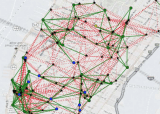 four-passenger cars could serve 98 percent of taxi demand in New York City, with an average wait-time of only 2.7 minutes. “Instead of transporting people one at a time, drivers could transport two to four people at once, results in fewer trips, in less time, to make the same amount of money,” says Rus. “A system like this could allow drivers to work shorter shifts, while also creating less traffic, cleaner air and shorter, less stressful commutes.”
 Already, I feel I will try harder to choose UberPool, with this in mind. It’s comforting to remember that I’m not only saving money, but contributing to lesser traffic congestion for others. I’m using pool about 60% of the time now, and will try to increase that percentage. Maybe this will override my sense of feeling cheap or burdening Uber drivers.
 walkerviewpoints