What now?

November 9, 2016

In my opinion, we have elected the wrong President. My opinion of this man has been clear from the very beginning of his campaign. I won’t bother to reiterate his many shortcomings for this job, as I and millions of others have done so quite thoroughly across the last 18 months–and it didn’t matter to his supporters!

I’m hoping his ardent supporters don’t really want the full agenda of his promises. There are only a few I want: I want improved economic growth. I want more good jobs for everyone, especially the middle class and the poor, and I want reduced inequality. That’s a tall order, but it’s enough.  As I have explained before here, 4% annual growth of our economy will meet my grandest wish for that measure. I don’t even require he get us to the 6% he promised. That’s not possible, no matter what is done. I will forgive him for abandoning the wall and the discrimination against migrants. I don’t wish him to beat up on our trade partners, or to leave NATO. I’ll forgive him all those abandonments, if he is smart enough to modify his stance rapidly.

I acknowledge a few good things about him. I guess that can be said of anyone.  He’s willing to disagree with Republican dogma, and that’s a great asset (to me). And, while I’m OK for social security to be reduced for those of us who don’t need it, his promise to maintain it, contrary to the policies advocated by Paul Ryan, is a positive signal on behalf of the poor.

Jobs, wages, and some movement toward better economic fairness, equality, and shared prosperity. This is the critical part of his promises. As I have explained before, the maximum economic growth for a mature economy like the US will not provide better equality. Growth alone does not provide equality. Reducing inequality will take redistribution. And, it’s not just “Wall Street” that has been profiting at the expense of the lower class. It’s people like the President elect, himself, what with his use of the tax code and bankruptcy law.

I don’t want the wall. I don’t want Muslim immigrants denied entry to the US. I don’t want trade battles with all our allies and friends, especially not with China and Mexico. I don’t want us to become too cozy with Russia. I don’t want another war.

One of the first indicators of possible acceptance and support for this new President is his choice of key advisors and cabinet. Let’s see who he chooses. If he reaches across the aisle and is able to draw in those who disagree with some of his policies, those with reasoned thought and experience about the area of responsibility, I’ll be hopeful. If he nominates a moderate judge to fill the vacancy on our Supreme Court, I’ll be hopeful. If he chooses only among those who have catered to him, I’ll be very concerned.

Then let’s see what his opening policy proposals are, with the detail that never clarified them during the campaign.

My fear is that we may be in for four years of bitter disappointment for unfulfilled grandiose promises in incomes, wages and jobs. Promises that, in fairness to Trump, could not be fulfilled by even the most superb leader among us, not even if we had a cooperative legislature, because the resistance of structural reality (a slow growth world for a considerable time, technology, and globalization). But, he promised, so he should be held accountable.

And, the populace who supported him, how will they react to this reality, failure to deliver? My hope is they will be observant and demanding, holding him and his leadership accountable, as perhaps we might interpret their votes for Trump to have done with respect to their disappointments up to how: They voted to throw out the Obama administration and try something radically different, notwithstanding the abundance of evidence that the current administration was denied legislative support to programs which would have improved matters significantly.

A more realistic outcome to disappointment in failed promises, given the Trump rhetoric to date, is that the new Trump administration will try to blame the future disappointments on the legacy of the past, the recalcitrance of Democrats in Congress to approve extreme proposals, on the Chinese and the Mexicans, or the Muslims among us, or anyone who can resist, prevent, or even disagrees with him. If this should be the outcome of failed promises and if the Trump army chooses to believe this kind of explanation, we are in for a very bad time ahead. A long, bad time.

The American voters have chosen this man. Now we must turn to the future. His followers might have fomented rebellion, had he lost. I hope the rest of us will not. Let’s have another peaceful transition. Let’s give him a chance, to see what he can do. I would love to apologize in time to President Donald Trump, for my distrust of him. I would love to see him successful.
Populism and Trump

October 26, 2016

This new term–“populism”–is in the news every day now, here in the US, and also all over Europe and elsewhere. What is it? In the November/December issue of Foreign Affairs, Fareed Zakaria suggests it can best be understood as,”…suspicion and hostility towards elites, mainstream politics, and established institutions.” As Zakaria explains, populists can be liberals or conservatives–both can feel disenfranchised. A number of the supporters of both Bernie Sanders and also those of Donald Trump can be seen as populists. Both camps feel they have lost out–in jobs, wages, and protections.

When I was studying in London in 2012, my favorite professor and I had a conversation about the growing inequality in China (his expertise) and around the developed world, including the UK and the US. Neither of us could see anything politically feasible that offers a potential reversal of the trend in steadily rising inequality. He observed that the only solution would likely be revolution. That’s because no matter how good the arguments, the wealthy (who have the political power) simply will not agree to any meaningful form of redistribution.

Unfortunately, it isn’t only the resistance of the wealthy. Technology and globalization are also exacerbating inequality, reducing job opportunities for the under educated, lowering wages. And, there is another thing–the countries most experiencing populism advancing are also experiencing slow growth. Countries which are not experiencing slow growth generally are not seeing populist movements within.

In my opinion, this is evidence of the power of inequality.  Economists agree that inequality is likely to rise in periods of slow growth. Thomas Piketty wrote an 800 page best seller to explain this subject in 2013 (Capital in the Twenty-First Century). He forecasts a long period of slow global growth ahead, and explains why this will inevitably advance inequality. In other words, growth is necessary for reducing inequality.

The West is headed for a long period of slow growth ahead. The political candidates can promise more growth, but as Piketty explains in detail, it’s simply not gonna happen. Maybe for the US 2%, best case 3%, but we’re not going to see 4%, no matter who’s elected, no matter if Congress was completely aligned to do the right things (which they’re not). No matter the size of the Trump tax cuts, economists do not see growth stimulated. Tax cuts reduce government services which hurt workers more than the wealthy. This is a form of reverse redistribution–gains for the wealthy, net losses for the working class.

And, economists agree that while growth is necessary to reduce inequality, they agree it is not sufficient. That is, even if we had 4-5% annual GDP growth in the US, that alone would not reverse the advance of inequality. As Piketty explains, we would need redistribution. “Redistribution,” a word we haven’t seen in the political news. Not even Bernie Sanders has chosen to use this word. Redistribution is often misinterpreted as simplistically limited to “taking from the rich and giving to the poor,” or, as some Conservatives would say, “taking from those who worked hard and earned it and giving to those who want to live off the government.”

Of course, redistribution can take many forms, too many to try to list here. But consider that one might be to take from our military budget to increase our education budget. This way, there would be less wealth accumulation among the owners of the military industrial complex, but better opportunity for the underprivileged who currently cannot afford education, plus also better qualified workers for business, which helps the capital owners of the those businesses. This would be “redistribution.” Same kind of argument for infrastructure–improving it helps both the wealthy and the working class–they can get to work easier, afford housing a little farther out, and employers get access to more employees and better transportation for goods and services.

But, alas, there seems to be no appetite for considering even the most benign forms of redistribution. I belong to a group called “Patriotic Millionaires,” which argues that many of us recognize the dire problem ahead if we don’t regain some of our lost equality, and we’re willing to see our taxes increase if we see it going to advancing opportunity for the underprivileged. We feel our government has benefitted us and we are willing to contribute to redistribution. We don’t blame immigrants or China and Mexico for our problems.

Donald Trump is the leader of a populist party whose members are mostly on the Right side of our political divide. He’s trying to blame the lack of jobs and wages on immigrants, and appeal to nationalistic themes, especially targeting foreign countries for destroying our “greatness,” and promising a more powerful and decisive military which will annihilate any foreign threat. This is not the solution to the economic woes of his supporters, but they are so fed up with what “Washington” has (not) done for them, that they are ready to believe this demagogue.

Regrettably, in my opinion, it is just the politics and economics of the right that have controlled “Washington” for the last several decades and that’s why we are in the condition we are in. So in a way, the Trump Populist supporters are simply voting for return of what we have been experiencing.  They need to “pay no attention to the man behind the curtain.” (Wizard of Oz) They need to take a basic economics course.

My professor thought revolution will come, but he thought maybe in 50 years. Watching the enmity of our election process, it could be sooner.

Wells Fargo-It’s Not Enough

October 15, 2016

Tim Sloan has been named to replace John Stumpf. Based on my knowledge of Sloan, he has the potential to be a better CEO than Stumpf. He is qualified to do this job.

But, there is still a problem which has not been resolved. The release of the former CEO is not sufficient to deal with the magnitude of the problem. Wells Fargo allowed some 2 million fake accounts to be opened and 5,000 lower level employees have been fired.

As I argued in my October 8 post in which I recommended the departure of Stumpf, there is more that should be done.

First I want to say I’m not among those who suspect bankers as intending to harm the public. I spent half my career in banking. Having spent 12 years at Wells Fargo in the 80s and 90s and time with two other major banks, I do not harbor suspicions that bankers are criminal or bad people. No one I have known in working in three banks was of this nature.

Further regulatory and legal examination will determine whether there was criminal action. I’m not expecting that. I’m doubtful anyone in management intentionally sought to line their own pockets in any way through this practice, including focusing on increasing stock value based on inaccurate growth statistics. And, I will be surprised if any member of senior management (those reporting directly to the CEO) actually directed employees to do this. If anyone down the chain of command in retail banking did, those managers should be fired, of course.

Nevertheless, the aggressive Wells Fargo sales culture was a major element of the Wells Fargo corporate strategy. That culture and the risks of that culture were fully known to the members of Wells Fargo’s direct reports to the CEO. I feel everyone in that small circle, the folks whose compensation appears to be in the range of $10 million per year (not including all stock benefits), should all be penalized. By way of illustration, reduce compensation by 50% for the coming year, by 25% for the following year, and by 25% for the 3rd year. That’s a start–recognizing by that management all failed in their fiduciary responsibility, regardless of their functional responsibility.

I’m sure this team had the usual meetings with the CEO, in which all functions performance and practices were reviewed. These managers are complicit, regardless of whether they fully understood. If they didn’t think of the risks, that’s fiduciary negligence. This is not a case of one rogue trader causing a large loss. In such a case, I would think those outside this function should not be held responsible. But in this case, it was a key element of corporate strategy. The risks should have been understood by all in senior management. All reporting to the CEO should accept responsibility and penalty.

Tim Sloan is a more difficult issue. Representative Maxine Waters and others argue that Sloan should not be the new CEO–that perhaps he should step down also, or perhaps at least someone outside the Wells Fargo management team should be recruited to be the new CEO, to assure independent investigation and correction of the culture problem. I respect this view, given the above argument. If all of senior management are complicit, then Sloan is clearly more complicit, because he was COO, presumably with enough responsibility to be ready to replace the CEO, meaning he needed to fully understand the major risks in all functions.

Here is what I would like:

Regarding Sloan: If he is to be the new CEO, I’d like to see him penalized more severely in compensation than the other members of senior management. And, I’d like to hear him make a complete statement in full honesty, explaining why he didn’t take action in his role as COO and why he should be trusted to fix the problem. I’d like to hear that. It needs to be convincing.

Regarding the 5,300 fired. I’d like Wells Fargo to offer a meaningful rehabilitation program to all but those who went beyond the pale–on the premise that management was responsible for pressures that drew these employees into inappropriate action, and for whom the dismissal severely damaged their reputations, careers, and lives. Rehabilitate them. Dismiss those above them who knew and provided the pressure.

Regarding the Board: The Board has to accept responsibility too. I think there should be significant departure from the Board, perhaps especially those who have been on for the longest time, and a number of new independent directors should be elected, with an eye to corporate social responsibility focus and experience.

Finally:  According to Glass Door, the multiple of CEO compensation to median employee compensation in large US companies has risen from about 20 times in 1965 to 200 times now, and often as high as 300 times. The Huffington Post reports that John Stumpf earned 473 times the salary of the median Wells Fargo employee. Average pay for retail bankers there is about $33,000. I’d like to suggest Wells Fargo lead the next era of corporate responsibility by establishing a new limit, and move to it immediately in 2017. I don’t know what that should be, but it’s not 473 times.  If median pay at Wells Fargo was $65,000 how about 100 times that as maximum for the CEO, “all in” (included stock benefits)? Does anyone think Wells would be unable to find a CEO to work and do a good job for $6.5 million? And his immediate subordinates for perhaps $5 million? I understand some candidates would take other jobs for more money, but I believe there’d be plenty of good people who would do great work for this pay–and I think those are the type of people who would not be compromising ethics and social responsibility.

Paul Ryan, a Disappointment

October 8, 2016

Speaking today in Wisconsin, House Speaker Paul Ryan once again exhibited very disappointing behavior. He had yesterday criticized the just released sexist comments made by Donald Trump 11 years ago, but the did not ask the candidate to step down. He has compromised whatever values he had as an American, as a true Conservative, as a true Republican, and as a leader, by finding a way to support this demagogue as the Republican President for President of the United States of America. What a disgrace and what a tragedy Donald Trump’s election would impose upon our great nation! I expect better judgment of the Speaker of the House.

Ryan made his opening point today that we need to get people off welfare, back into jobs. Why do Republicans continue to complain about welfare and welfare recipients? Do they really think the preponderance of welfare recipients would rather “live on the dole,” than have a decent job with opportunity to advance and increase income over time? No one can know what the cohort with such a view is. It’s a matter left to one’s view of humanity. I am an optimist as to the essential nature of man. I believe that cohort is small. Most people want to work. And for those who do want to rely on welfare at this time, I am sure many of them only feel that way because they see the alternative as hopeless–no jobs or terrible jobs at minimum wages, such as the $7.25 per hour in North Carolina.

In my just previous post, I have shared my opinion of how we got here. The key problem that drives the voter frustration is lack of good jobs, lack of opportunity to change one’s economic status, and stagnant wages, while the rich have increased income and wealth dramatically and steadily since Reagan in 1980. Conservative policies (sometimes identified as neoliberalism) have advanced across this period, under both Republican and Democratic administrations. Social support programs have been reduced, starved, and eliminated across that period. Republicans and their policies strongly advocated foreign trade and globalism, without concern for the displaced American workers. Isn’t it ironic that the current Republican candidate for President is disavowing foreign trade–essentially–because his stated intent to “get tough” with our trading partners will only weaken our foreign trade. Foreign trade is a huge benefit to the US, and more so for the uneducated who are supporting Trump. They don’t understand. They’ve been deceived.

Wanting to get people off welfare is not a unique Republican policy. We all want that. If they want a distinct policy to define Republicanism, let them provide a detailed prescription as to just how we are going to provide good jobs for all welfare recipients. If it makes sense, I’ll change parties and become Republican. But, it’s not going to be easy. There are a number of structural issues weighing strongly against the creation of good jobs with good wages, especially for those without a college education. Here are a few:

Technology: In a previous post I estimated that some 4 million US jobs may be lost as vehicles of all types become self driving. Technology is eliminating jobs in search for greater efficiency, and lower cost. The benefits of technological innovation are increasingly going to smaller groups of founders and employees.

Globalization: Regardless of global populist movements to close borders, globalization and foreign trade will continue, because the money and wealth creation, capitalism drives it. This means jobs will continue to be lost to foreign countries which have cheaper labor.

Education: We have starved our schools, and we are experiencing a declining percentage or our population going to college. This at a time when technology and globalization demand increasingly well educated workers, and yesterday’s factory work is eroding to technology, outsourcing, and foreign competition.

So, Paul Ryan, “let’s get people off welfare” may play to some who have been coached to resent government and all its services. But it doesn’t play with me or those who understand the issues. If you want our support, display the specifics of just how you’d do this. And remember as you lay it out–most economists see slow growth ceilings globally for the foreseeable future. And furthermore, economists agree that without redistribution,  economic growth is necessary for reducing inequality, but is not sufficient. Other things must be done along with growth. The good news is that many of the positive actions to help the underprivileged do not hurt the wealthy much and help everyone to enjoy a better society. Just one example–fixing our infrastructure is one form of redistribution–helps everyone–but Republicans say no–let the bridges fail.

But Republicans won’t tolerate any form of redistribution. They want to rely on growth alone. It won’t work. Not likely I’ll be changing parties.


Inequality is the Cause

October 8, 2016

What interests and concerns me most today about San Francisco, the US, and indeed the whole world, is economic inequality.

What I write here today is mostly opinion. I believe I could back up most of it with confirmative research, but I’m not going to take the time and space in this posting. I have studied the issue deeply and am constantly reading and increasing my understanding. In my 2017 year in the Harvard Advanced Leadership Initiative, this is what I want to study further. I hope to find an avenue for influencing movement toward better equality and opportunity

Here in late 2016, approaching a critical election in the US, following a surprising vote in England (to leave the EU), there is confusion as to what are the causes of all the political anger that is resulting in these dramatic and troubling developments here and elsewhere. Some say it is caused by immigrants. Some terrorism and failed foreign affairs, or specific foreign countries–e.g., North Korea, Iran, Russia, China. Some say it is ISIS. Some say it is the Democrats and President Obama, who has been in office for  8 years.

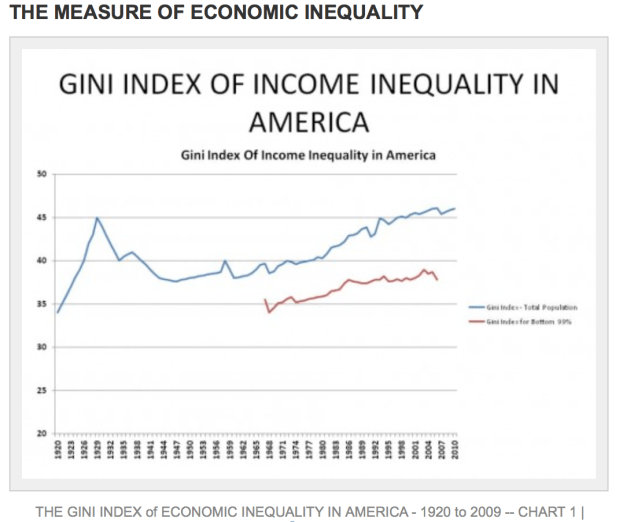
I believe the root cause of much of the frustration is economic inequality. Yes, it wouldn’t be such a concern if there had been “trickle down,” where the rich get very rich, but everyone else gets steady improvement. But, in most developed countries, the second half has not happened. We’ve been stalled since 1980 when neoliberal economics started a steady global advance. Now a number of countries are experiencing record inequality, and in the US we’re back to the Robber Baron era around 1920.

Here is what I think would be better if we had economic inequality back to the level of the 1960’s when we saw a highly egalitarian country following the GI Bill and social programs launched following WWII:

If we had better equality and opportunity, we would have better jobs available, better opportunity, and gradually increasing real wages. I think this is the root of the problem. People are angry primarily because they don’t see how they can advance, or in many cases how they can provide for their families. They’re vulnerable to blaming targets politicians rail against.

Foreign countries as the source of our problems: This goes to what really is our problem? I think it’s primarily lack of good jobs, lack of opportunity, stagnant wages. Blaming the economic stagnation of our middle and lower class on other nations is nothing other than a convenient “nationalistic” political agenda to make the crowd angry. It wouldn’t be necessary to cause all the trouble with other countries if we didn’t have our own problems to blame on them. China has been a net benefit to the US–huge.

Foreign trade and globalization: Same. The US provides far less to help displaced workers than do other countries. We brought much of the frustration on ourselves as we led the race to globalization without any plan to help the displaced. If foreign trade ended now, the people who would suffer most are the middle class and poor, because they buy more of the cheaper foreign goods than do the rich.

Migration: If we had a somewhat more equal world, good income and opportunity in Somalia, Syria, Afghanistan and Iraq, people there would not be wanting to leave their homelands.

War: If we had more equality in the US and the developed world, I believe the vitriol which feeds the recruitment for ISIS, would lose a great deal of its appeal. War is often fed by jealously and anger over how certain people live in luxury while others can’t even feed their families.

Terrorism: Same. We wouldn’t need the wall or the massive border protection and TSA.

So, a lot of the anger people feel is directed to the wrong targets, as politicians try to stoke anger and make promises of “fixes.” But the real problem is jobs, wages, and opportunity for the middle and lower classes–here, in England, and in China and elsewhere.

It’s understandable to blame the current administration. Of course, it’s convenient to blame David Cameron for failing to sufficiently protect England vs. demands of the EU, and it’s convenient to blame President Obama for anything at all that is wrong in the US.But the administration of our country has three constitutional elements: The President in the Executive Office, Congress, and the Supreme Court. A Republican party brought us the economic crisis which the Democrats inherited under Obama in 2008. Obama’s administration for the last term has had two houses controlled by Republicans determined not to do anything to fix the plight of the lower classes. And up till the death of Justice Scalia, the Supreme Court was also weighted to the Right.

If the American people could understand these issues and vote in today’s Democratic ticket, control both houses, and the next few Supreme Court seats, I believe we might see some improvement, thanks in part to Bernie Sanders influence on the agenda. He’s wrong about foreign trade  which is largely good for us, but  he’s right about education and inequality.

screenshot-2016-10-08-14-20-25

Source

By the way, this writer is not recommending equality, everyone the same, just a better balance. Something like the 60s. My parents were poor, but they found opportunity and they advanced. During that time the rich got richer, but everyone else saw steady improvement also. Today all the incremental wealth and income is going to the rich.

Corporate Responsibility–Wells Fargo

October 7, 2016

My longest term of employment, 12 years, was with Wells Fargo Bank. I never forgot the great experience of working there.  I was proud to see the continued success, totally unblemished since the 90s when I left, while almost all major banks, nationally and globally, had major surprises, mistakes, some costing billions of dollars in fines, accounting losses, lost shareholder value, and reputation damage.

Most problems for others have involved wholesale credit losses, monetary exchange, trading, compromised customer data, failed acquisitions, and the like. Wells Fargo’s failure is different. But, like the others, it involves failed management, failed oversight, failed governance.

Wells Fargo has been able to operate conservatively, with tight underwriting and trading standards, avoiding the credit excesses that have caused others more aggressive to stumble and fall. One reason this strategy has worked so well and so long is that Wells put major emphasis on their retail operation, and less on international and wholesale activities–where the problems for others have mostly been concentrated. The idea is that with transactions in retail of such small amounts (vs. the millions and billions of individual wholesale transactions), there is less chance of a big problem. And, if the underwriting of credit cards and mortgages is kept conservative, there should be no problems.

But, we now see what can go wrong on the other side of the ledger–not the assets (loans), but rather on the sales side.We have certainly seen issues of this type in the past–e.g., the aggressive marketing of mortgages by some financial institutions, leading up to the 2008 financial crisis.

Somehow the aggressive high pressure sales culture in retail at Wells  ended up promulgating a systemic practice of opening fake accounts to meet sales goals. Managers might tell the branch team, “I need 20,” reportedly, meaning “find a way to open 20 new accounts today so we can meet our sales goals.” This led to more than 2 million fake accounts opened, ultimately resulting in 5,300 people being fired.

Who’s responsible for this? Could it really be, as originally asserted by Wells’ CEO, a group of “rogue employees.” No, no one believes that. There could not be 5,300 rogue employees.  On the other hand, I do not think this was a conspiracy. I doubt that opening fake accounts was encouraged or approved by the senior management. I don’t think this was an overt attempt to create more personal wealth for senior executives.  To that extent, I disagree with Elizabeth Warren. I would not favor a criminal investigation–unless it is discovered that some middle and top level managers knew about the practice and encouraged it. I doubt critics assertions that Stumpf and senior colleagues intentionally promoted this to line their own pockets.

But I agree with Senator Warren that certain members of senior management should be terminated, including the CEO. Regardless of intent, this was a huge failure in management. And I agree that there should be a clawback of bonuses and downward adjustment for a time in stock awards. I think it should be massive for those up the chain of command in retail, and I think the rest of senior management should have a lesser clawback–this is a management “team.” All of senior management should be financially penalized.

The promulgation of the excessive sales culture is not new–it has been developing at Wells since the 90s and it is endorsed by management all the way to the CEO. It’s a key element of the bank’s strategy. This cannot be blamed on 5,300 lower level branch employees.  Stumpf and those in retail responsible for the culture leading to this  should resign, or be terminated. I doubt the wisdom of asking past executives to return to right the ship–this sales culture was not developed under Stumpf. It has been there for decades, and only got out of control under Stumpf.

What to do about it otherwise? This will take some serious thinking. Wells says they are abolishing sales goals. I don’t think sales goals are necessarily wrong, or necessarily the problem. It’s how aggressive those goals are and how they are administered. There is a difference between encouraging, motivating, and rewarding sales accomplishment and putting so much pressure that employees cross the line to satisfy management. On the one hand, if Wells truly eliminates any sales goals (without substituting some other name for them, like “targets”), I would wonder about the future profitability of their business, because sales are the source of growth for every kind of business.  On the other hand, if they do substitute some other system that is just “goals” under another name, the pronouncement to eliminate sales goals is going to be remembered and brought to their embarrassing attention. There is no easy way out of this dilemma.

It’s time for capitalism and corporate America to take responsibility at the top. It’s time to stop firing junior people when they were led or directed, either by clear orders or by aggressive goals without attendant policy overseen to avoid excesses. Wells management either knew and didn’t do enough to fix it, or didn’t know. Either way, that’s a huge management failure.

Wells Fargo–please do the right thing.

The Irony of It All

Here we are, with a restive and angry populace in the US (and across Europe), looking for someone to blame for the lack of jobs, the absence of wage growth, the withdrawal of critical services to the underprivileged.

Seemingly miraculously, the very agents who created the circumstance are on the brink of  managing to pin the blame on others, and to convincing those harmed that more of what they have been imposing will somehow create a solution.

Truly amazing, but you have to give it to them for creativity (and for the power of their big money to cleverly make their case). Helping this along is the reduced level of investment in education in the US. This creates a larger blue collar citizenry who are vulnerable to the rhetoric of the Right and have not the educational tools to break it down and see through it.

The making of the case has been ingeniously woven into a cocktail of appeals to the undereducated (and, of course, in a different way to the wealth interests of those who have not suffered, but indeed have prospered due to these policies, at the expense of the lesser privileged). The cocktail includes fear of loss of gun rights, fear of threats to religious “freedom” (such as anti-abortion), blaming the illegal immigrants for wage and jobs problems, blaming other nations, stoking fear that our national debt is soon going to sink us, and blaming the Democratic leadership of the last 7 years. None of these are relevant to the essential frustration of the disappointed, whose central frustration is economics–jobs and wages.

I was planning to make a regularly demanded acknowledgment at the end of this post, but I know my conservative friends will only read on if I put it here: There is certainly blame to be placed on Democrats as well–on the Clinton administration and also the Obama administration. Both administrations have been part of the advancing trajectory of neoliberal economics since Reagan and Thatcher. They have also resisted and succeeded in many cases, against the growing force of big money and a Congress with a Right wing determination to allow nothing to be done to reverse the trend. The Affordable Care Act was achieved against great Republican resistance. A number of smaller accomplishments could be listed for the Democratic administrations, but nothing in the way of significant spending, not even for our aging infrastructure.

Those who have not had the opportunity to study economics cannot easily see that the advancement of conservative economic policies has been so relentless and so successful. Take a look at the thorough overviews provided by Robert Reich in his Saving Capitalism (2015)  and Joseph Stiglitz in his The Price of Inequality (2012)Among other studies, these books lay out the whole problem, which has seen the tentacles of Right wing economic policies extend deep into legislative, legal, and regulatory changes which are driven to benefit the wealthy who fund the media campaigns to advance the program. Reich does an excellent job of explaining why the “culprit” is not the one the Right targets. The government is not the culprit. In fact, the government is nothing more than the set of laws and rules that are advanced, and the changes advanced have largely created a “government” under control of big money.

Here again is the irony of our ignorance: The Right claims government is the problem, while in fact the government as designed is actually advancing inequality to the benefit of the wealthy. But creating this myth enables successful continuous campaigns to reduce taxes, and the reduction is more significant for the wealthy than for the underprivileged. The cuts in government come mostly in services which would have benefitted those of lesser incomes, such as public education. How ironic!

So, now it’s only 69 days in the US to see what the next era of life here will be like. Will it be “pull up the ladders,” build walls, threaten our global neighbors, promise solutions and find ways to blame others for lack of delivery? Or, will we manage to put down the demagogue Trump and his powerful backers and have a chance to truly address that which is at the root of the problem?

It won’t be easy. Even if Hilary Clinton wins, there will be continued Right wing resistance to any form of redistribution, even to such as infrastructure improvement. Infrastructure improvement which, ironically, benefits both the underprivileged and also the wealthy. Ironic.

The powers of resistance to slowing the advance of inequality (much less reducing inequality) are the moneyed interests who benefit at the expense of others, but there are other contributing factors. Two of those are globalization and technology.

Globalization: Briefly, promises to bring manufacturing jobs back to the US face the economic reality of lower costs and wages elsewhere. That won’t change.

Technology: See my previous post in which I provide guesstimates of 4 million US jobs at risk as drivers eventually yield to self driving vehicles. This is only one of many employment sectors that will suffer as technology advances.

Another is the slowing growth of the world economy. See Thomas Piketty’s Capitalism in the Twenty-First Century for a good understand of the impact of this on wealth distribution.

Neither the Right nor the Left can stop these forces, notwithstanding  rhetoric to the contrary.

I’m with Joseph Stiglitz and Robert Reich, whose research finds that the greatest economic growth (promised by both parties) will occur only with reduced inequality–more equality. One way or another, I can only see redistribution as the solution. The good news is that there are many forms of redistribution and they don’t have to be dramatic. Cost to the wealthy can be modest, incentive to invest and take risk remain high, and a better (and safer) world for all.

Otherwise, the ultimate solution can only be revolution. Let’s not allow that.

In Opposition to America First

As I watched the speakers at the Republican Convention rant about dangers of immigrants, dangers of foreign trade, fears of Muslims, extolling our police, fears of the Democratic opponent taking away the 2nd Amendment rights, I saw a message from our President Obama, which directs us to a much higher and more valid calling. He’s asking us to focus on global development.

“Development” to economists means finding ways to help countries grow, especially “third world countries,” developing countries, low income countries. If we can do this better–direct more of our resources very thoughtfully and effectively, we can accomplish the following: We can reduce the enmity that many people in disadvantaged countries feel for us as the economically elite; we can improve the economies and jobs opportunities in those countries, thus reducing the demand for immigration to developed countries; we can reduce terrorism, which is in part based on anger that we enjoy such wealth and help the rest of the world so little ; we can improve foreign trade because healthier foreign countries and customers would buy more US products.

What are we doing now? Our current budget for foreign aid is less than 1% of our federal budget. NPR explains what is included: “The largest portion of the money goes to health: a third of the U.S. foreign aid budget in 2014, or more than $5.3 billion. The next two biggest portions go toward economic development and humanitarian assistance. Small sums of aid support democratic elections in other countries. A tiny portion goes to protect forests in countries where logging is destroying natural habitats. Some aid funds programs that train local law enforcement to combat drug trafficking.” Only 1/6 of this small 1% of budget, so about .15% (that’s .0015X) goes to economic development. And NPR reports we have one of the lowest percentages of budget to foreign aid. Many other nations are more generous.

Complicating matters is the fact that much of our foreign aid has strings attached–the products and services they cover are often required to be purchased from US vendors, thus denying the local workers the advantage of the jobs that might have been created.

Such programs by US and others have received enormous study and criticism over the years. Some studies find some programs programs do not yield sustainable results in the foreign country, for lots of reasons. It’s a complex undertaking.

So one question is whether it is even possible for us to make an impact, if we should want to. This alone is a big enough question to potentially deny any serious consideration, given the current attitude in the US (and elsewhere) regarding the ability of government to do anything effectively and efficiently–to positively impact foreign governments’ economic development.

Republicans generally distrust government. Much of the current Right wing political campaign is built on stoking distrust in government. The impact is to support legislation that continues to starve government (at all levels) in budget, resulting in continuing reduction in funding for education, social services, and infrastructure, while protecting and increasing spending for military. But the Right trusts this one huge part of government–the military.  They seem to think we do have the capability to do efficient work in our vast military budget, which is equal to the next 7 countries’ budgets combined, according to the Peterson Foundation. The Washington Post finds that when all associated with defense and international security is added, we allocate 20% of our budget to this, vs the 1/6 of 1% on economic assistance to other countries. If that’s true, why couldn’t we become good at development, as arguably (to the Right) we are at defense–why can’t we be good at helping foreign countries succeed–at a fraction of the cost of our military budget. It can’t be more complex than waging war.

In fact, there are many parts of our government (at all levels) which perform as well as private industry or better. Our private sector has frequent failures, which end up costing consumers in time, money, and also costs investors in lost value. There is no universal truth that either the government or the private sector is better in performance. That the private sector is invincible and the public sector can never do anything right is the myth propagated by the Right. One suspects the ultimate goal of the Right is to gather support for reduced taxes on the wealthy. Criticizing and starving government is just the political vehicle to galvanize voter support.  And, there is great question among many economists as to the old “supply side argument,” still made by Art Laffer, Reagan’s economic advisor–that reduced taxes on the wealthy automatically goes into investment, creating jobs. In fact, lately, more and more of those tax savings go into market investments, increased savings and wealth, and luxury homes and other luxuries–jets, art, etc. This has the effect of increasing inequality in wealth, which has risen dramatically.

And, scholars find some of the foreign aid provided by rich countries does indeed yield results. There is an abundance of literature on what works and what doesn’t. Programs must be crafted to the particularities of institutions and customer in each country.

I argue that we have the capability to do this well. We have the financial capacity to significantly increase our dollar investment. If we reduce military spending gradually as we ramp up economic development spending, I argue that we will find over time that we no longer need the amount of military spending. The world will gradually become more peaceful.

So, sorry my wonderful country, America, God bless you. But I am not in favor of America first. God is not the God of only America. God is the God of all. All mankind should be equal in the great destiny of all time. People in Gambia and Bangladesh are just as important in my eyes and in the eyes of God as those of us so very privileged to be born here. Just as important as me and my daughters and my wonderful grandchildren. Just as important. Let us not forget the great advantage of birth here, and let us seek to provide the same to all citizens of this planet.


Brexit, only the Beginning

Nationalist, anti-immigrant, anti-foreign trade, anti-globalization concerns have given rise to right wing extremist political groups in many developed countries. Britain’s nationalist movement has just resulted in a decision to leave the EU. Donald Trump immediately congratulated them and promised we will “do the same” when he is elected. He might be elected, regrettably, after stoking concerns into fears and promising inappropriate and unworkable solutions–e.g., deporting 11 million immigrants and building an impenetrable wall at the expense of Mexico (his equivalent of “same.”) Similar movements are growing in France, Italy, Germany, and elsewhere.

The cause of this begins with the third wave of globalization (yes, there were two before this one in the history of the world). Beginning around 1980, major developed countries set off on a third wave, driven by the dreams of vast profits for the corporations of their countries, as they would expand their operations around the world. Expand by both selling abroad and producing abroad. Open borders was a key component of the “Washington Consensus,” developed by economists supportive of supply side economics under the leadership of Ronald Reagan in the US and Margaret Thatcher in Britain.

On the surface, there was nothing wrong with the objective of “open borders,” essentially meaning unfettered “globalization.” In the imagination of policy makers (including those at the World Bank and the IMF), this would benefit all. Western corporations investing in the economic “South” (such as sub-Saharan Africa) would hire local workers and those economies would grow and prosper. People would be raised out of poverty. Western consumers would benefit by access to products not available domestically, and from much cheaper products.

But, the theory did not work out as planned for everyone. The neediest countries were not attractive to the big Western corporations. They didn’t have institutions, property rights, rule of law, or infrastructure. Too much risk for investors. Instead, Western corporations mostly invested between themselves, with exceptions of certain Asian countries which had at least minimally acceptable conditions, such as China. Where the Western companies did invest in poorer countries, the Consensus advice (and IMF and World Bank demands) were for reduced government and privatization of state owned enterprises–but in those countries, government provided the majority of employment. People lost their jobs and didn’t get hired elsewhere. It was a disaster for many lesser developed countries.

For the Wester countries, their corporations prospered, and Western countries reaped increased taxes. Western consumers saved a lot of money, since Chinese labor costs delivered products to us at a fraction of the cost when produced domestically. The few benefitted lesser developed countries, such as China, advanced rapidly, bringing millions out of poverty. The West was happy.China was happy. Much of the world was not.

But it all moved too fast. There was no planning for safety of workers losing their jobs. In my home state of North Carolina, a center for furniture and textiles, many factories and mills closed. They couldn’t compete. Even sofas could be delivered from China at far less than as produced locally. Governments did not address the displacement of workers in their 50’s, with little alternatives nearby. We could have offered training in new upmarket skills and relocation. But the ethos of the neoliberal economic policies did not include worker protections–in fact, it preached “flexibility” for corporations with respect for workers. Translation–less and less protections for workers, more and more for corporations.

And the architects of globalization did not contemplate the huge demand for immigration from poorer countries to richer ones, or how to deal with that in a fair and equitable way, between all developed countries.

Compounding all this was an rapidly expanding era of technology and financialization. Technology resulted in reduced jobs in some fields. Hundreds of toll takers at the Golden Gate Bridge were displaced by FasTrak scanners which automatically authorize or charge as the car whizzes by.

Also compounding was the era of slower growth globally which is extending. As explained by Thomas Piketty and by Mohammed El-Arian, this has contributed to exacerbating the wealth and income disparity. The Gini index of inequality has spiked to historic levels in many developed countries. It is undoubtedly true that a large portion of the immigrant drive is due to inequality–the search by poorer people to risk their lives to get to a better life for their children. And, it is also undoubtedly true that ISIS and terrorism is fed by hatred resulting from Western opulence, vs. Middle Eastern deprivation and war. And by resentment for US interference in the affairs of the Middle East.

So, the third wave of globalization is now in reversal, beginning with the UK. Others are likely to take similar actions–close borders to immigrants, and severely control foreign trade where there is fear of displacement for local workers.

There are great benefits to globalization, but in the above ways we went about it wrong– without sufficient planning, especially for the dislocated in our own countries, and for the condition of citizens in underdeveloped countries. Because of these failures, and the factors leading to increasing inequality in many countries, citizens are frustrated and angry, both in developed countries, and also the lesser developed. Leaders like Trump are capitalizing on these concerns and directing blame inappropriately, for their own political benefit.

Brexit is just the beginning of a global movement to close borders, restrict immigration, and slow globalization. Too bad, because (a) managed more properly, there are great benefits to globalization, and (b) it cannot really be stopped. Due to social media, technology, transportation, etc., is is still moving forward, just at a slower pace for a while.

I have a vision of a better world for all, a “one world,” where my wealthy neighbors and I find a way to concern ourselves for the welfare of those who live in  Bangladesh, Syria, or The Sudan. Looks like that vision is going to be delayed.

Let’s work toward the better solutions to globalization, toward resuming a “one world” advance in a more orderly fashion.


Our Political Polarization: If Only…

May 19, 2016

We are desperately in need of compromise, collaboration, and focus on common agenda. If we continue down this highly divisive path, nothing meaningful can get done.

If only the Republicans would stop trying to simply reduce government or abolish it, and present specific proposals to re-engineer and fix our government. And if only Democrats would acknowledge the faults of government and make their own proposals for reducing the cost and waste in government, and allowing certain responsibilities to be turned over to local governments.

If only Republicans would modify their opposition to all forms of redistribution and accept modest increases in taxes on the wealthy, with proceeds used for causes which will help both wealthy and the poor, such as infrastructure and education. And if only Democrats would acknowledge that entitlements (social security, medicare, and government pensions) need to be re-structured to reduce benefits to older citizens who do not need them so much, so as to improve the federal budget.

If only the Republicans would acknowledge that carefully designed additional government spending on real projects such as infrastructure can easily be financed and will pay back in future tax revenues stimulated. And if only Democrats would get serious about reducing, eliminating and sunsetting regulations that are ineffective in protecting us and are burdensome on businesses.

If only Republicans would get serious about eliminating tax breaks for hedge fund managers, loopholes for corporations, and schemes to reduce inheritance taxes. And if Democrats would collaborate to assure that fiscal revenue gains from these would be used in a manner benefitting all–such as partly to reduce the federal deficit and debt, and partly for enhanced earned income tax credit or equivalent measures.

If only Democrats would  mount programs to support those who lose jobs to globalization (re-train, re-locate, etc.) and to fossil fuel reductions. And if only Republicans would admit climate science is real and work with Democrats to find fair solutions to workers and companies to wind down the pollution of our planet. This, instead of both parties trying to solve the dilemma ineffectively–Democrats trying to abolish fossil fuel energy, and Republicans denying it, primarily to protect dying industry and the big money behind it. Isn’t the right common agenda the protection of our planet and the protection of workers? We can eliminate fossil fuels gradually and we can retrain the coal miners and move them if necessary to find work in solar and other emerging industries. Some businesses will gradually shut down, but that’s the nature of the evolution of industries–some gradually die and new born are born. Let’s just focus on helping the workers transition to the new ones.

If only both parties would make specific proposals as to exactly what they would do in Syria, Ukraine, and other global hot spots, so that we can stop battling just over words, like “being tough,” vs. “negotiating,” “leading from behind,” vs. “making America strong again.” No one really knows what these mean.

If only both parties would agree, with approval of Congress, to severe limitation of big money spent on elections, with companion media agreements to provide equal time to candidates to debate and present policy proposals.

If only both parties would realistically see the dilemma of our relationship with the rest or the world. We were the leader in pursuing globalization on behalf of our businesses. We sought freedom to invest throughout the world and for foreign companies to invest here. This has brought economic benefit to the US. Now we face strong nationalistic forces suggesting that foreign companies and foreign citizens (immigrants) have caused harm. The answer is neither to pull up the ladder and close our borders and punish foreign countries and companies, nor is it to continue without acknowledging and creating support for Americans whose jobs and wages are lost to foreign trade. We can have smarter foreign trade, and we can provide for the impact on US workers. We can do both.

And, we can then start to see that we should not, indeed cannot, turn back the clock on globalization. We can begin to treat the citizens of other countries with the same concern we give our next door neighbors.

There is much room for compromise before there is any violation of core beliefs. There is a vast lake of commonality available to us. Yet we stand on opposite shores of the lake hurling criticisms and insults at each other.

There are solutions requiring only a very modest amount of compromise. Two business people with disparate views usually can sit together for a short time and conclude a path to progress that serves both agendas to a  satisfactory degree. We have allowed our political leaders to hide behind political dogma as their excuse for lack of solutions.

Americans must shift the demand on their political leaders from being faithful to an empty political agenda, to getting problems solved and moving us forward. That is the leadership we need.