The Ultimate Test Cometh

It’s one thing to promise, and another to deliver. The time to deliver is approaching. Conservatives have now started to promise jobs and wage growth. What will happen if their promises are not delivered?

Conservatives have finally admitted that inequality is indeed a problem, a major problem. They tried for decades to say it was not a problem, that it is only fair that those who work harder or are smarter, or even by reason of inheritance or nepotism, have more income or wealth, get to keep what they have obtained.

And the rest of us…? Well, it’s a free country and I guess you just didn’t have the stuff, or you made bad decisions along the way. And that’s just how the ball bounces. I’m not responsible for your misfortune.

But while Conservatives may be self-oriented, they are not stupid. They now face a noisy and growing crowd of Americans demanding better jobs and better wages. Conservatives have discovered that about 1/3 of Americans are Liberal, about 1/3 are Conservative, but about 1/3 are somewhere in between, and that last 1/3 have yet to be persuaded that the Conservative agenda is good for them.  At this time, that 1/3 suspects the Conservative agenda is good only for the wealthy. And for that critical 1/3, the mixing in of gun rights, abortion bans, and no immigration is insufficient to  make the case for the Conservative agenda. They don’t see the connection to jobs and wages. There has been a steady rise in the income and wealth of the upper classes across the last 30 years, and only stagnant wage growth for the lower classes, along with employment becoming far more precarious.

Essentially, the sheer reality of inequality has been forced upon the Conservatives. If they don’t at least pretend to care about it, they will lose a lot of upcoming elections. And, if they only pretend and do not come up with real solutions, they will lose, just somewhat later, when broken promises come home.

So, now the Conservative message is being re-honed to broaden the appeal, trying to make the case that lower taxes, less government, and honoring the property and rights of the wealthy is in fact, good for the working class too. When asked just how all of this will benefit the middle and lower classes, the answer is the promise of a higher GDP growth rate. That alone will create the jobs and the wage growth that has been missing (and for which they blame the Obama administration).

Never mind that history shows the economy grew faster under Democrats across the last 50 years than under Republicans. This time around will be different, they say. Never mind that the supply side tax cut philosophy pioneered by Arthur Laffer has lost credibility. Savings from reduced taxes to the wealthy are not going into building businesses to create jobs. They are just going into the stock market or possessions of the wealthy. Never mind that “trickle down economics” has not trickled down–so far.

Whether we end up with Trump, Cruz, Clinton or Sanders, it seems inevitable that the Conservative agenda will prevail. It has prevailed and strengthened across the 8 years of the Obama administration, thanks to Citizens United and the explosion of “dark money.” That agenda claims that we will fix your frustration with jobs and wages. The prescriptions are reduced government, reduced taxes, reduced regulations, reduced immigration. These will bring you the jobs and the wages. Donald Trump claims we’ll get all these jobs back, “great high paying jobs,” by getting tough with China and Mexico.

Well…those prescriptions are not going to do it. There is more to it now. First, economic growth will be hard to stimulate in this global cycle. The proposed policies will not move it much. There are massive changes in technology and globalization that will not be countered by growth alone. Second, economic growth is necessary, but insufficient to achieve jobs and wage growth–i.e., to begin to move the inequality index slowly toward a more egalitarian country, like we had in the 60s and 70s.

And I imagine the smartest of the leaders of the Conservative movement are aware that this set of policies will not do it–will not create jobs and wage growth. But the promises will buy time.

There are approaches to the bad word “redistribution” which can be quite tolerable, even helpful to both ends of the economic spectrum. Among those are infrastructure improvement and education. Those will take a long time, even if we get political agreement, which in itself seems far away. The issues and broader prescriptions are laid out well by Joseph Stiglitz and Robert Reich, and also by Bernie Sanders.

Of course, the usual answer to failed promises, in business and in politics, is to blame it on something else or someone else. That is always tried. But, as time passes and it becomes increasingly evident that Conservative politics and economics are dominating, it will be more and more difficult to pull that wool over the voters eyes.

Two disclosures:

1-The opinions expressed in this blog are entirely my own and in no way should be attributed to any of the organizations with which I am affiliated.

2-There are good, intelligent, and capable leaders among both Conservatives and Liberals, among both Republicans and Democrats. I have friends across the entire spectrum. While it is not entirely fair to characterize any political group with a broad brush, time and space limitations preclude any attempt to be more granular. My apologies to all. My primary concern is with neoliberal economics and its impact in widening the inequality gap.

 

No more Government, except….

Unknown2

One of the falsehoods which has been promoted by the extreme Right is that those  of us on the Left want more government. They say we don’t see the waste and inefficiency in government. They say we don’t even care what more the government might add–it’s all good!  They like to say Liberals just want more and more government, and along with that comes more and more government intrusion into our “freedom.”

This is far from the case. I don’t know a single Liberal who just wants more government. I can’t even find one, even with vigorous googling. No-one extols the virtues of government. Everyone I know on my side of the political spectrum is critical of government–all forms of it, more so the Federal government than Local and State. We see highly flawed performance (e.g., Veterans Administration, purchasing practices in government and the military), regulations that often create more obstacles to advancement than realistic protection, seemingly bloated employee counts, burdensome pensions, and a lot more. We see this is the case under both Democratic and Republican administrations.

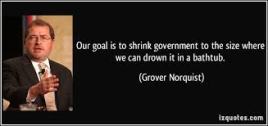
Grover Norquist speaks for the extreme Conservative stance: “My goal is to cut government in half in twenty-five years, to get it down to the size where we can drown it in the bathtub.” The Right likes to argue that government is the enemy of freedom. This has proven to be an effective marketing ploy when coupled with continuous demands for reducing taxes. A big swath of our citizens, burdened  by lack of jobs and stagnant wages, respond favorably to reduced taxes. Conservatives argue that all they want is protection of property rights. Some will allow a little more, but most forms of “welfare,” or “social support” programs are out. For many, environmental protection is out. Immigration is out. Human rights are out.

In fact, the real difference is not who wants more government and who wants less. Both extremes  want less, but both extremes want more in certain areas. One difference is that more often the Conservatives’ favorite parts of government also benefit their own pocketbooks.

Conservatives want the convoluted system of tax preferences the government gives to corporations and the wealthy. They want the step-up basis in estate assets on death. They want the carried interest tax benefits to hedge fund managers. They want the capital gains advantage. They want the loopholes that enable the wealthy and corporations to pay far less than their statutory rates. They also want tariffs on foreign products, subsidies for US manufacturers and farmers, protection for intellectual property rights far beyond what is in the best interest of individuals and the economy.They want more government spending on military, some because of interests in military equipment businesses, some simply because they are hawks or see that a nationalist pose widens the Conservative political appeal, along with calls for gun rights and religious rights. All of these things are “government,” and they all cost money to maintain. Conservatives want government, but only as it serves their interests.

Liberals also want more government in some areas. We want better infrastructure, equal education, and reasonable support for those of our citizenry who need help through hard times. We want our environment protected. We want human rights protected. We think much of what we need can be financed by reduced military spending, reduced subsidies and tax breaks for the wealthy and corporations (a simplified tax code without carveouts, without raising statutory rates), by carbon, tobacco, and alcohol taxes. And Liberals I know, those who have some degree of wealth (e.g., Patriotic Millionaires, to which I belong), are willing to see our taxes increased. Many are willing to surrender a portion of their “entitlements” (social security, medicare, mortgage deductions), to help make the budget work.

State and Local governments are less the subject of criticism by either Party. The City of San Francisco is healthy financially, but my street is full of potholes. There is an official in Oakland who is about to retire with a pension of more than $500,000 per year for life. These are among the many ways we spend money locally, by state, and federally, which do not seem to make sense to both Liberals and Conservatives. In some cases, it does make sense, as Conservatives argue, to reduce Federal government by simply turning over Federal tasks to States and Local governments.  But some tasks need to be managed federally–such as infrastructure across State lines, social support programs, environmental protection, and much more. Otherwise, the United States will evolve to the Not-United States. And, localization doesn’t necessarily result in reduced taxes, as State and Local taxes increase to replace reduced Federal taxes.

While both extremes are critical of government performance, Liberals generally recognize that corporate performance is also far from perfect. We don’t want to drown government. We want to fix it. We don’t concede that as impossible. Without government, there would only be chaos, where rich oligarchs would rule individual territories.

What is the final  cost comparison when Conservative and Liberal interests in government are calculated? It’s hard to say. Reductions in military, subsidies and tax loopholes might result in less budget deficit under Democrats, even after we add back what we have lost since Reagan. Let’s save the debate over who grows GDP faster, but suffice it to say, it’s not clear that Republicans do.

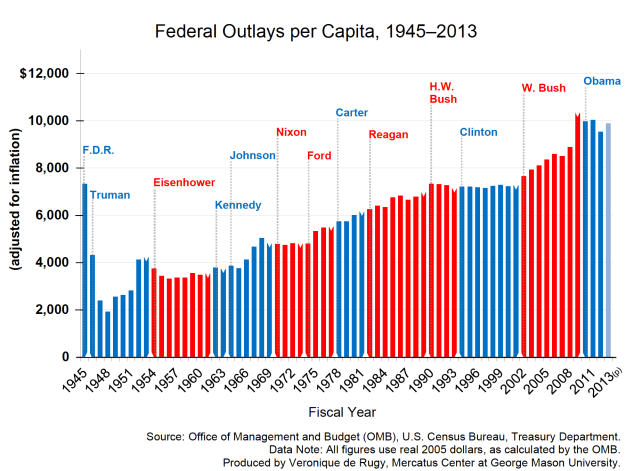
The history is that both Democrats and Republicans have increased the cost of government, and perhaps Republicans more than Democrats.

Screenshot 2016-04-17 21.48.01


Jobs, Jobs, But How?

April 9, 2016

Everyone seems to agree that jobs are the main problem. There aren’t enough of them, and what there are don’t pay well. Even Americans with one haven’t seen real wages increase in years, unless they are in the “C class” (meaning the title starts with Chief, like Chief Executive, Chief Financial Officer, etc.).

My Conservative friends say this is all we need to solve our inequality problem. Jobs, good jobs. Mostly they say we just need economic growth to get them. That’s all. That will provide jobs and wage increases, and that will solve the inequality.

But how? How will we be able to create enough of those kinds of jobs? None of our Presidential candidates are articulating just how that can be done. We are faced with slow growth globally. Workplace changes are dramatically impacted by globalization (jobs going abroad) and technology (digitization, robotics, artificial intelligence, reducing needs for humans).

The easy answer from the Conservatives takes two primary tacks. The first is to hark back to the past, recounting previous workplace transitions, and arguing that somehow the same will happen again. Best example is to remind that once we had 30% of Americans working in the fields. Now it is 3%. All those displaced eventually found jobs in factories. No problem. I must say it doesn’t comfort me to say that somehow, inexplicably, we can count on that happening again, and that we should do nothing but wait. This notion is likely to go the way of the now discredited “Kuznets Curve,” which argued that inequality will rise and then will naturally fall–without government intervention.

GE employs 305,000 people and  Coca Cola 700,000 (counting bottling partners). The largest US based employers are Walmart and McDonalds, with 2.2 million and 420,000. Many of these kinds of companies are finding increasing ways to replace staff with technology.  The companies of the technological revolution employ far fewer than their industrial predecessors. Google employs 61,000 and Facebook only 13,000. And, the drivers who comb our streets in giant buses with darkened windows to haul developers to and from San Francisco and Palo Alto are protesting their wages.

The second conservative argument is that the technological revolution we are now undergoing does produce jobs. For example, here in the Bay Area, it is reported that for every tech worker hired, 5 jobs are created elsewhere in the economy. But what kinds of jobs are these–restaurant workers, grocery clerks, drivers, house cleaners…?  In a previous post I outlined the likely impact of driverless vehicles coming across the next 10-20 years–about 5 million jobs at risk. Can anyone explain how all the good jobs lost to technology will be replaced with good jobs, plus many more for the many currently underemployed, with two jobs to make ends meet, or driving a night shift Uber.

Summary on technology–it is far from clear just how the technological revolution is going to produce large numbers of good paying jobs. We’re in a country which needs around 250,000 new jobs per month, just to sustain this very slow growth. I’m not optimistic.

If we try bringing jobs home by punishing companies using foreign workers, pulling up the ladder at our borders, placing high tariffs on foreign imports, and denying immigrant workers (as Donald Trump threatens), we will raise the cost of our goods. We will also depress US economic growth (the jobs creating engine), which is heavily dependent on foreign trade.

Health care for our aging population will provide some of the jobs needed, but many of these will be in the form of personal care, again largely lower paid jobs which are dirty and difficult.

The nature of the jobs being produced illustrates a big problem with this line of thinking. Stipulating to the ability to produce those kinds of jobs, that still won’t fix inequality without a lot of other changes. That’s because the system is now rigged to drive the preponderance of gains to the top 10% and the top 1%.  Conservatives will say that’s ok, if everyone has a decent job–they say the workers won’t care that the super rich gain immensely, as long as they have a job, a house, a car, and a chicken in the pot. That’s the economic theory called “trickle down.” All is well, as long as a little trickles down.

Just consider how long it took Coca Cola and GE to reach market value of combined $464 Billion vs how little time it took Google and Facebook to reach combined value of $939 Billion. Consider the amount of executive wealth creation that has been amassed by Google and Facebook founders and executives in a very short period of time. Certainly, considering developer pay, there is some “trickle down” in Google and Facebook. Employees of those companies get paid well, but not so much elsewhere. Trickle down might have been OK for most Americans for a time, when inequality was at reasonable levels, but it has risen to near oligarchic proportions, and people do care. That’s why Sanders and Trump are drawing big crowds.

Then there is the matter of whether it is even mathematically, economically, possible to generate enough growth to provide the jobs and wage growth during this stage of the long term cycle. The World Economic Update Outlook for January 2016 from the IMF is titled “Subdued Demand, Diminished Prospects.” I think it is not possible, without major structural changes in our government which will permit a broader distribution of incomes, opportunity, and wealth in our future. For my Conservative friends, yes, those changes should include reduced entitlements for us older citizens who do not need those, and we need a restructuring of pensions for public employees.

I’m all in favor of stimulating the economy and creating more jobs. I’m in favor of reducing regulations that inhibit those starting new businesses. But it’s not enough. Changes akin to the recommendations of Stiglitz, Reich, and Sanders would be necessary–and politically that’s not going to happen without a cataclysmic world event like the Great Depression or WWII, which drove such changes in the middle of our previous century.

No one should be surprised that we’re fighting for small solutions like minimum wage, “blunt instruments” as economists call them. But these will not make much impact.

Anger will continue to grow.


How It Only Gets Worse

March 25, 2016

I really believe it’s all about inequality. If we had managed to retain the substantially lesser inequality of the 60’s, things would be very different–and so much better for all–the poor, the middle class, and the wealthy, too. That was a time when we had far better opportunity for all, a better social support program, reasonable tax rates, and plenty of opportunity for the best to get rich.

But across the last 35 years, we have steadily moved to the economic Right in laws and policies, now giving much more freedom to the private sector and far fewer protections to the workers. We have steadily decreased taxes and reduced government. Our economic inequality has now risen to the level of the “robber baron” era of the 1920s. The wealth of the Walton (Walmart) heirs is now equal to that of the lowest 132 million Americans. Both political parties have been forced to acknowledge the problem, but that has not resulted in any political agreement as to how to fix it. In fact, it seems we are increasingly polarized over solutions, and each side is making it worse.

I count myself among the liberals or “Progressives,” those who want a greater share of income and opportunity for the middle and lower classes. Some of us are reacting to the above situation in ways that only make matters worse. For example, some Progressives think the solution to rising cost of housing is in more and more regulations and restrictions on landlords. Restrictions that will further limit the rights of landlords to evict tenants or to resolve the grievances or damages they experience with certain tenants. Such measures give some short term protection to certain tenants. They also want to raise the demands on developers for the percentage of new units which must be priced for the lower levels of income

When viewed from the broader perspective, these additive restrictions (on top of a long list which already exists) only further constrain investors in buying and building new rental housing. Those who already own are more and more motivated to use the few remaining escape clauses to take the property out of the rental inventory–owner or family move in, or Ellis Act, as examples. And, such restrictions end up benefitting bad tenants as well as good ones.

Meanwhile, Right wing politicians argue that more freedom for the private sector and reduced taxes on the wealthy, will somehow stimulate economic growth to levels never experienced, and that this alone will solve the problem. They add that getting tough with our trading partners will enhance the US economy, and that further expanding the largest military presence in the world will be a good way to spend a greater percentage of the reduced income we will have after more tax cuts.

One can’t blame the Progressives for wanting tenants to have decent rents and opportunity to stay in the city and live a decent life. Progressives see that on a national level they have little chance against the Right and its lawyers and lobbyists, little chance to promote a comprehensive plan which would ratchet back the decades of laws, rules, contracts,  and interpretations, such as to establish a more fair playing field for all. So, they work to chip away at what they can. But in the long run, this doesn’t add to affordable housing. In fact, to the contrary.

And neither can one blame those on the Right (if you stipulate to their beliefs, as in supply side economics and Horatio Alger views of the nature of man). They can’t see that there is any form of redistribution which would be acceptable. Not any. Not even raising taxes on the wealthy a little and using the money to improve roads, bridges, airports and our internet.

It’s as if both sides are frantically fighting to take their respective beliefs further to the extreme, when what we really need is a meeting in the middle: Reasonable (modest) increase in progressive tax rates; restoring some worker rights; less investment in military, more in infrastructure, is a short list of adjustments we should all be able to agree on.

The current state of affairs is not entirely the fault of the political Right. Democratic administrations across the last 35  years have also failed. And, the challenge has been exacerbated by dramatic advances in both technology and in globalization across that period. But there can be no doubt that the increasingly predominant economic policies across that period have been “neoliberal,” meaning Conservative, meaning Republican and Right Wing. How the economy has been managed and how all the rules of engagement in economic transactions have been adjusted has everything to do with the state of affairs we find ourselves in today.

The anger reflected in the voices of millions supporting Donald Trump means that even Republicans are aware that what “establishment” Republicans have been doing for 35 years is not working and is not acceptable. That’s a good thing. It’s only regrettable (highly) that the Republicans could not have found a single candidate (except John Kasich, who seems unlikely to win) who has a clue as to how to fix the problem.


That Which Divides Us

March 11, 2016

Unknown5

As I wrestle with the radically opposed views our people have come to so strongly hold, I increasingly feel that it comes down to a very few basic principles, which may be illustrated in the form of questions.

Regarding opportunity: (A) Do you believe many people need and deserve a helping hand, and with that, will contribute to society; or (B) that everyone can and should make it on her/his own if she/he only tries hard enough?

Regarding social services: Do you believe (A) that the majority of those in need are decent law abiding people who want to work and keep trying to find jobs: or (B) that the majority of those in need are happy to live off welfare and other social benefits?

Regarding immigrants: (A) Do you believe that most trying to get into our country (whether legally or illegally) are good people, just like you and me, and that they will contribute to our betterment, just as our immigrant forefathers did; or, (B) that far too many of them bring crime, terrorism, and steal jobs Americans need and want and we need to severely restrict immigration?

Regarding economics, which is most needed at this time: (A) Getting money into the hands of the people who will spend it and thus drive demand and motivate the wealthy to expand businesses and jobs; or (B) reducing taxes on businesses and the wealthy who will then invest in businesses and create jobs?

Regarding our federal government: (A) Do you believe a strong federal government is needed to assure safety, rules and regulations, health care, education and other basic services on a basis consistent across all states; or (B) do you believe the federal government is simply impossible to manage and we should turn most of these powers over to the states?

Regarding incentives: (A) Do you believe that those who succeed, regardless of whether by luck or genius, should share a portion of their wealth with others; or (B) that those who honestly become wealthy deserve to keep all of it and do with it as they will?

Regarding foreign conflict: (B) Do you believe the US should take the lead and intervene in foreign countries where human rights are at risk; or (A) do you believe the US should only do so as a last resort after negotiation and engaging agreement from other nations?

Regarding globalization: (A) do you believe we should work to extend foreign trade: or (B) that foreign trade only results in lost US jobs and we will be just fine without it?

Regarding taxes: (B) Do you believe that reducing taxes will stimulate the economy and create sufficient new jobs; or (A) that government intervention is some form of redistribution is needed to accomplish that?

My apologies if I have insufficiently disguised my own bias, which is now A in all cases. And a reader may rightfully observe that stating the above as A and B choices is far too simplistic. There are complexities. There are nuances. And those who are more liberal may nevertheless sometimes choose B over A, and vice versa, depending on their values. Some liberals who greatly fear for safety may oppose immigration just because there cannot be 100% assurance that not a single terrorist will slip in.

As I’ve tried to make my case for A with friends, I can’t see that I have changed anyone’s position. I have come to the conclusion that our biases are very deep seated. The Trump and Sanders campaigns seem to illustrate that a leader who speaks to such critical biases immediately garners a loyal following, regardless of the logic to support their proposed solutions. And once a strong public stance is taken by supporters, it’s near impossible to persuade one person to change. Facts don’t seem to matter. The bias trumps facts.

Our biases may come from parents, from environment, from education, or from personal experience. In my own case, my positions previously tended toward B on some points. I wasn’t influenced to change by arguments with friends, or from speeches, magazine articles or books. As to reading or TV, I think I gravitated to media which was consistent in bias with mine.

I was influenced deeply by only one thing. It was an extended experience. I went back to school for a year in my late 60s, studied beside 20 somethings, listened to all the lectures, wrote all the papers, took all the tests for credit. I had to study the core data, as opposed to just reading opinions from the Wall St. Journal and The Economist, which I came to see were full of the biases of those publications. I wish everyone had the interest and opportunity to go back to school and really dig into the data and the issues.

Americans are highly polarized. Our major differences begin with how we can better address inequality. How can we produce better jobs, enable better wage growth, while at the same time preserving the opportunity for our best and brightest (could be me, we all think) to strike it rich and not have to give most of it to the government.

Economics is not 100% of the answer, but it is a huge part of it. Would that all candidates for high office were required to take a basic economics course at a major university, and get a passing grade.

Unknown6

Of course, economists disagree over much. But some things are universally agreed among all economists. One of these is that there is ZERO possibility that US economic growth can be raised to the levels (6-10% GDP growth annually) to pay for the tax cut plans and the job growth promises of most of our candidates (e.g., Trump). Zero.

Unknown7

Much as we vilify government, it is the only tool we have by which we can come together to deal with that which is impossible for the private market alone to accomplish.


Affordable Housing in San Francisco

March 9, 2016

Unknown

Just today I was walking my little dog Bravo down Washington Street. Two doors from my home, I stopped to talk with a neighbor. I’ll call him Dave. I have lived here 6 years and I’ve seen him many times, often stopped to chat for moment. He’s a nice guy. Others in the neighborhood speak highly of him.

He disclosed to me that he’s moving on Friday. He has been a renter here for 23 years. The woman who owns the home is exercising her rights to return to the home and live in it. He said there is no legal protection for him in this particular situation. He and his wife have found a place further out, but still in the city. Good for them. He raised his kids here, and it’s sad for them and for neighbors to see him forced to leave.

But he’s one of the fortunate. He has an established chandelier business operating out of his home. He is probably a little better off than the average renter in this city. So, I’m glad for Dave.

But what is the solution regarding rent control in San Francisco?

There is a serious problem of insufficient affordable housing in some of our major cities, and many of them have adopted rent control as one of the measures to try to protect lower income citizens who cannot afford to buy, and cannot afford the kind of rent increases which occur sometimes. According to Zillow, rent has increased in San Francisco neighborhoods from 11% to 30% in the past year alone. Rent control is allowing about 1% increase in rents by landlords in rent controlled properties (those built before 1979). Without these protections, many of lower income tenants would not be as fortunate as Dave. They would have to relocate to distant suburbs, the closer of which are also rapidly becoming unaffordable. So, I don’t blame anyone who is taking advantage of rent control for doing so.

But there are big problems with rent control. One is the challenge to landlords. I’m occasionally one of those. When I am, I obey the laws to the letter. But as the restrictions on landlords keep increasing, the challenge of finding landlords who want to own such properties increases. How can an investor estimate her/his likely return when you don’t know whether your tenant will say one year or perhaps 23 years? If the latter, your return on investment is likely to be negative or extraordinarily low.

Is it fair to landlords who own or want to buy buildings built before 1979, to restrain them to annual increases like 1% when market increases range from 11-30%? No, it’s not. I don’t blame Dave, but he has had a huge windfall of protected rent levels for 23 years, and the landlord has had a huge loss. Rent control motivates many landlords to minimize maintenance and/or improvements and service because they are in the red already. Others are forced to seek ways out by moving in themselves or “Ellis acting” the property and selling the units individually to buyers. So, in economic terms, rent control is a “blunt instrument” in the fight to achieve affordable housing solutions in San Francisco. It certainly does not add to the stock of affordable housing. It slowly removes units.

Unknown2

The new conditions being considered to be imposed on developers–that affordable housing up to 25% of the units being built be required–also are a blunt instrument. The measures proposed by some of our “Progressive” Supervisors are supported by many citizens who object to almost any change in our city. Developers cannot make any sizable contributions to housing with that requirement, due to the costs of land and the lengthy, expensive, and risky path to declination or approval. Affordable units are sold at a loss to developers, so market rate unit mix is critical in estimating the chance for a profit.

These proposals dictate to the private market (developers) impossibly high economic hurdles. These proposals will simply slow development to a near halt. One thing Progressives fail to understand about developers–development is a very high risk business. It’s not a license to coin money. Many projects are stopped, many fail, many lose money, and it’s hard work and high risk to get one done and make money on it. Which of us would invest in something that has only a chance to succeed, takes money along the way, and if successful, the returns are 10 years out?

Often when success does happen, it’s primarily due to the Progressives making it so hard that there is little supply of new homes when the project finally is finished. Increasing demand and little supply drives the price at the end of 10 years to levels that neither developers nor Progressives could have imagined–but only for the very few projects which can make it through the gauntlet.

If rent control is not the answer and additional demands imposed on developers are not the answer, what is?

Regrettably, with all the complications of it, this is a problem perfect for government. It’s not an acceptable excuse that attempts by government in the past failed in some cases. The attempt to force the solution onto the private market has had a long run now, and it is failing miserably.

We need affordable housing, a lot of it. We’ve been trying to turn it over to the private sector but simultaneously over-regulate it.  We fall farther and farther behind as we try harder to force developers to do what they cannot economically justify. People like Dave are increasingly forced out. Their departure is bad for all–bad for restaurants, bad for retailers, and ultimately also bad for all the capitalists who rely on the labor of our lower paid workers who need and deserve to live in our cities.

I’m a huge advocate of more affordable housing. I welcome it here in my Pacific Heights neighborhood, and on my block. All we need is a property, a developer, and sufficient City financial assistance.

What can government do? More on that in a future post, but when the private market simply cannot do the job based on its essential motive–profit to owners, when risk is high and profits are insufficient to motivate, we have to look to government to step in and partner with the private market. We have to fix the problem of government and enable our government to take the right actions–that’s going to mean money and investment. But there is a return on government’s investment. Returns come in the form of a better city for all, enhanced attraction to investment and jobs, and increased tax revenues from increased economic growth.

As David Prowling explains, the unique San Francisco resistance to change fuels the Progressive movement. Progressives add regulations and demands.Regulations are not going to contribute to the solution, unless in the form of less, not more.  Meanwhile, the Right is obsessed to constantly reduce taxes (revenues to government) and shrink government, thus denying the economic ability of the right partner to help solve the problem.

Thus, in our beautiful and (to date) successful City by the Bay, we have come to represent the extreme in standoff and gridlock, which is also paralyzing our nation. We need to find the avenue to being an example of the solution.


Unknown3


Science Fiction–Not at All!

March 3, 2016

This post focuses on one significant upcoming additive advance to inequality. There are many other advances also moving in the same direction. It takes time and hard work to reach agreement on fair solutions and to implement them.  We are way behind. The dangers are rising.

The near certain example is in transportation.

images1

Experts estimate that we will have abundant self driving cars within 20 years, you’ll see some of it on your streets much sooner–like right now on Highway 280 between here and Google in Silicon Valley. Self driving cars will be made available via an app on your phone. The car will drive itself from a nearby lot to your home, take you to your destination, and then take another passenger or wait on the outskirts of downtown until end of the workday. You won’t need a particular car–you’ll probably use a service where a small fleet of cars serves a population X times the number of drivers.

images

There will certainly be some initial distrust, images-2reluctance to go to a self driven car. Some will will be attached to the enjoyment of the driving experience–at least when (rarely) not in traffic. But, considering the comfort and convenience cars that drive themselves will bring, it’s likely a lot of us will be won over. Brookings says 90% of Americans drive to work.

If that’s not enough motivation, consider the savings. The cost of a membership in shared self driving cars will be a fraction of what it costs now for everyone to have 1, 2, or more cars. Your garage, if you have one, can be turned into whatever you want, maybe air bnb. Drivers will have the opportunity for big savings–the car, the maintenance, the garaging, the gas, and the insurance. Consumer reports estimates that the annual median cost of car ownership is $9,100. Half of the cost is depreciation, which for those who go to self driven cars can be spread among many users, as is maintenance, insurance, etc.

Ancillary societal benefits are major. Experts estimate that 30% of real estate in many large cities is dedicated to parking. Most of this won’t be needed in the future.   Then there are gas stations, repair shops, auto parts distributorships, car washes, etc., which can relocate to the edges of the cities. All the freed space can be recycled into housing, shops, parks, etc. The growing complaints in many major cities around traffic will be significantly resolved because a high percentage of traffic congestion in downtowns is due to drivers looking for parking. Cars will unload their passenger at the door of their office building and zip off to the suburbs to wait until needed again.

There will be parallel change in all other vehicles currently driven by people.Trucks and busses will be self driving as well. A few facts:  There are 3.5 million truck drivers in the US. There are 234,000 taxi drivers and chauffeurs. There are 665,000 bus drivers in the US. There are 162,000 Uber drivers. There are millions of support jobs partially at risk as well. For example, in addition to the 3.5 million truck drivers, there is another 3.5 million who do work in support of trucking. Some of those will also be at risk as a result of automation advancing. Amazon and Google are considering delivering our packages in self driving cars or with drones. Add in farming vehicles and forklifts.

The preponderance of these hard working drivers are only high school educated, and highly at risk to this rapidly approaching advancement in technology. With electricity expected to be the bulk of future vehicle power, displaced drivers will be increased by displaced gas station operators, and likely reduced manpower needs in human resource departments of trucking companies and bus and taxi companies, reduced need for manpower in vehicle insurance sales and service, and many other affiliated work areas associated with transportation.

There are technological issues yet to be resolved. There are risks to self driven vehicles having to do with weather, reliability of technology, rescue in event of emergency, and cyber crime. But there is little doubt that this future will arrive–the only question being when and how rapidly and widely it advances. All auto manufacturers are aggressively preparing for it, as is Uber and Google, among others. Some say we’ll have 10 million self driving cars within 10 years.

This post has focused on drivers. There are many other jobs at risk to technology. The Huffington Post reports from a study finding that 47% of all the jobs in the US are at risk to computerization within the next 20 years.

Inequality is at record levels in the US and other countries now. It’s going to get worse if we don’t start now to face it and prepare to moderate it. Globalization and technology are driving it. Conservative economics, in force since Reagan, prevent any government intervention to moderate it.

John Maynard Keynes, the famous economist, said in 1930, that within 100 years we would all be working only 15 hours per week, due to forecasted technological advances. Those advances have come. Keynes did not consider to whom the benefits of technological advance would go. They have gone to the inventors and capitalists who created and funded them. That would be OK, the essence of the American dream, if it were not for the fact that the advancement of technology is steadily removing the need for human workers, while we are doing nothing to compensate for that.

Thee are so many things we could do.  We could invest in modernizing our rusting and failing infrastructure. This would provide replacement jobs to many and would be good for all Americans, increasing the income and wealth of the 1% also. We could  find ways to assure equal education to all. Better educated workers would benefit the 1% also. We could create training programs for apprenticeships in plumbing, electrical and all manner of personal services which are not rapidly being replaced by technology. We could help displaced workers re-locate to where employment is available. And, we can and should strengthen our social support programs. See my previous post regarding prescriptions. All of this costs money, but all of it will save us money in the long run.

The alternative is not appealing, a growing danger for my children and grandchildren. And the threat of a revolution is growing. In my view, the response of Americans to both Trump and Sanders evidences the seeds of revolution unless something is done.


Trump: The Plus and Minus

February 27, 2016

Unknown1

First the positive–yes, there is more than a little of that, believe it or not! Here’s what I like:

  • He says the war in Iraq was a huge mistake, and George Bush failed the American people. No other Republican dares to admit that.
  • He acknowledges the good work Planned Parenthood has done for women, objecting only to their small segment of abortion work.
  • While he does oppose Obamacare, he (sometimes) acknowledges the value of the individual mandate.
  • He says the government should not leave the underprivileged without health care.
  • He may be less hawkish than most of his Republican Presidential competitors–probably would not be inclined to interfere in new conflicts abroad.
  • He feels we should talk with our “enemies,” rather than stonewall them–e.g., Putin.
  • He is a “dealmaker.” This means he’s likely to be more willing to compromise and get things done. Cruz and Rubio clearly are both extremist in dogma and probably would not concede any of their extremist principles.
  • He is not beholden to big money (other than his own).
  • He says he will remove the tax advantage given to hedge fund managers.
  • He is not slavishly dedicated to Israel, seems to also respect the Palestinian side of the conflict, which open mindedness would be more likely to yield a solution there.
  • He is not excessively dedicated to a document written in 1789. The Constitution needs to be updated for our times. Certainly Cruz would not and Rubio says he only wants a balanced budget amendment (with which I do not agree–too limiting of our fiscal tools in an emergency) and term limits for congressmen. There is much more which should be updated–e.g., the right to bear guns. Slavish adherence to the Constitution as if it is sacred is ridiculous. Many successful nations have updated their constitutions.

Essentially, Trump refuses to be controlled by Republican party rhetoric or agenda. He calls himself Conservative, but he doesn’t worry about whatever the litany is for the Republicans or the Tea Party. In a word, this is what is most appealing to me about Donald Trump. What difference does it make whether one adheres to principles developed by someone else–let’s have a President who will think for herself/himself.

————————————————————————–

Is that enough to make Donald Trump a good Presidential candidate? No. Not even close. He’d be a HUGE risk to our nation if he should get the job. Why?

images

  • His positions (see his website) reveal very little in the way of substance, and very few positions are even attempted.
  • Some of his stances are absolutely crazy–e.g., believing his “wall” will solve all the illegal immigration problems, that Mexico will pay for it, not to mention the abhorrent brutality of deporting millions of parents and children.
  • We don’t know who he would choose to advise him, whether he even listens to anyone, and it appears he is extremely vulnerable to those who fawn over him.
  • He has no government experience and relatively little management experience, when examined. He knows little of foreign actors, world history, or foreign policy.
  • He does not understand economics.
  • He is quick to make a decision, and if he’s angry at the time, we don’t know how he would respond as Commander in Chief. If he is insulted or feels the US is insulted, he might pull the trigger.
  • Joining all his Republican competitors, he feels he can raise GDP growth and solve all our problems. Growth alone doesn’t do that, and 6% is unachievable in a mature economy in these times.

The tragedy of our times is that the anger of the American people ends up vested in this bombastic business guy, whose accomplishments when examined carefully are not very great, even in business, littered with bankruptcies and questionable hiring practices, starting with a large inheritance–hardly a “self made” success story. Let’s see the tax returns–there’s probably food for concern there as well.

Trump is appealing to a lot of Americans because he channels their anger and he simply disregards political dogma of all sorts.  But along with that goes the reality that we can’t discern where his basic principles rest, and that’s frightening. But while we cannot know how he would respond as Commander in Chief, neither is it more comforting that we know how Rubio and Cruz would respond.

The anger Americans have is first around wages and jobs. Republicans cannot point to much they have done about all that. Causes are globalization, technology, financialization, but exacerbated by right wing extremist policies focused on downsizing government and more freedom to the private sector. It’s gone to an extreme. See my previous post briefly summarizing points in Robert Reich’s new book. While both parties have blame in the failure to properly address these problems, Republicans deserve the greatest blame, by far.

Yet, with rhetoric drawing in evangelical values, gun rights, nationalism, blaming immigrants, etc., Republican have pulled the wool over many Americans’ eyes.

The reality Republicans have forced upon our government is that they have frozen the legislative function, denying any fiscal tools to help deal with economic growth (See Mohammed El-Arian’s new book). Now that the Federal Reserve is almost exhausted of monetary tools,  the Executive arm and the Supreme Court are the only avenues to deal with controversial issues that arise as time passes in a dynamic time and a complex nation.

Where does this leave us? It looks like John Kasich, the only remaining Republican candidate who makes sense, will not make it to the nomination. So, unless Michael Bloomberg decides to run as an Independent, I’ll only have the choice of Bernie or Hilary.

Republicans, you opened the door to a Donald Trump with your stubborn extremist positions. Now, let’s see how you’re going to deal with it. And if he makes it, do you really think you can once again blame the problems on the Democrats?

Foreign is Not So Far Away

February 23, 2016

Growing up in High Point, North Carolina, I had no concept of Asia or Asians, little of Europe (only from history class), and almost no exposure to recent immigrants in my small town.  In retrospect, it was as if America was an idyllic island and the problems of the world were remote. I knew there had been two world wars, but no one had really threatened us on our shores (aside from Pearl Harbor). “Foreign” was far, far away.

While my town has only grown modestly, it is not uncommon now to see Arab and Indian headdress or hijabs on the streets of High Point, and we have a beautiful Islamic Center. There are numerous Asian restaurants. Local furniture magnates have learned which of their stock is best supplied from China and how to use the unique woods of Tasmania.

In the meantime, between the 60’s and now, immense benefit and opportunity from globalization has arrived. But along with that,we are stumbling into a labyrinth of issues which cannot be solved by one country operating in only its best interest. These include the sharing of scarce global resources; concern for the global environment; proliferation of weapons of mass destruction; immigration; the complications and the winning and losing in global trade; and many others.

Unfortunately, we seem to have learned far too little about how to work collectively as a global world. It’s as if the race to expand capitalism pell mell globally has outrun our ability to anticipate the problems or to collectively agree on a set of rules, so that the results can be optimized and reasonably fair to all countries. Consider the struggle Europe is having over establishing an equitable sharing of the burden of refugees fleeing Syria. And, most of our “foreign” focus seems to be on which nation is a military threat, and how we can be strategically or militarily prepared and stronger than others. This seems true not only for the US, but for most other countries.

In our schools we teach listening, understanding others, collaborating, teamwork, compromise, sharing. In our universities, we often organize students into teams to work together to solve a problem. Such groups are now likely to include different races, religions, and nationalities. But such “teamwork” does not seem to extend to our foreign affairs. There is a resurgence of nationalistic and protectionist sentiment in many countries–Russia, England, Germany, France, and clearly also here in the US. Negative economic tides exacerbate such attitudes, as political leaders (e.g., Putin, Trump) are quick to blame our economic problems on another country. The stick is being wielded liberally and aggressively, and anyone suggesting a carrot is branded weak. “Leadership” is defined in terms of aggression and power, seldom in terms of collaboration and mutual concern.

The current issue of The Economist includes an example. The Mekong River runs through six countries, starting high in Tibet and reaching the ocean in Cambodia. China has 14 dams planned on the Mekong, to augment the 6 they already have. Laos has 9 planned, and Cambodia plans 2, all for the hydroelectric power they can generate. But dams restrict the flow of migratory fish, and restrain the flow of sediment which feeds the farm soil of the river basins. All of this means that there is desperate need for collaboration and restraint, but the Mekong River Commission is underfunded, understaffed, and is not subscribed to by all Mekong River countries. A major disaster is potentially in the making for the millions of people dependent on the Mekong, due to lack of collaboration, and absence of a comprehensive regional best outcome objective. Should China care what happens downriver? I think so.

The examples of damage are not all outside the US. Consider our attitude toward Mexican immigrants to the US. Most of our rhetoric is focused on building a bigger wall. Is there any room for political collaboration with Mexico to enable increasing the flow of law abiding immigrants and/or helping Mexico to create better opportunities for them there? Marco Rubio ducks the question by saying we cannot talk about better US/Mexico immigration policy until we have a better wall. Why not? If we had such a program, maybe we wouldn’t need a bigger wall.

I’m hoping for progress toward realization that we need to change our attitude. We’re not just Americans anymore. The US has spearheaded a rapid acceleration of globalization in support of our quest for profits, wealth, and economic growth. If that’s something we really want to happen, we can’t ignore the major consequences to our planet. We can’t ignore the plight of those who happen to be in the path of the raging torrent of economic progress we fuel.

Ian Brimmer and Nouriel Robini describe a “G Zero” world where the US has no longer the unilateral power nor the will to lead the world singlehandedly. Existing global organizations also lack the power and structure. Neither the G2, G7, G8, nor G20 seem capable of arranging order and fairness in the world. They forecast growing chaos and conflict if we don’t find a collaborative solution.

“Foreign affairs” doesn’t seem to capture it. Maybe “global affairs” doesn’t either. We need a change of attitude and maybe a new term. And, we can’t attach all the blame to politicians like Trump and Putin. We, the citizens of these nations are allowing, even encouraging, a myopic view. And we are the ones who will have to pay the consequences.

As to the US, it should be clear to all by now that we cannot and should not seek to unilaterally lead the world by making all the decisions. The balance of world power is defined by economic, military, and ideological comparison. Any ranking of those criteria shows its a very different world than it was in 1989. We have to collaborate with other nations. But if the US is the driver of globalization, trade, and financialization, we need to accept that along with our pursuit of such objectives must go responsibility to concern ourselves with the impact of our capitalistic campaigns on others.

“Foreign” is not as far away as we might sometimes hope, and it is getting closer every day.

What Can/Should be Done?

February 11, 2016

About inequality, that is. I am arguing that inequality is the biggest problem facing America. My previous posts detail how extreme it has become. So much is written about the issue, but so little is offered in prescriptions–what can be done? Those who do offer solutions are venturing into the unknown and are subjected to a multiple of criticisms beyond those who just write about the problem. Here is a short opinion piece based on some of the few brave who dare to venture there.

As to the question above, it’s really two questions, isn’t it? What should be done is probably different from what can be done, considering today’s politics.

The Republican Presidential candidates often start by denying the problem, like what many of them do with carbon emissions. If any acknowledgement is given, their prescriptions can largely be boiled down to one: increase growth in the economy. They are only half right–it’s nearly impossible to reduce inequality without growth. But, they are wrong that growth alone is sufficient. Growth is necessary, but not sufficient. The “trickle down” theory has been disproved across several periods of strong growth since 1980, when Conservative policies began to dominate US economics. During such strong growth periods, inequality continued to steadily advance. That has also been true in another major economy where GDP growth was about 10% annually for 30 years–China. China’s inequality has increased steadily across that time, and now is about equal to ours. Poverty was dramatically reduced, but inequality rose.

And, not to mention just “how” do they intend to increase growth–in what is increasingly clearly a low growth global environment.

In his 800 page Capitalism in the Twenty-First Century, Thomas Piketty said the best prescription would be a global wealth tax. I like that, but even Piketty admitted it could not be done.

Bernie Sanders has some prescriptions. Here are a few that fall under Inequality, the #1 issue on his website:

  • Increase taxes on the wealthy
  • Prohibit US Corporations from sheltering profits overseas
  • Raise the minimum wage to $15
  • Putting millions of Americans to work in fixing our infrastructure

All of these make sense, provided we debate and negotiate exactly how they are done. For example, future increases in the minimum wage should be based on local cost of living in each city and state. Some places are much cheaper to live in than others. Increased taxes on the wealthy need not be raised to levels that would seriously affect motivation–e.g., from the US 39% max tax rate to Germany’s 47% seems a reasonable example.

Dr. Robert Reich has a number of prescriptions in his Saving Capitalism, an excellent new book:

  • Turn back laws favoring business vs. labor
  • Strengthen the rights of debtors vs. creditors (allowing bankruptcy for home loans and student loans)
  • A broad series of measures intended to return corporations to an earlier era in which they sought to serve not only shareholders, but also customers and employees
  • Reverse Citizens United, which allows big money to heavily influence elections
  • Essentially, overhaul the rules governing these five foundations of the capitalistic system: property, contracts, bankruptcy, monopolies, and enforcement

Can policies such as these, enough of them, actually make it through the highly divisive US political process to enactment in some meaningful form? Would they collectively create a current version of FDR’s New Deal or Lyndon Johnson’s Great Society, which served sustain a period of relative equality and opportunity? It happened then, and made a huge positive difference.

Great Society Chart

It is clear now that inequality will not resolve itself. It will not be solved by growth alone. It will only be solved by some form of intervention by government. And Conservatives have established a formidable political objection to government. As Robert Reich makes clear in his excellent book, the Conservative message is that government is the enemy of freedom. In concert with that message, step by step, most of the mid century social support programs have been substantially weakened or eliminated.

Thomas Piketty agrees with Professor Chris Bramall, under whom I studied at SOAS 2012/13. Bramall is a China expert, and understands the costs and benefits of revolution. Piketty and Bramall agree–governmental intervention to reduce inequality is not going to happen without a cataclysmic event. To get to the Great Society, the world had to experience WWII and the US had to experience the Great Depression. Piketty and my professor were talking not only about the US, but looking at similar trends in inequality and similarly prohibitive political attitudes in many developed countries. They feel we must either await some similar cataclysmic event, or the reversal will only come with revolution.

Reich is more optimistic. He sees evidence in the criticisms on both sides of the aisle for Wall Street, hedge fund managers, and generally for anything identified as “the establishment.” He feels that it doesn’t matter that some of this is political necessity, lacking genuine commitment from the Right regarding the need to attack inequality. He feels this rhetoric reflects a growing awareness that the voters want change. I would add that the support Bernie Sanders is getting suggests growing strength at this time in support for upturning the halls of power and money.

As for me, I gave my first political contribution of the current cycle last week–$500 to Bernie Sanders. They said the 13th Amendment abolishing slavery could never be approved in 1865. It won by 2 votes. I gotta support what I think we should do, and later we’ll try to get what we can do as close to that as possible.


i think i can