“Saving Capitalism,” by Robert Reich

February 1, 2016

reich1

In this excellent book, Dr. Robert Reich addresses a major issue in the politics of our time: that Conservatives have created a powerful illusion of government as the enemy of freedom. In fact, he shows with clear logic and many examples, that without government, there is no freedom. There is only lawlessness, a dangerous place where none of us would feel safe.

Across the 30 years since Reagan, there has been a steady advancement of Conservative economic policies, favoring the free market over government, involving a steady erosion of worker rights vs. employer rights, and shifting corporate values from serving employees, customers and shareholders, to serving shareholders only. Exacerbating this are two other major factors: technology advancing rapidly through digitization, resulting in reduced need for workers in manufacturing and also moving into service businesses, such as legal and accounting; the third wave of globalization also advancing, supported by Conservatives–this is key to “free trade.” But, as jobs are lost to technology and to foreign countries with cheaper labor, there is no willingness of Conservatives to allow government to provide a safety net to 50 year old workers who need to be retrained or to enable them to move to cities where jobs are available.

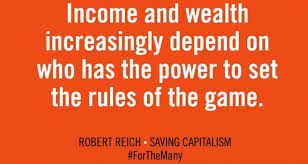
Reich explains that the right issue for debate is not whether we need government, but what do we want government to do, how government is to deal with a wide range of options.  Most specifically, he illustrates how the role of government has been shaped by the wealthy, with squadrons of lawyers and lobbyists, so that government primarily serves the interests of capitalism and big money–“who has the power to set the rules of the game.”

Reich,reich2 currently at Berkeley and formerly Secretary of Labor under President Clinton, has been an ardent advocate for the middle class and the poor. He’s been consistent in calling for adjustment to the “rules of the game,” such that we can return to the kind of shared prosperity that we enjoyed for many years after WWII.

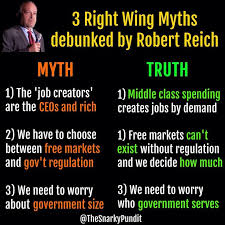
Reich’s argument is that where we’re going is not only tragic for the middle class and poor, but also for the wealthy. Start with the realization that supply side economics is not working–the idea that wealthy investors will drive growth by investing in production which hires people who spend the money. The investors simply have not been doing much  job creating investment. Instead, Reich reminds us that the middle class needs to have income in order to spend it to drive growth in the economy. That’s how the wealthy win from allowing a fairer distribution of wealth and income.
reich7

The siren song of “Conservatives” is small government. Usually there is little in the way of specifics as to what parts of government should be cut, just reduce government! Given that real wages have been stagnant across the last 30 years, while the 1% has seen astronomical increases in both income and wealth, the political dilemma Reich addresses in this book is easy to understand. Politicians offer to reduce taxes and struggling voters seize on the prospect for a little more money to spend.

Unfortunately, as this happens, with the limitation of politically unchangeable entitlements and Conservative support for military, the cuts end up in services that are critically reduce taxesneeded to enable the middle class and the poor to advance and participate in our prosperity. Eduction is cut, social services are cut, and help for unemployed is cut. Those who are voting for a little more discretionary income lose out–they lose protection from job loss, they lose social services, they lose education support for their children, and they even lose in infrastructure, and transportation is critical to our workers.

Everyone agrees, both sides of the aisle, that government is terribly inefficient, that many of our compounding regulations are obstacles to business and consumers, that many of our agencies (e.g., Veterans Affairs) are poorly run. We all agree government needs a thorough makeover. When businesses discover that they are too inefficient, a scalpel is taken to focus in on the divisions needing to be terminated and those needing to be re-organized, and selective improvement is undertaken, swiftly. No one on either side of the aisle has come up with a proposal to re-organize government. All the talk from the right is simply to reduce government. Reich explains in detail why that won’t help.

So, consider that the wealthiest 400 in the US have more wealth than the entire bottom 50% of our population. Consider that CEO pay rose 978% from 1978 to 2013. If you want to understand how such dramatic and dangerous changes developed in what was once a relatively egalitarian country, please do read this book.

“Liberty produces wealth, and wealth destroys liberty,” wrote Henry Demarest Lloyd in 1894. Reich argues the only way to prevent this natural transition is for government to do its job, the right job, free of excessive influence from monied interests. Capitalism cannot function effectively without government functioning effectively.

More later on his prescriptions for how to reverse the dangerous trend.


A reviews you may want to read: Paul Krugman
I didn’t do it! You did it. But I can fix it!

February 1, 2016

images

Have you ever experienced this–someone made a a series of blunders–then cleverly accused others of being responsible for the mess, and succeeded in keeping his job and getting promoted? If you’ve spent 10 years or more in any sizable organization, private or otherwise, you may have witnessed something like that. Maddening, isn’t it?

That’s just what has happened to us in the US. The Republican party messed things up, and they may be headed toward succeeding in getting promoted.

Here is how it all happened: The George W. Bush administration took us into Iraq and Afghanistan, spending $6 Trillion, wars that have never yet ended, and have now spiraled into a new crisis with a terrorist group called the Islamic State in Syria. Then domestically, this Republican administration led us into a housing bubble which sparked a global financial crisis, costing 8.8 Million jobs and $19 Trillion in lost household wealth in the US alone. This is what President Barack Obama inherited when he took office in 2008.

In our President’s final year, we have finally recovered all the lost ground. We are producing an average of 220,000 jobs per month. Unemployment is 5%. The economy is growing steadily.

But, regardless of the current administration doing an outstanding job dealing with the mess the previous administration left, the US is not in good shape. Inequality and all that falls under that umbrella is the problem: A high level of poverty, wages stagnant or declining, jobs hard to find, except at the minimum wages, all the while the income and wealth of the 1% skyrocketing.

And why hasn’t the current administration been able to fix that too? In a brief oversimplification, the answer is globalization, technology, and the steady promulgation of conservative economics favoring capital and big money. These policies are called “neoliberalism” in economics. Key elements are free trade,  privatization, fiscal austerity, deregulation,  and reduced government spending. The emphasis is on strengthening the private sector and weakening the government sector.

In fairness, Democrats must also take a lesser part of the blame for the economics across the long period since Reagan in 1980, when neoliberal (Conservative) economics began to gain control of US economic policy. Bill Clinton also fell prey to Conservative economic pressures during his term. He backed off his promise to limit CEO pay.President Obama supported the Trans Pacific Partnership, a massive trade deal, without sufficient protections for American workers who might lose jobs as a result.

How have the Republicans made their case to the electorate that the current problems are the fault of Democrats, and across the 35 years since 1980, that we should continue to steadily advance neoliberal economics? First, without even acknowledging the mess the Democratic President inherited, they make these claims, (with my corrections to their falsehoods):

  1. The recovery just wasn’t “good enough” under Obama. More Conservative policies would have made it better. But those conservative policies got us into the mess, and Conservatives in Congress made sure there was no fiscal stimulus, just more austerity. Conservatives are also the proponents of free trade and globalization, which has led to the loss of US manufacturing jobs, but Conservatives accept no responsibly on the part of government to provide for the job losses those policies caused.
  2. Regardless of the House and the Senate being controlled by Republicans (in Obama’s 2nd term), any shortage of progress was the fault of Democrats. But there were no meaningful proposals sponsored by Conservative Congressmen. Obama has vetoed far fewer proposals than did his Republican predecessor.
  3. Much of the economic problem is the fault of Obamacare. But, there has been no alternative proposed by Republicans. None whatsoever. Still a mystery what they would provide if Obamacare is repealed.
  4. We need to continue to reduce government. Government is an obstacle to personal freedom. Tying continued tax reduction to reducing government has proven widely popular. But the reality is that without government there cannot be freedom. The question is what do we want government to do, not whether we need government.
  5. Much of the remainder of the problem was the fault of immigration policies. But no alternative immigration proposal has been brought forward by Republicans, and studies continue to show our immigrants are net contributors to our economy.
  6. As to the wars, the problem wasn’t that Republicans took us in there, but rather that Obama didn’t put more troops on the ground and keep them there. Chest beating is appealing to some. We have not achieved desired results in any wars since WWII. Why not try negotiating and global collaboration, for a change?
  7. And, as to Foreign relations, the US failed to act tough with Iran, China, No. Korea, Russia, and Mexico. Weak politicians often turn to nationalism as a way to galvanize people. Two of the nations in 6 above have been great economic partners to us (China and Mexico) and Iran and Russia could be–if we stop berating them. We no longer need to be the unipolar leader of the world–it’s a shared opportunity now.
  8. Then, Republicans spin their message to include Christian values, objection to gay marriage and objection to abortion. And they land on the 2nd Amendment and claim that Democrats are going to take away our guns. Evangelical values and gun rights have little to do with the economic malaise, nor are they rightfully singularly Republican values–but they do appeal to a large swath of Americans.

The underlying and greater fault by far lies with Republicans and Conservative economic policies, along with their stubborn refusal to provide remedy for the human damage caused (such as economic support and re-training for jobs lost). These policies, taken with globalization and technology have led to dilemma we currently find ourselves in.

Logic suggests as Americans we would recognize that these policies need to be changed. This is not likely to happen without voters seeing through the Republican rhetoric and voting in a different set of policies.


Patriotic Millionaires

January 31, 2016

pm_logo_horizontal

I have joined a group which calls itself “Patriotic Millionaires.” Please take a look at our website. There is a financial qualification on the website, but we are self policing. No-one needs to send in their financial statement or their tax return.

Here is what we stand for:

  • A fairer tax system that includes greater tax obligations for millionaires and major corporations who have benefitted the most from the nation’s resources;
  • Higher incomes, beginning with a minimum wage of at least $15 an hour, for wage earners, who are the foundation of our nation’s economy; and
  • Less political influence for those whose sole credential is the ability to pay for it.

So far, the young organization has only 200 members, but we’re growing!

Our target audience is two-fold, as I see it: We hope for media attention that will influence politicians and legislators with the message that many people who are successful want more balance. That’s because we have the impression that politicians only pay attention to the wealthy. Secondly, we certainly hope a lot more of the wealthy of our country will consider that life will be better for all, including the wealthy, if we can all share a bit more in our prosperity. And, of course, we hope the less wealthy will rise up and vote for change.

Many members don’t like the name, Patriotic Millionaires, because the use of “Millionaires” may sound elitist. However, the consensus is that the message we’re trying to send may be best served by the name–essentially, that there are many of us who have some wealth, who feel we want a system that is less generous to the rich and more generous to the rest. In other words, we recognize that we have a  moral and also a national sustainability obligation to re-establish a fairer economic system.

As to being a “millionaire,” CNBC says there are about 7 million of us. A million certainly isn’t what it used to be. Last meeting I suggested we should be trying to recruit some of the ultra-rich, where personal wealth starts with a “B.”

Various members I have met have other agenda.  One person is also concerned with how our voting process is constructed. Another, similarly, very concerned with gerrymandering. Another with education inequality. Another with more generalized differences in opportunity. Another with discrimination in race and gender. So far, everything I heard can fall under an overall “umbrella” we can call “inequality.”I’m certainly on the lower end of financial qualification to be a member, but I completely identify with the agenda and sympathize with the concerns of other members I have met.

I think of it this way: We are just citizens who feel we have had some success in this country and know we didn’t do it alone. We recognize we had help along the way. We recognize that taxes are necessary to pay for the services and the legislative and legal structure of our country. These things are essential to assuring a healthy and fair economy and country.

To me, it doesn’t matter whether you define your success with the financial criteria of Patriotic Millionaires. What matters is that you have had some success by your own measure. You may be a veterinarian, a young engineer, a young professional in any industry. You may be an electrician or a plumber, or a university professor. If you feel the country has been good to you, if you recognize that you needed help along the way and it was valuable to you, and especially if you know that our government is critical in so many ways in order to assure that kind of opportunity for all, then I’m with you. It’s people like us who have to stand up and make sure our political process and our governance is re-directed to assure a fairer future.

To me, it doesn’t matter whether you are one of the 7 million or not. If you see your life and our country this way, then you’re on our side of this battle to adjust the balance of power in our country. Patriotic Millionaires is one of the growing number of organizations rising up to raise political attention and objection to the dangerous trends in our economy.

The members of this group (and many others) do understand that. And, we understand that to simply keep reducing taxes and continually shrinking government is a recipe for disaster–and we’re already way down that track. The ultimate destination of that process is a nation of few oligarchs who set all the rules of the economy for their own benefit. The ultimate destination is growing discontent leading to protest and revolution.

To believe in the importance of government doesn’t mean that any of us fail to see that there is enormous inefficiency in government, that there is egregious waste. All of that deserves re-engineering, a thorough makeover. However, in the absence of any politician offering even an approach to that, the answer cannot be to simply shrink government. Not even the super rich really want to see that happen. Believe it or not, there are some of those who feel as we do.

And those of us with wealth will not be strong enough to change the system. We need a lot more than 7 million votes to do that.  We need the vast middle class and the poor to know there are a growing number of the more privileged who agree with them that the system needs to be changed.


It Doesn’t Have to be this Way

January 27, 2016

Unknown

It doesn’t have to be this way–with US inequality back to the levels of our Robber Baron Era, around 1925. There are other ways to craft and manage and sustain an economy without this becoming the end point.

Consider Germany, for example–a modern, developed, sophisticated and thriving nation, 4th largest economy in the world, with per-capita GDP of $48,000 (vs our $55,000). Germany’s unemployment rate is 5% (ours is 6.2%). 65-70% of the German population are Christian. The workforce is highly skilled. We have a lot in common with Germany and its population.

Germany’s population is 81 million. Ours is 324 million. Germany’s Chancellor Angela Merkel is trying to uphold the German constitution which obligates Germany to accept an unlimited number of immigrants. So far, Germany is estimated to have accepted 57,000  from Syria, approving 93% of applicants. In contrast, the US is struggling over whether to accept any immigrants whatsoever from Syria. A country one fourth our size is likely to take in more Syrians this year than we will take in refugees from all countries, according to Bloomberg News.

This post isn’t about refugees, but it is about compassion and fairness. Germany (and much of the EU) has a much bigger social support system (in economics, called “transfer payments”) than does the US. Our inequality is not markedly different from Germany’s before transfer payments. But, after Germany’s 25% of GDP in social support payments and our 16%, the real inequality of the US is far greater than that of Germany. Here is the comparison for the highest income categories, after transfer payments, with income including capital gains for both countries, for the 47 years from 1961 to 2008, the latest comparable data available.

Date                                         1961                           2008           % Increase

Top 1 %         Germany             13.3                           14.52                9.1%  

Top 1%          US                       10.64                         20.95             96.9%

Top .1%         Germany               5.6                            6.51              16.2%

Top .1%         US                          3.65                         10.4             184.9

Top .01%       Germany               2.2                             3.07            39.5

Top .01%       US                          1.38                           5.03            337.0

Source: World Wealth and Income Database: http://www.wid.world/#Database

There is no reason to think the comparison will be less dramatic when a 2015 comparison is available, because there has been significant worsening in our inequality since 2008. But setting that aside, compare the very modest change in the German highest income levels share of the total German national income, to the shocking change (in red) in the US. Most of that has happened since 1980, when conservative economics began a gradual and steady increasing control over our economic policies.

In the US now, the top 400 individuals have as much wealth as the entire lower 50% of our population. That bottom 50% had 3% of our wealth in 1989, but today has only 1%.

Across the entire spectrum of incomes, the comparison is perhaps best summed up by the “Gini index,” which most economists use as a primary tool to compare inequality between populations. Germany’s Gini index is 30.1, while the US Gini is 41.1, according to the World Bank. On this index, 30 is considered low and 40 is considered high.

Another result of our US economic policies is that we now have one of the highest poverty rates among developed countries. We have 17.5% in poverty. Germany has 8.9% (as of late 2000s). One of the underlying factors causing this is that with the transfer payments we do have, the bulk are increasingly oriented to those who are working, leaving the unemployed with little support, leading straight to poverty, homelessness, and worse.

Conservatives try to depict Liberals as seeking a 90% tax rate on the rich, and complete equality for every decile of income. That does not characterize the Liberals I know. We want room for motivation, for reward to the smart and the hard working. We like capitalism–but not the capitalism we have developed and reinforced across the last 30 years. I bet most Liberals would be happy to have a balance like Germany–an ultra rich class that has 15% of income going to the 1%, with a Gini index of 31%, and with a tax rate of 47%. Liberals fully recognize and value the need for motivation for entrepreneurs as well as those who want to work harder to advance. And, I think it would be a very good place for Conservatives to live and thrive, also!

All we need is for the pendulum to swing back gradually toward a fairer and more sustainable balance between the rich and the rest of us. There are many ways to gradually move the pendulum back, while still maintaining incentive to the creative and hard working. A carefully developed social support system is one way. Ratcheting back the power of big money in politics is another way. Giving organized labor more bargaining power is another way. Even fixing our roads and bridges is beneficial to the middle class and lower–so they can afford housing farther out and still get to work and back.

Marco Rubio likes to taunt his Democratic opponent, by saying “Sanders would make a good President–of Sweden (forgetting Sweden doesn’t have a  President).” He goes on to say we don’t want to be like Sweden (or Norway or any other country). This is America.

Well, America is not doing very well at the moment. If we can’t look around and discern that sometimes others perform better than we, we’re blind and even more at risk.

It is possible to have a healthy and vibrant nation with greater opportunity and equality, with only slightly higher taxes, and with abundant opportunity for the creative and hard working to build their wealth. Germany is one example.


Democracy Failing

January 25, 2015

broken democracy

Our American Democracy is failing. I confess: Some mornings I wake up wishing I lived in a benevolent dictatorship.

My country would have a benevolent dictator who could unilaterally decide that we would have a simple progressive income tax, with no deductions or loopholes. He (or she) would manage our Federal budget of $3.6 Trillion to assure a sufficient amount to bring our infrastructure to world class standards. In my vision, we could do this by appropriate downward adjustment in our military spending of $631 Billion and by re-engineering all government agencies under proven professional leadership. Our government would invest in innovation in health care and technology. Our private sector would be motivated and required to better address living wages, and social and environmental justice. A cap would exist on C Class compensation–how about 100 times that of workers, instead of the current 300 times?

In my country, there would be no such thing as gridlock. Sensible decisions would be made and implementation would be immediate and efficient. No regulations would exist without a sunset ending and none would have inadequate funding. Government leaders would be paid as much as corporate leaders. A safety net would exist to protect decent hard working people from facing poverty and homelessnes just because globalization took their jobs to Bangladesh.

In this country, we would not be vulnerable to nationalistic rhetoric, nor would we be distrustful of people on the basis of race or national origin or faith. We would not set out to fix all the problems of the world with weapons, and would work with other nations of the world to collectively address the world’s conflicts and human rights abuses. We would concern ourselves with the welfare of the citizens of other nations of the world. Our budget for aid to developing countries would be equal to our military budget.

Our dictator would not be susceptible to arguments that the “Constitution” is sacred. In fact, it would be updated periodically to reflect the vast changes since it was written. For example, the Second Amendment would be radically changed to recognize that the young lawless nation which needed everyone to bear weapons, is now a country with vast armies and police, where the second amendment as originally written is now seriously threatening our safety, as opposed to assuring it.

All of these things would be much more possible if we didn’t have the kind of democracy we currently have.

Not all, but many of these benefits exist in China: People don’t carry guns, the government builds roads, bridges, airports–rapidly–and the government invests alongside industry in bioscience and technology. This week’s Economist reports that China has decided to provide more than $100 Billion to state investment funds which will invest with private companies to build a Chinese chip industry targeted to beat the US, So. Korea and Taiwan by 2030. Why can’t we?

Here’s some of why our Democracy is looking weak compared to China’s dictatorship just now:

  • Our current Democracy is paralyzed in gridlock. We can’t even agree to fix our roads and bridges.
  • Our current democracy has come under the control of big money.
  • Our current democracy does not adequately assure opportunity for all. The relative equality of the 60s is rapidly disappearing. We are back to the inequality of the Robber Baron era around 1925. We are doing nothing to reverse these trends.
  • Our citizens display a frightening lack of understand of the role of government, what is freedom, how there is no freedom without government.
  • One of our great political parties has gone completely haywire and a lot of Americans appear vulnerable to their message, which is a mixture of fear, gun rights, religion, and nationalism.

Danny Quah, a professor at the London School of Economics, defends against arguments that China cannot continue to succeed without Democracy: “Notwithstanding all the obvious benefits to people of individual freedoms, whether entire nations perform better when their citizens have untrammeled free choice is a proposition with neither mathematical proof nor definitive empirical support. No generalization exists of the Fundamental Theorem of Welfare Economics that might allow convincing pronouncement on the optimality of free political outcomes…But H.L. Mencken noted: ‘Democracy is a pathetic belief in the collective wisdom of individual ignorance.’ ” Certainly China’s “meritocratic” process of selecting leaders looks a lot more intelligent when Americans seem to be seriously considering voting in Trump, Cruz, or Carson.

Winston Churchill once said that democracy is the worst form of government, except for all others that have been tried. I still think Democracy is the best form of government, and that China will prosper by moving gradually to its own form of greater citizen participation. There is something terribly correct about citizens having the right to choose their leaders and their laws. And benevolent dictatorships often fall prey to the corruption of power and money.

But, our Democracy is in serious trouble. We face dire consequences unless we coalesce around an agreed conscience for what we want our country to be, where that agreement is not overly influenced by capitalism, wealth, lobbyists and lawyers. And, the above bullet point characterizations of our failing democracy are now seen clearly at the ends of the world, due to media, technology and globalization. We no longer represent the ideological pilot for global governance.

It wasn’t always this way. It doesn’t have to be this way.

The Best of Times or the Worst of Times?

best and worst

“It was the best of times, it was the worst of times, it was the age of wisdom, it was the age of foolishness, it was the epoch of belief, it was the epoch of incredulity, it was the season of Light, it was the season of Darkness, it was the spring of hope, it was the winter of despair, we had everything before us, we had nothing before us, we were all going direct to Heaven, we were all going direct the other way–in short, the period was so far like the present period, that some of its noisiest authorities insisted on its being received, for good or for evil, in the superlative degree of comparison only.” Charles Dickens, A Tale of Two Cities

Which of the following is true? (A) The last 25 years have shown amazing advances in the lives of mankind across the world; or, (B) The last 25 years have seen developments which seriously threaten the lives of many across the world. Which?

In his impressive new book (The Great Surge, the Ascent of the Developing World), Dr. Stephen Radelet makes a credible case for A. I had the privilege of meeting Dr. Radelet over dinner this week, and I was impressed.  I’m sure all his findings will stand the test of verification by anyone similarly encouraged and wishing to check. He cites 1 billion escaping extreme poverty since 1990, dramatic reduction in deaths of both children and mothers in childbirth, a huge increase in the number of girls getting an education, a reduction in the number of civil wars, an increase in the number of democracies, and more. His message is that we are far better off now then ever before, and that the trends are almost all positive.

I have also been reading Robert Reich’s new Book, Saving Capitalism. Those who follow this blog know that I have been focused on the issue of inequality for some time, since studying it in some detail in London in a graduate program in 2012/3. This is a phenomenon which is very troublesome, approaching dangerous levels in some major parts of the world.

In fact, here in the US (remarkably similar to China), inequality has risen to the levels of what is known as the “robber baron era,” around 1925. Here is what has happened to the percentage share of US earnings and wealth for those at the top of our income and wealth, just since 1960, accelerating when neoliberal economics began to gain control and when globalization began its third and rapid rise, around 1980:

Share of US Income

1960                   2015

Top 1%:      10.03%              21.24%

Top .1%:       3.25%              10.26%

Top .01%      1.17%                4.89%

Meanwhile, average hourly wages of $19.18 in 1964 rose only to $20.67 in 2014, in constant 2014 dollars–meaning that hourly workers had only $1.49 in increased wages per hour across 50 years (Pew Research)! Our hourly workers’ share of the increasing pie when to the top of the income scale, as shown in the chart above (from World Wealth and Income Database).

Too much of the pie is going to corporate chieftains, whose pay has risen from 20 times those of the workers in 1965 to 303 times that of the workers today (Fortune, 2015). And it cannot be true that American CEO’s are worth $5 million more than those of Switzerland, and $9 million more than those of the UK (Washington Post 2014). Certainly there are competent people who do not require the $13 million we pay annually, to do an excellent job as CEO. Studies have shown reverse correlation to highest pay and highest performance, so we know the pay is not properly tied to performance.

Some people argue that inequality is simply natural and good–this is simply how the free market rewards those who are most competent. But as Dr. Reich explains, it is far from natural. Conservative powers have found they can galvanize many in the middle class by pitting government against freedom in their political messages. But the mechanisms that enable the free market to be defined, are all crafted in government. This is done through legislation and regulation, how law is interpreted, and how penalties are assessed. Without government, there is no free market, no freedom, just a lawless and dangerous landscape. Conservatives at the top fully understand this, and are really not opposed to government–they recognize that government is critical to assure their property and other rights, and they work hard to craft it as they desire, with squadrons of lobbyists and lawyers.

With the recent shocking Supreme Court decision in Citizens United, the gates were opened for big money to spend just as much as they please to assure the candidates who agree to their desires get elected. The Nation reports that the Koch brothers plan to spend $900 million on this presidential election.

Some people argue that any tinkering with rewards will destroy motivation so fundamental to the US ethic. But, Thomas Piketty points out in his best selling 2012 book Capitalism in the Twenty-First Century,  that we have had periods with much higher tax rates for the wealthy (as high as 90%). The economy prospered and new businesses starts were high during such times.

Why should we be concerned with increasing inequality?

  • It’s morally unfair.
  • It relegates a large number of people to subsistence, when there is enough for all, if shared more equally.
  • More equality is good for the wealthy too, in the long run–consumers with a little more money spend more, and they expend greater effort if they too can hope for a salary increase.
  • The logical extension of increasing inequality is protest, leading to revolution and bloodshed.
  • We are in the process of destroying an important element of the American ideology–that there is prosperity for all. We are at risk of becoming an oligarchic nation, where a very few take increasing spoils, while the masses suffer.

We don’t ask for 90% effective tax rates on the wealthy–but 14% effective (in many cases) is terribly unfair (Mitt Romney, 2011). Warren Buffet said his tax rate was lower than his secretary’s. We just don’t want workers in San Francisco to have to support a family on minimum wages here. That’s less than $30,000 annually. We have one of the highest minimums in the US, and people cannot live on that in our beautiful city.

With all the resistance to any form of redistribution, no one has made a cogent argument that these trends will correct themselves without government intervention. Dr. Piketty explains in his book that the reason the US experienced a long period of relative egalitarianism in the 60s and 70s was due to legislation–government actions taken in response to the Great Depression and World War II. He fears that without such a cataclysmic economic shock, there is no reason to expect that “normal politics” will result in any government action to move us gradually toward improving inequality.

And, as to “redistribution,” a word that even Bernie Sanders will not use (because it can be interpreted as cavalierly taking from those who earned it and giving it to those who want to live off the government), the fact is that we have enormous amounts of redistribution going on now–but in the wrong direction. Just consider carried interest tax benefits to hedge fund managers, protections legislatively given to gun manufacturers, and patent extensions given drug companies and technology companies. This is redistribution. And redistribution in the reverse direction does not mean handouts–we could start with infrastructure and schools, which benefit even the wealthy. Fixing some of these “loopholes” would be another way to slow the growth of inequality.

Dr. Radelet said of those amazing advances he documents, the most successful were the result of collaboration between private industry, government, and philanthropy. With respect to inequality, none of these three forces even take a strong stand that inequality is a problem–yet. Talk is always cloaked in “opportunity” instead, and conservatives argue that nothing more than increased economic growth is necessary to solve that problem. We have had periods of strong economic growth since 1960, and inequality has only steadily increased during these periods.

Dr. Radelet is not seeking instant fame by publishing an extremist view that all is well in the world. He identifies many of our major problems, such as unresolved climate change, population growth and resource inadequacy in the developing world, wars over resources, terrorism, and more. He also offers three future scenarios in his final chapters, one of which is not pretty.

Both A and B are true. Yes, the world has improved in some very important ways. Even the poor of the world benefit from the remarkable advances in medicine and education, as well as technology, especially since 1990. These advances deserve celebration and there may be justification to believe they will continue.

But, No, we cannot conclude that the trends of major imperatives in the world are all positive. There are still winners and losers. Too much is won by big pharma, too little shared with the neediest who cannot afford the cost. Too much is gained by the creators of technology, too little shared by those who work for them at the lower levels. Increasing inequality is a dangerous issue, leading to starvation, homelessness, unrest, and eventually to retribution by the underprivileged against the privileged.

I continue to argue that the most dangerous risk for the US is the continued rise in inequality. It leads to danger for all of us, and there is no solution short of government redistribution in one form or another–which does not see remotely possible. It is time for us to agree to start moving the pendulum back.


The Old Woman and the Court

rental

I have never been in court, on either side of the law, never as plaintiff or defendant. But I was chosen to serve on a San Francisco jury this week. The judge said it would only take a day and a half, and that’s what it took. It was an “unlawful detainer” case, meaning a landlord sought to evict a tenant.

The defendant was an elderly Filipina with less than perfect English, not represented by counsel (defending herself), with poor eyesight and poor hearing. She was poor, qualified for that reason to live in a BMR (below market rate) unit in a new high rise building south of Market. It was a small studio. She’d been there since 2013, but the trouble began in August 2015, when a termite inspector reported finding bedbugs in her unit. A second inspection reported same. The inspector said certain items of upholstered furniture were heavily infested. There was no trouble with payment of rent. She always paid on time. There were no other complaints from the landlord.

The plaintiff’s lawyer presented witnesses attesting to bedbugs, and to her failure to agree to the remediation as required in the bedbug addendum to the lease–which essentially said if there are bedbugs, you are responsible for all costs of getting rid of them, regardless of whether you agree you have them or whether it can be proved that your unit is the source of the infestation, which the plaintiff did not try to prove. She was told the cost to her for taking her belongings out, freezing them, and returning them would be $3,700. Some furniture probably could not be returned.

She was very polite to the judge, plaintiff counsel, and the jury. No one questioned her honesty, but some questioned her comprehension of the issues. She declined to cross examine any witness, clearly unsure how to do that. So, her view of the dispute came only through her one opportunity to testify. She said she had no bedbugs, and now has no bedbugs. She said the pest inspector did not find any when he looked, that they looked together, both times. She said she was asked repeatedly to sign the agreement for remediation, without being given the opportunity to read the agreement. She said management stopped communicating with her since September when the legal process of eviction was started. She asked, why are they evicting me? I don’t have a place to go. I will be homeless.

In the jury room, 8 of 12 jurors felt it was clear–she signed the lease and the addendum. Whether the terms were fair or not was not within our instructions to opine. The 8 felt the pest service must be right about the bedbugs. 4 of us felt not so sure about that.  I kept asking how can someone live in a small heavily infested unit since August and not experience any of the common conditions of bedbugs–such as lots of bites? While she had poor eyesight, she carried a magnifying glass to read, and it seemed to me she would have seen bedbugs if they were there.

There was much debate about the strange #3 of the 7  questions that each of the jurors were required to vote on–whether her unit was neat and tidy, as required to minimize the opportunity for bedbugs. If not, she was in violation. If so, she was not. She admitted to having most of her possessions in boxes, stacked along the walls, some higher than her short height. One of the 4 of us reluctant to rule against her said her own home was like that–but everything was neat and in order. There were no photographs provided to help us judge. She said it was neat, they said it was not. How were we to know?

After several exchanges with the judge for clarification of instructions to the jury and points of law, and further debate, 2 or the 4 reluctant jurors changed their opinion, thus getting to the 9 of 12 required to reach a verdict favoring the landlord. The verdict was that she had violated the agreement and she could be evicted. The only small comfort was that the 4 with reservations persuaded the group that no damages whatsoever should be granted the landlord, because everyone felt the landlord handled the matter very poorly. Plaintiff’s counsel polled each juror on each question. I voted no and no on violation and eviction.

Here are my questions and concerns:

  • Why couldn’t she have been convinced by the landlord that there were bedbugs (if there were) and it was important to eliminate them?
  • If there was no proof that she was the originator, why didn’t the landlord offer to pay for the remediation?
  • And, most important, why didn’t she have a lawyer?

A solution to all this could have been reached short of court, and if not, more evidence in her defense might well have resulted in a different conclusion.

There was very little room in the specific instructions given the jury, for any weight for fairness–only in the matter of damages–and the limit was zero–i.e., we had no option to have the defendant reimbursed.

What we hope for and what we want to believe is this: That the “system” available to those in peril in our society is a combination of the rule of law (our court system) and benevolent government and philanthropic support. And, we also hope that the wealthy party in opposition to one of our underprivileged will go the extra mile–trying hard to resolve disputes before they get to the courts. They didn’t do that in this case. It seemed to me it would have cost the landlord far less to pay for the remediation and work with the tenant to resolve the matter. But this case was rushed through the system and the system failed, in my strong opinion.

This is yet another example of how our politics, our government, and our unrestrained capitalist system, taken together, fail the underprivileged in our society.

gavel

Guns

Jan 7, 2015

gun

I listened to the whole town hall tonight. Did you?

How can anyone now argue that “He wants to take away our guns”? This seems to be the primary argument from the NRA, Conservatives, Republican Presidential candidates, and others, including some Democrats.

It couldn’t have been more clear that he is not planning to take away guns held by law abiding citizens. He is not. It’s not in the executive orders proposed and if it were even in the back of his mind as a purely personal preference, it would have to get through Congress. This is also his last year in office. So, even if you are not convinced that he doesn’t hope for that, it doesn’t matter.

The second argument is that these executive actions won’t solve the problem because criminals will find another way. The president used this example–if we could reduce deaths by gunshot from 30,000 annually to 28,000, wouldn’t that be sufficient success to justify the action? Can anyone really argue that this action has zero chance of preventing anyone who shouldn’t have a gun? Really–you think it wouldn’t stop anyone? Well, maybe one inappropriate purchaser who was simply denied access during the height of his rage, giving us the chance that he thinks twice the next day and does not go to the black market. Maybe you can concede that?

An associated argument is that the real risk is mental health. We should be focused on how to detect and manage gun ownership associated with mental health risks. The answer to this is yes, we should, and this needed action in no way needs to delay our attention to background checks. Let’s do both.

The third argument is that we are failing to enforce the laws we have–why don’t we just do that? Well, yes, we should, but does that mean we shouldn’t do anything else until that is done?

The fourth argument is no matter whether the executive orders would help reduce deaths or not, no executive orders should be taken–all actions should proceed through Congress. Well, it turns out that the number of executive orders from President Obama is far fewer than from President Bush (and also Clinton).

Furthermore, does anyone really think that Congress (our Conservative legislators, some beholden to the NRA or gun owning constituents) is ready to even discuss/debate any methods of legislating additional controls over gun sale or possession?

I’d be a supporter of going a lot further. I’m with Father Pfleger, who spoke. I’d be happy to have a national registry required. I’d be happy to have us ban entirely certain types of firearms from being bought by anyone except law enforcement. I’d be happy if titles had to be transferred when a weapon is sold. And if a weapon harms and the title has not been transferred, severe penalties would go not only to the perpetrator of the weapon, but also for the seller who failed to transfer title. As Father Pfleger said, we do that for cars. Why not for guns?

But, that’s not what our President is proposing. It is simply not what he is proposing, has remaining Presidential time to do, or could even remotely hope to do, considering the opinion of the opposing leadership in Congress.

It boils down to this: We haven’t been doing anything to reduce deaths by gunshot. Let’s do something, even if it is insufficient! Let’s do something!

Postscript from New Yorker on Jan 8: Poll: Republicans Would Rather Actually Be Shot by Gun Than Agree with Obama

Come on Republicans, show some backbone, get off the conspiracy to take your guns theory, stand up and take some action. If you don’t think any of this helps, step up and tell us what WOULD help, and help get it into the legislative calendar.

power


The Summer of 1967

helping

Jan 3, 2016

First National City Bank (now Citibank) recruited among the MBA’s at the University of North Carolina in the Spring of 1967. I was fortunate to receive an offer and I was very excited to accept the job. I wasn’t that long out of the tobacco fields of North Carolina. I had only been to New York once before, on a bus trip from High Point High School. And I was to receive the generous annual salary of $9,600!

But I had to call the senior personnel officer, whose name was Peter Thorpe. I said something like this: “Peter, I’m so excited to have this job opportunity with your bank, but am embarrassed to confess I have a problem and I am forced ask your help.” He listened. “My wife is pregnant with our first child. We don’t have any savings and I owe $1,175 on a $1,200 student line of credit with Wachovia Bank.” My parents didn’t have any savings either, both being manual laborers in High Point factories with only High School educations, and four children. “I have only one suit and one pair of shoes suitable for work. I’m sorry to ask—but is there any way you can consider an advance on my first paycheck to allow me to buy one more suit and one more pair of shoes? And we don’t know anything about housing in New York City. Can you advise us how to find decent affordable housing?”

Very soon he called back to say this: Yes, they would give me the advance on my first month’s salary, and on top of that, he had a housing solution for us, for the first three months in New York. He had talked to his friend Bill Chisholm. Bill, who was with First Boston, and his wife Frannie lived at 47 E. 88th, just off Madison Avenue, close to Central Park, in a large co-op apartment. They always took their children to their Connecticut home in June, with Bill commuting into the City from there for the summer. They had never rented out their city home while away, but Peter had easily persuaded them to help out this young couple from North Carolina and let us use their home for the summer of 1967. The only cost to us was to be their maintenance fee, which was $250 per month, just about what we could afford for rent on my salary.

We met Bill and Frannie and their children when we arrived. They showed us their large home, asked us to use everything, enjoy ourselves, let the doorman know if we needed anything. And they left us, stunned at the expanse of eight rooms and upscale furnishings of this elegant apartment and its surroundings on the Upper East Side. That summer was amazing–what an introduction to the City! The only problem was that we had to find a place we could afford for that price by end of summer, but we understood that and we had time to find it. Our small apartment in Queens bore no resemblance to the Chisholm home, but we were launched, and it was ok!

It’s been almost 50 years. I wish I could find Peter Thorpe and Bill and Frannie Chisholm, or anyone related to them. If you know how I can, please let me know.

I’m older now, but some experiences of long ago remain crystal clear, like this one–as if it was only yesterday. Reflection on the meaning of this experience and others of similar benefit to me, is bringing increasing concern that we as a people are failing to acknowledge the helping hands that collectively made all the difference for most of us. Most days I feel I “made it,” although I am far from the 1%. Every day I know I might not have made it (probably wouldn’t have) without people like this along the way. Peter, Bill, and Frannie are only a few. I have a long list of others.

On top of that, while from a poor family, I was male, White, Anglo-Saxon, and Protestant. What if I had been a young woman of color, from the Middle East, and Muslim? What then? Would there still be outstretched hands? And, have we all fallen prey to the illusion that we did it all alone, without any help? That everyone can miraculously pull themselves up by their bootstraps?

If we do not acknowledge our natural advantages of birth, if we do not acknowledge the many helping hands most of us were offered along the way, then we are not likely to understand what we all need to do to make it right.

I keep trying, but I am far from repaying the debts I have to those who helped me along the way, many of whom are no longer here. I suspect Peter, Bill, and Frannie did not feel they were so very significant to us, that theirs was only a small thing to do. But it wasn’t.

Maybe today or tomorrow, I can find another opportunity to extend a helping hand to someone.

It’s not so hard to do, usually doesn’t cost much, but the collective impact can change the world.


True or False

December 31, 2015

TF-1

  1. Economic growth is necessary to enable improved opportunity, reduced poverty, and lessened inequality.True! It is almost impossible to accomplish these without economic growth. We do need more economic growth.
  2. Economic growth alone is sufficient to accomplish all the above. False! Necessary, but not sufficient. We have had periods of maximum US growth across the last 30  years, and we only lost ground on these goals. Some form of redistribution is necessary, plus other government actions.
  3. Cutting taxes is the best way to stimulate better economic growth. False! Consider  from The Atlantic: “In 1990, President George H. W. Bush raised taxes, and GDP growth increased over the next five years. In 1993, President Bill Clinton raised the top marginal tax rate, and GDP growth increased over the next five years. In 2001 and 2003, President Bush cut taxes, and we faced a disappointing expansion followed by a Great Recession.”
  4. Republican candidates’ tax proposals offer excellent solutions to solve our economic problems. False! Consider from The Economist, a Conservative publication: “The Republicans have spent much of Barack Obama’s presidency denouncing debt and deficits. Yet their proposals to introduce unaffordable tax cuts for the rich would send both ballooning. So long as such schemes are a prerequisite for winning the Republican nomination, a party that prides itself on economic management will lack a credible policy…The plans would also greatly exacerbate inequality, which has increased in the 15 years since George W. Bush cut taxes for high earners.” 
  5. The US tax system is broken. True! But it’s not because taxes are too high. There were periods of greater economic growth and greater equality and opportunity when taxes were much higher. While Republican proposals will only make things worse, we do need a massive simplication of over complex tax codes. Consider this example from the New York Times this week. Our tax codes are vulnerable to the ultra rich, their lawyers and lobbyists, none of which is available to the middle class.
  6. Muslims are a threat to our country and we have no choice but to treat them as a dangerous class. False! Only a tiny sliver of radical extremist Muslims are dangerous. The vast majority are just as trustworthy and contributory as any American. They represent a great world religion which brings much to us. There is danger in tiny slivers of extremist Christians as well.
  7. As Americans, it is our job to lead without others if they delay, in solving human rights abuses around the world. False! We are no longer the unilateral superpower of the world. It is time for us to share leadership, even if negotiation means delay in action. In most cases, what is gained by agreement of major world powers far outweighs the costs of delay. Plus, we can’t afford it and we never seem to resolve the problem, leaving a worse mess in many cases.
  8. Our focus on ISIS, Al Qaeda, the Taliban and the various terrorists of the world should be concentrated on how to militarily destroy them. False! At this time we are forced to support military action in Syria, but our wars have only proven that deeper animosities are created, lasting generations. We must devote energy and resources to helping to create opportunity for the underprivileged, wherever they are in the world.
  9. Immigration is not a threat to our country– in terms of lost jobs, lower wages, and costs to the economy. True! From David Bier: “In a study by the Niskanen Center, I show that faster labor force growth is associated with greater income growth. From 1948 to 1980, the labor force expanded rapidly, increasing 76 percent, and real median income skyrocketed for wage and salary workers, rising over 80 percent for both men and women. From 1981 to 2013, real median income growth slowed to a meager 8 percent for men and 55 percent for women. Was greater labor competition to blame? No. In fact, the labor force grew at half the earlier rate, increasing just 43 percent. Relative to the size of the workforce, many fewer workers were competing for jobs during this period.”
  10. Inequality is not the problem. There is vast opportunity in our land, with examples every year of great success stories of people who started with nothing. Focusing on inequality will destroy motivation, which is the essence of the American system. False! From GeorgeCarlin of Scientific American: “By overemphasizing individual mobility, we ignore important social determinants of success like family inheritance, social connections, and structural discrimination. The three papers in Perspectives on Psychological Science indicate not only that economic inequality is much worse than we think, but also that social mobility is less than you’d imagine. Our unique brand of optimism prevents us from making any real changes.” See this infographic video on YouTube.

These are my choices as I end 2015! Thanks for reading my blog this year! I’ll keep trying–best wishes for a great 2016!

tf2
