Is Philanthropy from the Wealthy Sufficient, or Would a Little More Government Help?

April 12, 2014

Is Philanthropy from the Wealthy Sufficient, or Would a Little More Government Help?

My question for today is whether philanthropy coming from the rapidly increasing wealth of the most wealthy is going to the most critical problems of the underprivileged, and whether the magnitude of it is sufficient to make a difference.  Can increased philanthropy, a by product of increased inequality, be considered a good alternative to programs from the state?

In other words, is increasing inequality, when coupled with the increased philanthropy from some of the ultra-rich, going to make up for what has been cut as the neoliberal economic policies have been increasingly at work across the last 30 years to try to starve the government?

The policies successfully pursued by the Conservative Right since Reagan, have resulted in reducing government expenditures on a variety of critical programs–education, infrastructure, and social welfare are some of those. While medicare and social security have survived, many other social programs benefitting the poor have been reduced.  While this has been happening, our nation has experienced increaseing inequality. Income and wealth have grown dramatically for the wealthy, and wages have been stagnant for the middle class and the poor.  Meanwhile, in some quarters, among the ultra-wealthy, there seems to be a great deal of pride taken in their philanthropy.

This post is not intended to find fault with the generous philanthropy of some of our rich. I am not suggesting they gained their wealth illegally or immorally.  The minority who did that is another subject altogether.

Philanthropy of most all sorts is certainly beneficial–beneficial to someone, be it Stanford University (which recently raised a record $1 billion), the Catholic Church, California Pacific Medical Center (or your favorite hospital), and many others. There seems to be a sense of complacency, however, regarding what is happening comprehensively as the set of neoliberal policies have been playing out across the last 30-40 years.

My guess in preparing to examine this is that (a) little has been done to effectively analyze the question; and (b) there is a growing gap in the difference between public (government) support for the poor and what is directed to the poor from philanthropy.  My guess is that most philanthropy goes to entities like those mentioned in the previous paragraph, and not to the needs of underprivileged–unless one tries to determine how much a church, a major university, or a hospital ends up benefitting the poor.

One source is research sponsored by Google, focused on formal philanthropy, so not including measurement of gifts between individuals. Thanks to Rob Reich of Stanford’s Philanthropic Center for directing me to this limited research.

First, the estimate is that total philanthropy has been averaging about 2 percent of GDP since the mid 1990s. Of the 2 percent, Google finds that approximately 1/3 or about .7% of GDP goes to needs associated with the poor. They find that only about 8% of the 2%, or about .2% of GDP is channeled by philanthropy to the basic needs of the poor–food, clothing, housing, etc., and the remainder for things such as literacy and job training.
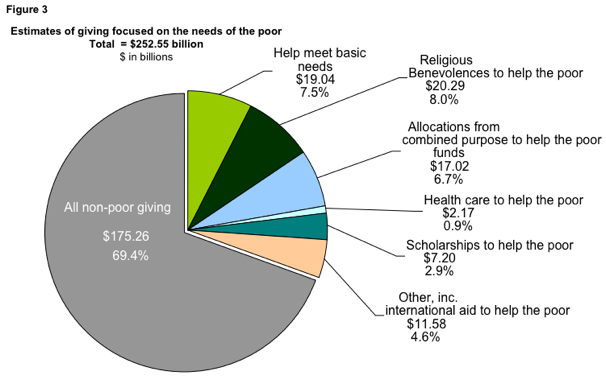

Source: Google; http://www.washingtonpost.com/blogs/wonkblog/wp/2013/05/30/only-a-third-of-charitable-contributions-go-the-poor/

In recent times, our national budget has been about 1/4 of the nation’s GDP–$4 Trillion vs. $16 Trillion. So, a very rough adjustment is to say that philanthropy is equivalent to about 8 percent of the national budget, and that the portion dedicated to the poor is equivalent to about 3% of the national budget.

Perhaps the lack of attention to the question is already answered by simply seeing the magnitude of philanthropy.  By comparison, the 2013 US federal budget proposed 20 percent for social security, 19 percent for defense, 16 percent for unemployment, welfare and other mandatory spending, and 21 percent for medicare, medicaid and related programs. So, by comparison to any of these, regardless of whether they have been cut, 2 percent of GDP or 8 percent of the national budget pales by comparison, not to mention 1/3 of this amount, the portion going to the poor.

So, it appears that philanthropy cannot possibly make up for any significant changes in social support programs.

But a few questions remain, just to close the subject:

What has been happening as wealth has been increasing so dramatically for the ultra-rich? Has philanthropy been increasing dramatically?

Source: National Philanthropic Trust: http://www.nptrust.org/philanthropic-resources/charitable-giving-statistics/

The answer appears to be yes, indeed, a nice increase of 100% or so since 1972! But, hold on, GDP in 1972 was 1/3 of what it is today, also in inflation-adjusted dollars–so, the growth in philanthropy has not kept pace with GDP growth.

Given that wealth to the top 10 percent has grown faster than GDP across these years, this suggests that the ultra-wealthy have not increased their giving in concert with the growth in their wealth. Take a look at the comparison done by Piketty and Saez, two of the foremost scholars on the subject of inequality.  For 30 years between 1950 and 1980, the incomes of the lower classes (the 0-90 percent group in the left most column) advanced nicely, even more than the percentage increases among some of the wealthiest. Note that the wealthy did not suffer, however, they just yielded a little equality to those of lower incomes.  However, for the 28 years since, the trend is reversed. The incomes of the 0-90 percent increased only 1 percent, while those in the top 1 percent increased their incomes between 81 percent and 403 percent.

Source: Piketty and Saez in http://www.wweek.com/portland/article-17350-9_things_the_rich_dont_want_you_to_know_about_taxes.html

I acknowledge that this comparison needs more work than I have put into it. These numbers are far too aggregated, and the analysis would benefit from more segmented data and comparison. For example, it would be ideal to have the philanthropy of the top 10 percent, 5 percent and 1 percent, to be able to compare that to the advances in incomes displayed above. I also want to point out that the Google analysis appears to focus only on what is going out from donors–thus not including what may be coming into large wealthy endowed foundations for distribution in future years. To be complete, this kind of analysis needs to consider that, as well.

Nevertheless, it seems that the basic question is answered: The amount of annual giving philanthropy in the US has not increased in parallel to the increase in wealth to the ultra-rich, and the amount of philanthropy, particularly considering the small proportion of it targeted to the underprivileged, cannot possibly fill any meaningful gap in shortage of support to the underprivileged in the US.

My conclusion: Much to the disappointment of neoliberals, here is another example where the private market, left uncontrolled, will fail the needs of the state–unless, of course, you hold the view that we need not spend anything much to help the underprivileged. I argue some engagement from the state is necessary.

Note that the Scandinavian democratic socialist countries such as Sweden have managed rather well in terms of prosperity, growth, and happiness of their citizens for a considerable period of time. England has a national health system, and the costs of that system are below our private insurance market based system, and it works as well or better than our system in many ways.

I’m not promoting socialism for the US, just noting that our fears of government are not justified by comparison to other countries.

However, we must press forward on all fronts and be practical. Until/unless some improved government solutions can be effected, we must work with the wealthy to continue to grow their contributions and help them to meet both their personal charitable preferences and also collaborate with government and other philanthropists to better address the needs of the underprivileged. According to Thomas Piketty and many others, we appear to be in a long term trend toward increasing wealth at the top.

Regulation Can Work–Capital is Responsible for its Ills

April 10, 2014

Anyone reading my recent posts will predict that I want regulation, because deregulating is one of the key precepts of the neoliberal economic philosophy, and from earlier posts, it is clear that I am among those who feel the broad set of neoliberal principles has served us poorly in recent decades, and needs to be re-balanced.

Indeed, I recognize a need for regulation in a number of areas in this increasingly complex world, regulations assuring food and chemical safety, medicine, architecture and construction in seismic zones, the environment, and banking certainly need regulation, as well as other areas.

However, I am in many respects a critic of regulation. Regulation has extended in many areas to a highly burdensome level, with little gained. People in many fields report that a very significant amount of their time is now dedicated to filling out reports, and that it is not evident from many of them that there is any significant improvement in safety. Some of this comes from fear resulting from an incident (overcorrection), some comes from lack of experience in the field (such as banking) by those constructing the solutions, and some may come from other motivations such as I describe below in the banking example.

Let’s take banking, a field I understand better than some others, having spent a career in it. If anyone reading this has taken out a mortgage in recent times, you know there now are numerous documents you are required to address. There are others the bank must provide and submit behind the scenes. And, there are regulations that slow the process and likely often prohibit many banks from making creditworthy loans they used to make, and most certainly make the banks very slow in meeting customer needs.

We could live without a number of those burdensome documents and rules.

How?

For example, let’s consider just a few rules which would provide far greater protection than the burdensome and time consuming reports and rules:

1.  Let’s separate even more clearly the fundamental banking process serving consumers and businesses from the trading and other speculative activities some of the larger banks participate in. If the latter activities are spun off entirely into separately owned entities, shareholders and depositors in the fundamental bank will be far less at risk.

2.  There is no good reason for banks to be allowed to speculate in commodities, such as food products, or in minerals and chemicals. This activity can be left to entities which do not accept deposits.  For customers who want to participate in such speculative activities, they should have a minimal net worth and acknowledge the risk they are taking. There should be no bailouts for failures of such entities.  Some of these protections are included in Dodd-Frank, but with far less clarity than I recommend.

3.  Capital requirements of banks have been raised. They can be raised further.

4.  For deposit taking institutions, a minimum down payment on mortgage loans is appropriate–at least 15 or 20%.  Private entities not allowed to take deposits can offer more aggressive mortgages, and we should not bail them out, if they fail.

5.  Simple rules requiring retention of a significant portion of every loan made–e.g., 25%, will do wonders to better assure the underwriting is carefully done. Sometimes it’s just too easy to sell a weak loan to others, and with only 10% retained on the books of the originating bank, that bank can afford to lose a few of those. But, 25% retained is sufficient to assure that the pain of a loss will be anticipated and will hurt.

This list of five is not intended to be a comprehensive proposal for regulating banking, to replace the Dodd-Frank legislation, the regulatory version of which is now approaching 20,000 pages. However a few dozen rules like this can provide far greater protection to depositors and the financial system of the US, and can save billions of dollars being wasted on burgeoning compliance departments of banks, expanding bank regulatory agencies, and hordes of accountants, lawyers, and consultants, as well as improving and simplifying the lives of all of us being regulated or on the other end of that process. These kinds of rule require very little paperwork and compliance personnel–either in the banks or in the regulatory agencies.  They don’t require lawyers to interpret them.

The irony of the conservatives complaining about regulation is two-fold in my opinion:

First, the economic disaster which precipitated the latest round of banking regulation was initiated in both Democratic (Clinton) and in Republican (Bush) administrations. It exploded under Bush. Had we not experienced that huge economic disaster, we likely would not have had the 20,000 pages.

According to economists, the neoliberal policies expounded mostly by Republicans or Neoliberals do indeed tend to result in periodic booms and busts–more so than the policies of Democrats or Keynesians.

Second and even more interesting is this–faced with the political demand from such crises that the system be better secured, financial capital is motivated to work through lobbyists to avoid the simple kinds of solutions described above, in favor of the complex solutions of such bills as Dodd-Frank. Of course, they’d like to avoid all additional regulation, but faced with the political certainty of more, they scramble to minimize the profit or return on equity expense of it.

The likely reason is that the actions described above are perceived by financial capital to have a more significant impact on profits and return on equity than the burdensome regulation.

After all, if minimum capital must be increased, the leverage of banking decreases, and it is the leverage of banking which enables the huge profits. Return on equity will decline as equity is increased, of course.

Similarly, if a bank is required to keep 25% of a loan they originate, sell off no more than 75% to other banks, preferring to sell 90% of it, they forego the profits on the additional 15% they would like to sell. Selling loans to others has two benefits to banks–there is often a “spread” or a fee financial advantage.  My loan at Prime + 1% can be sold to other banks at P + 1/2 and possibly a fee to me (after all, I did all the work to originate it). Thus, my gross yield on the 10% retained may climb from P+1% to P+5%. Another benefit is that selling off portions of loans I make helps to diversify my risk–I end up with smaller exposures, so that if something unexpected goes wrong with the borrower, I only have to suffer only a small portion of the loss.

However, when the portion retained is very small, the motivation to be careful and underwrite to avoid loss, is somewhat reduced.  Financial capital would argue that there is no significant diminution in underwriting and that the additional profits from selling off most of the loan are appropriate and deserved by the underwriting bank. But, if not at the loan officer level, then perhaps at the CFO or CEO level where the aggregates are calculated and where underwriting direction emanates, such structural exposures matter.

In these ways, I argue that financial capital (the equity interests and the top management of banks), lobbies heavily to avoid such simple forms of regulation, in favor of regulation which is costly and burdensome–the net result being more profits to bank shareholders and most likely more remuneration to bank CEOs.

So, when bank CEO’s and bank investors complain about the cost of regulation, bear in mind that there are indeed far less burdensome alternatives, alternatives far less expensive in terms of staff and consultancies and lawyers and accountants, much better for customers–but, perhaps a bit more expensive in terms of a little reduction in return on equity and perhaps top management compensation.

By the way, this is one of the ways we can enjoy a gradual redistribution of income and wealth in a nation approaching the highest levels of inequality in the world.  A little less for capital improves the balance.

I argue that the system would be much better off with a little less return on equity, a little less compensation to bank CEOs, and a substantially less burdensome regulatory structure.

10 Myths Propagated by Neoliberals

April 9, 2014

Neoliberalism is a political philosophy which is to the right of the economic spectrum. It originated in the 1930s and 1940s with such scholars as Friedrich Hayek, who proclaimed an approach in opposition to the dominant economic and political philosophy of the time–Keynesianism.  While the term is specific for economic historians, this philosophy has evolved to best identify today with the key precepts of the political Right. From my list below, it will be easily seen that this political philosophy is largely characteristic of that of the Republican party.

I do not consider myself a Marxist or a socialist. I think capitalism is the best economic system known.  However, that doesn’t mean it is perfect in the sense of universally serving all needs, especially when unrestrained or relied upon as the only tool for sustainable growth–but that is generally the position of neoliberals. I believe there is a role for government–to meet the needs which private investors are not prepared to meet (without substantial government subsidies), and to govern and manage the free market such as to do our best to avoid or correct for abuses of the free market.

A few of the most crucial myths which neoliberals have sold to much of the American public:

1.  That the uncontrolled market is best for everyone–we should reduce or eliminate the influence of government except in very limited areas.

The uncontrolled market brought us the global recession of 2008 to the present. Culprits included complex mortgage securitization instruments. Major financial institutions failed and citizens lost critical amounts of savings and were left with very low fixed income returns for years thereafter. While the wealthy also lost in the first stage of the recession, those at the top end of income and wealth gained dramatically during the recovery, while the middle class did not, and many are still unemployed.

2.  Reducing taxes is always beneficial to the economy and to citizenry.

Neoliberals have lured the middle class and the poor with the siren song of reducing taxes, which behind the scenes is called “starve the beast.” The beast of government, when starved, is forced to cut whatever is discretionary, which usually includes public schools, infrastructure, and any social support programs.  So, the lesser privileged end up voting in the small tax savings (big tax savings for high earners), with the unexpected end result that their critical services are lost.

3.  Reducing taxes always results in savings which go into investment and creates job–that’s the “trickle down.”

There hasn’t been any substantiation in recent years to the arguments made by Art Laffer and others. In fact, it appears that much of the savings increasingly going to the wealthy through tax reductions is going into liquid investments, expensive multiple homes, art, and the like, and relatively little into investments creating jobs for the underprivileged.

As to the trickle down, evidence such as this picture of income growth for the wealthy since about 1970 clearly shows that there has been no trickle down–it’s all been flowing up.


Source:  INCOME INEQUALITY IN THE UNITED STATES, 1913-2002*

THOMAS PIKETTY, EHESS, Paris EMMANUEL SAEZ, UC Berkeley and NBER 2004, Fig. 11.

4.  Government is almost always poorly managed vs the private market, which is usually well managed.  Government leaders are “bureaucrats” who will simply do what is in their personal best interest.

History is replete with exceptionally competent government leaders in many nations.  Business is also replete with many leaders who have had less than admirable character or competence. While government generally doesn’t have the competitive pressure that sometimes motivates efficiency in private enterprise, not everything can be accomplished by competitive forces. We can’t have two airports built in competition or two parallel highways built in competition. Furthermore, who can argue that it is entirely appropriate that the top 10 CEO’s last year earned more the $100 million each?  Can this really be argued to be “efficient,” in the best interest of shareholders and the public?

5.  Incentives in the form of bonuses, stock options, and the like are necessary to motivate good management, and even to motivate people to work hard or do the right thing.

I worked in the trenches for years before those kinds of rewards were available to me. I don’t remember lacking any motivation then, or gaining more motivation when I did have access to those. There is something in most of us which wants to do the right thing, advance and improve the area of responsibility we have.  This is not to argue against incentives, although some of those have reached outrageous proportions, such that we are left to wonder just how much more effort and focus was provided for the difference between perhaps $10 million and $100 million in compensation for those top CEO’s last year. This is to simply ask recognition that financial incentives are not the only motivation for good work–and/or that those incentives have advanced to well beyond what is necessary to keep leaders hustling.

6.  Liberty is the ultimate positive to be achieved, meaning that any form of collectivism is to be avoided because it means I have to accept some limits on my freedom, just in order to achieve the betterment of someone else in society.

There are times when my total freedom means less freedom or opportunity for someone else.  Along with freedom to worship as we please and freedom of speech, neoliberals have added freedom from taxes, freedom to have and carry a gun, and freedom to treat employees as commodities.

7.  Open borders are always better than any form of protectionism.

It is disingenuous for the US to continue to promote this key element of neoliberal economic philosophy, considering that in the early decades of our own industrial development, we used protectionism heavily to enable the nurturing of our infant industry. So did Japan, Korea, Taiwan, England, and most other developed countries. Furthermore, even at our now advanced industrial state, we continue to protect our industry, even to the extreme of providing subsidies to well-to-do US farmers who cannot otherwise compete with foreign agricultural products, as just one example. Yet, we continue to ask other nations to take down their border controls. Global trade is a good thing, but it needs to be managed, sometimes uniquely by each nation, weighing all consequences.  The US should also yield power in IGO’s to a better representation of the developed and developing world–the WTO is a good example.

8.  Private markets can handle most all the needs and ills of society, and do so far better than government.

A good example might be the evolution of housing policy for those without homes. Across the last 30 years in both England and the US, there has been a massive move toward moving housing for the poor to the private sector, using tax benefits and reduced regulation as the carrots.  This has not had the intended effect–we have seen no improvement overall in the quality or accessibility of housing for the poor.

Consider schools and infrastructure. Are these also all going to be best handled by private capital and/or by philanthropy? The ultra wealthy can use helicopters to avoid traffic and poor roads, private airports and private jets to avoid tired airports, and private schools to avoid the malais of our public schools.

It does not seem evident that private markets can do it all.

9.  Inequality is really a good thing–because it means we have maximized the incentive motivation, which is at the heart of capitalism.

To a degree, inequality IS a good thing, but inequality in the US has risen to among the highest in the world, a dramatic increase since the 60s and 70s when we were relatively egalitarian. Across this period, income and wealth have flowed to the wealthy while wages have stagnated for the middle class and the poor. I do not argue to eliminate incentives, just that the pendulum has swung too far. See the work of Emmanuel Saez of UC Berkeley in regard to taxation. There is little evidence that a higher tax rate on the wealthiest would result in significantly diminished incentive, investment, or economic growth.

10. Any form of redistribution is harmful because it diminishes the equal opportunity that everyone has in this country to succeed.

There are many forms of redistribution, and the choices need not take what has been gathered to date by the wealthy, but simply adjust some of the future incentives (e.g., capital gains taxes, wealth transfer taxes, carried income taxes, certain deductions, taxes on the earnings above a very high level) that uniquely benefit those of high income and wealth. A little less flowing to the highest incomes can be directed to better enable equal opportunity for everyone else.  There are a number of economists who also argue that economic growth is slowed at very high levels of inequality. Plus, there are non economic (moral, societal) reasons of improving the lot of the lower classes.  And, we potentially forestall a revolution, such as we have seen in a number of other countries.

There are more than 10 myths, and there are more arguments to show the weaknesses of the comprehensive neoliberal philosophy which has evolved across the last thirty years.  This post is simply intended to provoke some thought from all of us regarding a few of the examples of failure.

The pendulum has swung too far to the Right!

CEO Pay

April 1, 2014

In the New York Times on March 29, 2014, Deborah Hargreaves comments on the growing pay gap between CEOs and the median compensation of their employees (http://opinionator.blogs.nytimes.com/2014/03/29/can-we-close-the-pay-gap/?smid=fb-share).

She reports that in 2012, the pay of S&P 500 CEO’s was 354 times that of their rank and file! Last year, the 10 highest paid CEOs took home more than $100 million each. In the early days of the 20th century, JP Morgan thought the ratio of CEO pay to median worker pay should be no more than 20:1. In the 1970s, Peter Drucker thought that was still a good limit. Yet, since the 70s, we have only sharply advanced that ratio.

Arguments from the right are that we should not tinker with the market. Let the invisible hand do its work. Limiting CEO pay, they argue, will only drive the best CEOs out of the US to other jurisdictions.

Hargreaves reports that a survey of actual practices finds little support for that notion. There is just not that much international movement of CEO’s.

Hargreaves finishes without a strong policy recommendation. I do the same. It is not yet clear to me that a regulatory limit is the right solution to this clear inequity.

However, it is a valuable step for us to all recognize the magnitude of the problem. Wealth and income gains for the top 10 percent have grown significantly, while the real wages of middle class and poor have advanced very little across the last thirty years.

Two suggestions Hargreaves reports deserve consideration: Full disclosure of CEO/median pay by all public companies; and, a German practice of installing a company board made up 50 percent of workers, with the authority to establish CEO compensation.

Anyone who has worked in the business sector and has had access to the variety of major elements of compensation (salary, bonus, and stock options) certainly knows that attempts to structure compensation to clearly and directly reward or punish success and failure, is fraught with assumptions and guesses, and often fails to achieve the objective, as the real world twists and turns after such commitments are made. Often, it turns out that the chosen measures of success yield more to the economic and competitive environment than to the talent of the CEO. Likewise, it is also true that CEOs do sometimes lose their jobs when such uncontrollable factors are the cause of failure–i.e., no one could have done much better.

Often rewards are tied to short term performance, and/or to stock price performance. No one could have won on stock price in 2008, and no one could have failed in 2013. It’s not quite that simple, but almost.

Why would it be problematic to report in great detail to shareholders, just how CEO and other top officer pay compares to the median wage of the company? What could be wrong with including all forms of compensation, including bonus, stock options, use of the corporate jet, and any other forms of compensation (executive pensions, golden handcuffs, etc.)? What could be wrong with that?

I’m sure some on the Right will argue that shareholders simply won’t understand it, and it will only incite concern, rancorous shareholder meetings, and controls that do not reflect market condition in an increasingly globalized world.

In my opinion, we need some rancorous shareholder meetings, and it’s not in the spirit of competitive markets to deny the owners of the business (shareholders) all the information they need and the opportunity to decide the corporate pay at the top levels.

On my way around town this morning, thinking on this and related issues addressed in this blog, I was motivated to leave larger tips for the baristas and others who serve me–considering how poorly we have protected the opportunity of our citizens at those pay levels.

Regrettably, individual tipping and philanthropy will not be sufficient to enable the rebalancing we need to secure the sustainable future of our nation.

Foreign Policy–Should the US Act as Unipolar World Leader?

March 21, 2014

In 1990 Charles Krauthammer wrote an article in Foreign Policy Magazine, entitled “The Unipolar Moment.” In this now famous article, he accurately laid out the clear proposition resulting from the collapse of the Soviet Union: “The immediate Post-Cold War world is not multipolar. It is unipolar. The center of world power is the unchallenged superpower, the United States, attended by its allies.” At that time, US power was at it’s multi-dimensional power peak.  We didn’t need to consult any other power. We could unilaterally do whatever we wanted to fix the world’s problems. Our allies would quickly fall into line. Our enemies would withdraw. Our power was beyond question.

Writing on March 20, 2014, 24 years later, in an op-ed in the Washington Post, Krauthammer seems to have overlooked all that has happened since 1990. He needs to update.

In this article, he lambasts President Obama for failing to send military aid to Ukraine, presumably to prevent Russia from annexing Crimea, as indeed it has done. Krauthammer is not alone in such arguments. He is joined by the likes of John McCain, Lindsey Graham and others on the hawkish Right of American politics.  These critics do not even mention the need to consult other powers.

There are three contrary points to be made to Krauthammer and those who would have us double down in our efforts to be the unipolar military policeman of the world:

1. The US is no longer the unilateral unipolar power.
2.  Our military actions around the world have yielded little other than lives lost and budget deficits.
3.  The American public is not in favor of military engagement.

The US is no longer the unipolar power. The early nineties represented a unique period of unipolar power for the US. Global power is calculated by most scholars in terms of three considerations: Military power, economic power, and soft power (including ideology, foreign policy, and all other factors of global perception).  In all three areas, the US has lost its advantage, and at the same time a number of other nations have advanced in terms of one or more of these factors. Examples include China and India, Brazil and Turkey, Mexico and other countries.  US has suffered in the failed attempts of two wars, and in developing a huge budget deficit, triggering a global recession with its mortgage financing debacle, and becoming politically weakened by the obvious gridlock in our partisan Congress. Our form of government has been challenged by the success of China’s benign dictatorship and our attempts (e.g., the “Washington Consensus which drove IMF and World Bank’s largely unsuccessful policies in the 90s).  Our attempts to proselytize the combination of democracy and our form of capitalism as only end game of government has not been well received globally.

Thus, we have found ourselves forced to share power with others, due to our losses and their advances. They have insisted in bodies such as the United Nations Security Council, the World Trade Organization, and elsewhere.

This transition from unquestioned unipolarity toward a possible multipolar global order can be regarded as tragic, or it can be regarded as inevitable–no nation in history has been able to hold the unipolar position–it yields to multipolarity, or a new lead country comes to power.  It can also be regarded as healthy and in the best interest of the world, given that the US actions in trade and foreign policy are unavoidably heavily influenced by interests which are seeking US advantage primarily, as indeed are the interests of any single nation.  Isn’t it abundantly clear that a world government, at least ideally, would be better able to assure global fairness of trade, deal with health epidemics, the global environment, scarce resources, and matters of abject poverty and human welfare–better than any single country, such as the US or Russia?

Some think China is already the power for this century. This is another long debate, but the essence is that China is not ready to take over unipolar world leadership, and will not be for at least another thirty years, in the opinion of many respected scholars. Goldman Sachs says so, also! This is because of the Chinese view of the world and also the challenges they face in sustaining the growth of the world’s largest country, while facing issues of corruption, inequality, pollution, inadequate water, and being surrounded by nations with which they have had wars, and other challenges, with few allies.  Sustained strong growth is necessary to create 20 million or more additional jobs per year. Falling far short of that risks political instability for China.

While relatively weaker than in 1990, the US remains by far the strongest nation, stronger than any other collection of nations, and supported by an immense alliance of allies. This strength clearly exceeds that of the EU, the Shanghai Cooperation Organization, Mercosur, ASEAN, NAFTA, SELA, OPEC, or the “BRICS.”


Nevertheless, the power of the US can no longer be seen as unipolar in the sense of its status in 1990. Most foreign policy experts agree that the US must now collaborate with a number of other countries to effect the best answers to the evolving challenges of the world.  These growing countries insist on having a voice in major world affairs–and some don’t agree with the US in its actions–in Egypt, Syria, Iran, now in the Ukraine, and elsewhere. In fact, many of us realize the power of the US in world governing organizations is too great–a greater voice must be given to emerging powers and to the developing world–we don’t have all the wisdom!

Of course, achieving agreement in IGO’s is time consuming and laborious. The Right would seem to prefer quick military action.

Yet, our military actions around the world have yielded little other than lives lost and budget deficits: Estimates put the loss of US lives above 6,000 and the total cost of the two wars from $4-6 Trillion, $75,000 for every American household, with many of those households in the precarious financial position that this amount of money might have made all the difference–food, child care, education, not to mention what it might have done for poverty in Sub-Saharan Africa. The failure to achieve desired results abroad has damaged the global perception of US unipolar strength which existed when Krauthammer first wrote of it. These failures in war suggest to other nations that our military strength is not effective, notwithstanding all the dollars spent, and that our foreign policy and strategy left these countries dependent on the US and allies, while still riddled with corruption and internal conflict even after our withdrawal.

Third, I have not met anyone across the last few years who wants to send troops to Egypt, to Turkey, to Syria, to North Korea, to Iran, to the Ukraine, or any other of the many places in the world where there is conflict and mistreatment of humanity.

It’s not that we don’t care. Most of us do. That’s why we support increasing and improving our foreign aid (another hotly debated subject). That’s why we support strengthening the International Governing Organizations (IGOs). That’s why we support people like Obama who believe in the collaborative efforts of governments around the world–no single policeman acting unilaterally.

It’s also that these situations are invariably complex. They are thousands of miles from home, in cultures we little understand. And, by reason of our moral commitments to the methods of war and also international agreements, we choose not to cavalierly use methods that risk civilian lives, or use weapons such as chemical or nuclear. The political landscape is hard to understand and is constantly changing. We can’t easily identify the good guys and the bad guys. If we could isolate just the bad guys and properly remove them, that might do it. But, as an example, what if the bad guys were properly elected, as in the case of Egypt, or Yanokovich in the Ukraine? Do we feel we should override the elected decisions of a people?

While Russian action in Crimea is not appropriate, they do have some very strong arguments on their side: Yanukovich was elected. Crimea is largely Russian speaking and wants to be part of Russia. It’s not a black and white situation, as few are.

The point is, we are not able to be effective in achieving reasonable goals of improvement in most cases. And, it’s not just that the US in not capable, it’s that any country so far away trying to aggressively intervene is not likely to be any more successful than we. But if there is a chance of best trying to right the wrongs of distant places in the world, how can anyone argue that it’s not the job of world organizations to do that? Of course, some will say they can’t, or they won’t, so forget that–someone has to have the guts to step up.  I’d vote for that if the record from Vietnam on did not so clearly demonstrate that we can’t.

Finally–there is the nature of political discussion around matters like this:

The irony of such political rhetoric is that it is often cloaked in criticism of our weakness in threatening sanctions and then imposing what is seen as only weak sanctions, thus arguably resulting in our prestige and the importance of our “power” in the world being diminished–i.e., we say you’ll be punished if you do that, and when they take the forbidden step, we do little.

Yet, when these advocating for boots on the ground or even guns and weapons being delivered to those opposing what we see as invasion, or (as in Syria) what we see as crimes against humanity, etc., do they acknowledge that these steps also constitute threats–threats that if our foes do not stop whatever we object to, we will rapidly step up such aid or put (more) boots on the ground? These are also threats. Do they intend to “threaten” in this way, but stop at some line short of true military action such as we have seen in Iraq and Afghanistan? Is this kind of threat without action not a worse kind than the threat of diplomatic or economic sanctions? Or, would these critics intend to follow up with war? Could it be that some of these hope we will sufficiently provoke to justify yet another war? Why? The only beneficiaries of that are the military industrial complex.

I will have a great deal more respect for such critics if they will publicly state either (a) where they would stop (and any stop arguably creates just another empty threat–which they apparently oppose); or (b) that they would go the whole way into war if the desired action is not taken.

Hawks–there is no value to criticizing “threats” unless you answer these questions regarding your own proposed threats.

No matter whether the critic is on the Right or the Left, whenever I hear a litany of what was done wrong, I hope, but never seem to hear exactly what the critic would have done if he/she were in the deciding role, and certainly never get that final piece, e.g., “…and if military supplies do not turn the tide, I would then….”

Joe Stiglitz Raises Important Globalization Issues

March 18, 2014

Joe Stiglitz, former Chief Economist of the World Bank, hardly a liberal institution, posts an article in the March 15 issue of the New York Times.

Here is his concluding summary on the question of whether unfettered global trade, as pursued by the Trans-Pacific Partnership (“TPP”) is a good thing for the US and the world:

In this series, I have repeatedly made two points: The first is that the high level of inequality in the United States today, and its enormous increase during the past 30 years, is the cumulative result of an array of policies, programs and laws. Given that the president himself has emphasized that inequality should be the country’s top priority, every new policy, program or law should be examined from the perspective of its impact on inequality. Agreements like the TPP have contributed in important ways to this inequality. Corporations may profit, and it is even possible, though far from assured, that gross domestic product as conventionally measured will increase. But the well-being of ordinary citizens is likely to take a hit.  And this brings me to the second point that I have repeatedly emphasized: Trickle-down economics is a myth. Enriching corporations — as the TPP would — will not necessarily help those in the middle, let alone those at the bottom.” (http://opinionator.blogs.nytimes.com/2014/03/15/on-the-wrong-side-of-globalization/?hp&rref=opinion)

There are many who believe unfettered trade is a good thing–pure and simple. It certainly can be, but there are many occasions when it’s not so simple. 

Start with answering a question: What outcome to increased trade would be considered good? Is it sufficient for trade to result in GDP growth? Is it sufficient for corporate sales and profits to grow? Or, is it necessary or important to also consider whether the particular trade that is actually implemented, with all its unique rules and regulations, results in loss of jobs and therefore increased inequality and poverty? I think the answer has to be that these impacts of trade must be considered to determine whether the particular trade envisioned is good.  

One of the best scholars on this issue is Ha-Joon Chang. In his “Kicking Away the Ladder: Infant Industry Promotion in Historical Perspective,” 2003, he documents the behavior of countries like the US, Japan, Korea, and other of the now wealthy variety, as they faced the early development challenges now faced by today’s developing countries. All of these used aggressive protectionist tactics in the early days to enable nurturing young businesses which would not have had the chance to develop if they had faced unrestrained competition in the early days. Now, having graduated to a level of high GDP per capita, the same group is attempting to impose on others a set of limitations which they themselves did not accept at the equivalent stage of their growth.

Furthermore, Chang point out in this treatise that, “Whatever the intention behind the ‘ladder kicking,’ the fact remains that these allegedly ‘good’ policies have not been able to generate the promised growth dynamism in the developing countries during the last two decades or so” (p 29).

Stiglitz is not only arguing for some compassion in regard to the developing countries. He has pointed out in other works, such as his The Price of Inequality (2012) that opening borders indiscriminately can also be bad policy in developed countries.  When relaxed regulations make it easy for US manufacturers to quickly moved production from the US to China, and then when wages rise a bit, from China to Bangladesh, there can be populations of workers who are unexpectedly displaced and need help to be re-trained in order to tackle some job higher up the food chain–help they are not getting under policies implemented by Reagan and now aggressively supported by Conservatives. Conservative policies tend to assume that what is called “flexible labor policies,” a misnomer for “let the company do whatever is in the best interest of shareholders only, with no obligation to dismissed employees” are the answer to everything. 

Stiglitz finishes the article by reminding us that this kind of “trickle down” theory has not worked. 

If it worked, would we have record levels of inequality today? We have seen record GDP and wealth creation, especially for the top 20%, but little for the middle class and below.  

It’s really that simple as it relates to the “trickle down” theory.

George Will’s Misinterpretation

March 17, 2014

In his Washington Post opinion of March 14 (http://www.washingtonpost.com/opinions/george-will-democrats-policies-make-income-inequality-worse/2014/03/14/97d5074e-aada-11e3-adbc-888c8010c799_story.html?hpid=z2), George Will, no friend of Democrats or Barack Obama, seeks to fault the policies of Democrats in trying to find an avenue to reduced inequality.

Inequality is a recent development here in the US.  Forty years ago, we were one of the most equal countries, and in this short time, we have moved to one of the most unequal, thanks in large part to conservative policies driven by the likes of Reagan, Friedman, and now by the likes of George Will.

While inequality (essentially resulting from incentives which motivate hard work and creativity) is a good thing up to a point, a growing number of highly respected economists, as well as social scientists, medical experts, and others, are arguing that very high levels of inequality, such as we have today, result in many negatives–reduced economic growth, psychological distress to the lesser privileged, health issues, and a general discontent with the fairness of the system. These things can eventually lead to revolution, and indeed there is much world history to evidence this risk.

Let’s examine Will’s points in his article. There are three.

He starts with criticism of the continuance of farm subsidies totaling $956 billion. With this criticism, I wholeheartedly agree. We are not only subsidizing crops we shouldn’t even be growing, enriching already wealthy farmers, but also denying parts of the world which are much better suited in climate and labor costs to supply our cotton, rice, and other subsidized farm products–parts of the world in abject poverty, in which these agricultural products represent one of the few ways for their poor populations to earn a bare essential living. The question we have is how does Will determine to lay the blame for this on the Democrats? Farm subsidy programs have been in place for decades, supported by far more Republican than Democratic votes, paid for by the lobbyists for large food and agricultural interests. I would say it is much more clearly a Republican program. Take a look at a CATO Institute examination of Republican support for farm subsidies (http://www.cato.org/publications/commentary/republicans-are-weak-farm-subsidies): “…24 of the RSC’s 165 members sit on the House Agriculture Committee, the notorious overseer of farm-welfare programs. Total direct government farm payments to the districts of those 24 [Republican] representatives alone costs taxpayers more than $1 billion per year. Numerous other RSC members hail from farm states, and therefore have a vested interest in protecting payments to their constituents.”

Next, Will wants to attack food stamps, moving rapidly from there to welfare in general. He says we spend $1 trillion annually on welfare. It’s not clear how Will adds up his numbers. Other sources (http://www.usgovernmentspending.com/us_defense_spending_30.html) compare key US spending categories this way:  Welfare $396 billion; health care $970 billion; defense $820 billion. The International Peace Research Institute reports that we spend more than the next 10 countries combined on defense (http://www.nbcnews.com/storyline/military-spending-cuts/u-s-military-spending-dwarfs-rest-world-n37461). Let’s talk about reducing not only farm subsidies, but also defense spending and use the savings to spend more on schools and infrastructure.

And, the implication of his treatment of welfare is that welfare is not helpful in reducing inequality.  He seems to feel welfare is a waste.  Welfare programs can do with improvements, but successful nations do and must provide a safety net for those who are disadvantaged or are unable to work. I’m sure there are many on the right who would like to summarily identify those on welfare as “simply lazy,” but this is clearly not the case. Millions of Americans are lining up to apply repeatedly for scare jobs every day.  More on why we have such unemployment in future posts.

Will is right that the welfare program of the US is tilted toward the elderly, in terms of medical and social security payments, but he is not necessarily right that welfare is bad in general. And, again, this misallocation toward the elderly was not initiated by the Democrats–it has been true for decades since Medicare and Social Security were enacted. It was not taken down by Regan, or the either of the Bushes. Let the Republicans try to change the elderly orientation of welfare–their challenge will be as great as that of the Democrats–this is now motherhood and apple pie in the US. The elderly have the time, the money, and willingness to engage in politics–to fight a good fight, which the young do not have. I doubt the Republicans will bring on that fight, should they inure to majority in US leadership.

His third and final point is to attack the low interest rates of the Obama era as undermining equality by paying only low interest rates to the pensioners. He’s right about this. But, what were the policies of the Bush/Greenspan era which led to the crisis, which resulted in the need to manage interest rates at similarly low levels in the years leading up to the 2007 collapse?  The Democratic administration’s low interest rates were necessitated to enable a recovery from the worst financial disaster since the Great Depression–a legacy of Republican leadership. Congress was unwilling to do much of anything of a fiscal nature, leaving the Federal Reserve with the burden of trying to revive the economy with monetary policy alone. Those low interest rate policies under Bush and Greenspan were designed to artificially motivate the middle class to buy more homes, take out second mortgages, buy more cars, and keep the economy growing–that was the Bush/Greenspan 2002-2007 set of policies. This eventually resulted in a massive bubble which had to be addressed by the Obama administration.

There are certainly things the Democrats could have done better in the Obama term, but George Will is wrong and unfair in attempting to place unique blame on the Democrats in regard to these elements of policy.

From his choice of complaints, I would say the better discussion around these points would be around whether these problem areas are the fault of Democrats or Republicans, and how these kinds of vested interests can indeed be overcome to make changes for the common good. In terms of the present administration, the discussion might be about whether it is Obama’s fault that Congress is gridlocked, or whether that is more the fault of the right wing of the Republican party. More the latter in my opinion.

High Inequality Restrains Economic Growth

March 10, 2014

In his op-ed of March 9 in the New York Times (http://www.nytimes.com/2014/03/10/opinion/krugman-liberty-equality-efficiency.html?hp&rref=opinion), Paul Krugman provides a quick summary of the scholastic history of a key question: Whether high inequality restrains economic growth.

The Krugman article speaks well for itself, so I will only add a brief observation here, hoping you’ll look at the article itself.

Krugman is very reasonable in his position. He’s not proposing a huge redistribution from the wealthy. He’s not disputing the value of incenting everyone to excel by rewarding the successful with the fruits of their labor.

He’s simply saying that at very high levels of inequality, such as we are currently experiencing, there is a restraint to economic growth. Putting a little more income in the hands of the lesser privileged will result in spending, which will grow the economy.  This is good for everyone.

It simply does not appear that allowing the wealthy to continue to aggregate unlimited amounts of wealth is resulting in what the conservative economists and politicians of the Reagan era and beyond have been extolling–that the wealthy would invest it in production and this would result in jobs and “trickle down.”

In fact, as shown in previous posts here, there has only been a significant “trickle up” across the last 30 years.

More research needs to be done on Krugman’s last point in the article. Isn’t it possible such growth enhancement stimulated by a little redistribution actually results in more wealth for the wealthy also? Is it necessarily true that the efficiency of selective forms of gradual redistribution is such that the wealthy lose a little, as he acknowledges is possible? For example, if I get A% of B $ GDP now, maybe C% (a little lower) of D $GDP (a little higher) will be a larger number for me…?

But, even if this is not true, a very modest loss to the ultra wealthy is worth it for the common good of all, and also as prevention to the ultimate risk of revolt and revolution.  And, this is not a loss of existing wealth, only a little loss in the rate of future wealth growth.

The Puzzle–Why Haven’t the Losers Across The Great Divergence Protested?

February 26, 2014

As inequality has steadily increased (worsened) since around the 1970’s the question is, why hasn’t there been more of a popular backlash against it, from the middle and lower classes?

It can’t be because they haven’t felt it. The cost of higher education has increased across that period at approximately 2 1/2 times the inflation rate. Inflation alone would justify the $10,000 cost of a college degree in 1986 rising to about $21,000 now, but the real cost today is almost $60,000–and that’s not at Ivy League schools (http://www.forbes.com/sites/steveodland/2012/03/24/college-costs-are-soaring/).  The cost of medical care and housing have both significantly outpaced the inflation rate. So, there is no doubt the middle class and the poor have felt it.

This state of affairs is addressed in Beatrice Walton’s May 1, 2011, article in the Harvard Political Review (http://harvardpolitics.com/united-states/the-politics-of-inequality/). Quoting an MIT study, she reports that between 1980 and 2005, fully 80% of the US income increase went to the top 1%.  The Institute for Policy Studies says that from 1976 to 2007, the income share of that top 1% went from 8.9% of total income, to 23.5%.  Meanwhile, the real wages of blue collar workers have only increased 4.4% between 1981 and 2006 (http://www.hks.harvard.edu/fs/rlawrence/Lawrence%20for%20Brandeis.pdf). The chart below shows rising productivity of blue collar workers, but stagnant real (inflation adjusted) wages across the long period form the 80s to the present.

It can’t be because they haven’t felt it, can it?  And, if the workers had not been delivering added productivity (as shown above), the stagnant pay would at least be understandable–but, in fact, worker productivity rose steadily.

Walton quotes Professor Nathan Kelly of the University of Tennessee: “We found […] that as inequality increases, the public actually becomes more conservative. It’s actually the case that the rich, those with middle incomes, and the poor all become more conservative at the same time.” This confirms the suspicion that something is wrong–people should be protesting, but they are not–at least not very much. So, this still leads to the question of why? Paul Krugman says the era of rising inequality turns out to be coincident with the rise of “movement conservatism.” 

So, it’s not my imagination–people are suffering, but they’re not protesting very much. In fact, many who have been suffering have somehow bought the rhetoric of the right.

I have referred often to the theory of the “tunnel effect” developed by Albert Hirschman around 1973. He said that if two lanes of traffic are passing though a tunnel and one becomes blocked, slows to a standstill, for a time the people in that lane will not be upset, because they see the parallel lane moving swiftly and figure that this will soon be their fate as well–nothing to do but wait. This is the image the Right sells effectively–there is opportunity for everyone, you can be just as successful as the next person, and the last thing you want is to dis-incent motivation to succeed by threatening any form of redistribution. That, so they claim, will only result in no one wanting to take risk or try harder.

However, nigh onto 30 years of stagnating real wages is a lot longer than Hirschman had in mind as the level of tolerance. He said that at some point, patience and tolerance would wear out, and there would be protest.

Yet, except for Occupy, there has been little protest in the US. And Occupy was unable to get its priorities and agenda together to move the one issue of inequality forward. They had many other elements of dissatisfaction. Similarly, in China, there are hundreds of thousands of protests annually, but even the top ranked areas of concern–pollution, inequality, inflation, and corruption–none of these individually have taken on a national campaign. Of course, in China it is possible that one reason is that the State is prepared to quell any such moves, but that’s not the case here.

Why have we been so tolerant, while our lane has been only slowly crawling, and the adjacent lane is moving fast and even steadily accelerating?

I believe some reduction in inequality, achieved thoughtfully and gradually, would actually benefit the rich with faster economic growth for all.  More important, this is the opinion of many respected economists.  

What are the ways to do this? A comprehensive health care system is one form of equalization–providing coverage for the middle and lower classes, so that they can stay healthy, can work, and can contribute to the economy. Yes, there is an element of redistribution in any such system–but it’s fair, fits our American ethic of equal rights and privilege for all. Obamacare is one legitimate attempt to do that. Let the Right come forward with its own plan and let’s see if perhaps it can do the job better–we should all be open to that.

Another critical element of equalization is education. It has developed that the wealthy send their kids to private schools all the way from kindergarten to Harvard and Yale. But the middle class can no longer afford that burden and are left with the poorly funded public schools and little political voice to influence improvement in them. Hirschman also wrote about this phenomenon, calling it the “exit voice.” That’s when the influential withdraw from public services to get their needs met privately, which they can easily afford, leaving a mess for the rest to try to conquer, with dwindling government and tax revenue for funding, and influence.

Rightist rhetoric has done a very effective job in persuading the middle and lower classes to vote for reducing taxes. Some think this is cleverly built into the campaigns of conservatives as a “starve the beast” plan—that is, if lower classes can be sold into lower taxes (which they all can see will increase their take home pay), they won’t translate that to the absolute correlation of less government revenue and therefore less ability to pay for health care, education, housing for the poor, or other forms of welfare.

Taxes can play a role. I’m willing to have my income taxes rise a bit and my deductions reduce a bit, if I can see that the investment of these tax dollars is going toward a little more equalization and opportunity for the bottom half of our income pie.  What about the inheritance tax?  If we are a nation which believes one can pull oneself up by the bootstraps, then why don’t we trust that our children can do that too? Maybe that’s because it’s not really true anymore–you need the 20 years of private education to be able to do that,  and it helps if you live in the right (prestigious) neighborhood, belong to the right clubs, and have some money to invest.

There are many other ways to achieve gradual redistribution, to gradually reduce the level of inequality.

So, it’s clear that the tightening squeeze on the middle and poorer classes is not resulting in significant protest. But, it’s still not clear why those who are losing in the inequality advancement are not protesting more. Credit must be given to the Right for constructing a complex set of messages which obscure some of the equality and opportunity disadvantages–messages about reduced taxes, religion, abortion, military strength, property rights, gun controls, and other things prized by the lesser privileged.

The argument that allowing the rich to get richer so that their wealth will trickle down because they will invest it in production and  production creates more job, has failed across thirty years. With exceptions, of course, the wealthy are not investing as much as the theory imagines, putting more in liquid investments and homes, boats, planes, etc. 

So, for now, there can only be hope that some political and economic wisdom can be advanced and we can make some modest adjustments before it’s too late. 

Marc Thiessen–Altered Reality

February 24, 2014

Opportunity–A Concept Abused by the Right

Marc Thiessen, conservative editorialist, speechwriter for George Bush, offers another typical right wing attach on Obama, using the key word “opportunity,” which I commented on in the just previous post.

He titles this opinion piece “Obama’s War on Opportunity.”

“Opportunity” is the preferred term for both the right and the left–neither camp is willing to touch the word “redistribution,” preferring to focus on a word which is deeply embedded in the Horatio Alger ethic of Americanism. The idea from the right is that if government just gets out of the way, anyone (regardless of your lack of advantage) can pull yourself up by the bootstraps and become wealthy. And, if you do become wealthy, the idea is that you did it all on your own–not due to any advantages you had by birth or along the way. Based on this idea, you deserve to keep all that you accumulate. Furthermore, the idea goes, if you are allowed to keep all you accumulate, you will choose to invest it in production which needs workers, and thus you will be creating “trickle down” that the conservatives like to argue as the solution to all the ills of the poor and the middle class.

But…if this is really the way it works, what happened across the last three decades before Obamacare came along? Inequality steadily increased to it’s dangerously high levels–all that increase with several Republican Presidents and without any Obamacare. Wealth for the highest income classes rose astronomically. If they invest in jobs with their added wealth, as goes the conservative argument, then why are we so lacking in jobs now? Could it be because they do not (lately) invest so actively in production, preferring to hoard their wealth in liquid investments, or assets such as lavish homes, and some in foreign bank accounts? Of course, this is not intended to suggest that none of that investment in production is happening. Of course, some is–e.g., Google hired 52,000 workers to date. But, in essence, not nearly enough is taking that route. Much of that added wealth is not adding to growth of the economy.

Thiessen has this to say about the Affordable Care Act (which, of course, he refers to by another intended pejorative name beginning with the demon named Obama): “Obamacare will reduce overall employment by the equivalent of 2.5 million workers by 2021,” claiming to be quoting the Congressional Budget Office. In fact, this is what Douglas Ellendorf, actually explained: “Because the longer-term reduction in work is expected to come almost entirely from a decline in the amount of labor that workers choose to supply in response to the changes in their incentives, we do not think it is accurate to say that the reduction stems from people ‘losing’ their jobs.” So, here is another very selective way of interpreting the analysis–chosen to slant the news in a highly negative manner. On the other hand, if this Act only enables people to make choices–i.e., they don’t have to work quite as much just to pay health care, couldn’t that possibly be a good thing? In the business of our first objective of late, to create jobs, is it necessary for us to force into employment those who do not choose to make more, who are happy to enjoy a more modest life with a little less work?

Thiessen goes on to attach the Obama minimum wage raise proposal, as costing jobs. Here is what the conservative Economist magazine has to say about that (Dec 13, 2013): “[…] a moderate minimum wage [is not] as undesirable as neoclassical purists suggest. Unlike those in textbooks, real labour markets are not perfectly competitive. Since workers who want to change jobs face costs and risks, employers may be able to set pay below its market-clearing rate. A minimum wage, providing it is not set too high, could thus boost pay with no ill effects on jobs.” The analysis goes on to explain that when the new wage is at or below 50% of the median, it does not cost jobs and helps poor people, possibly increasing growth of the economy (they spend the money). So, they conclude, it works for the US, but not for Germany.

For another, more accurate viewpoint, consider Paul Krugman’s opinion of the Affordable Care Act, in the NY Times Feb 23, 2014 (http://www.nytimes.com/2014/02/24/opinion/krugman-health-care-horror-hooey.html?hp&rref=opinion). It looks like the Right cannot find any real examples of people who have been hurt by the new Act.

But let’s acknowledge one thing about this Act: It IS a form of redistribution. There, I said the hated word–redistribution. And a little redistribution is just what we need. Health care is one very good arena in which to do a little redistribution.

I’m waiting for the Right to make their own proposal regarding health care? Are they simply afraid to do so?