One Way to Increase Growth–Affordable Housing

One Way to Increase Growth–Affordable Housing

My Conservative friends tell me I put too much focus on the role of government, or on redistribution. With respect to my primary concern–inequality–they say let’s just focus on economic growth. They argue that we just need to increase economic growth.  And, they’re right–to a degree. It’s true that economic growth is necessary to enable improving the lot of the poor. They’re right that obstacles to growth hurt the chances of the poor. That’s easy to understand. Robust economic growth means more jobs, increasing wages, and more revenue for government to use in social welfare, education, and infrastructure, all of which benefits both the rich and the poor. They argue that enabling more growth requires reducing the restraining impact of government–rules, regulations, restrictions, costs. So, they argue for less government, not more.

I don’t concede the point that economic growth is sufficient. It’s necessary, but not sufficient. I argue in these pages that modest and gradual redistribution will help everyone in the long run. I argue that government needs to play a greater role in education, infrastructure, and social welfare. Those are also forms of redistribution. But, I constantly acknowledge the political reality of today–we are not likely to see much progress in these areas. And, I certainly agree there are rules and regulations we can do better without, and that government is often inefficient.

So, I am constantly looking for things we might agree on. Affordable housing should be one. The argument which should be persuasive with my Conservative friends is that providing more affordable housing will increase growth. Why would it? Because home prices in major cities have increased dramatically, resulting in many people finding they can’t afford to either buy or rent. A small studio of 400 square feet in my neighborhood of San Francisco rents for $2,500 per month. And, it’s very difficult to find a tiny home (a studio) in San Francisco for under $500,000, even condos or TICs (“tenants in common” properties).

This means capitalism is restrained in three ways: (1) It’s hard for local businesses to find employees because workers can’t afford to live in the city. If workers are forced to resort to the fringes of the urban area to find affordable housing, they may be exhausted with commuting and unproductive. And gentrification is creeping steadily out there as well. Commutes to affordable homes are extending farther and farther. Local support services needed for urban business success can’t survive because the lower wage workers (waiters, retail clerks, taxi drivers, dry cleaners, etc.), are not available, or are too expensive to hire.

(2) The homeless who can be rescued by housing for the very low income are a special case. Setting aside our moral obligations for a moment, Conservatives can understand that we can save a lot of government spending on drug programs, crime prevention, incarceration, street cleaning, etc., if we can rehabilitate these citizens,and getting them into shelter is a critical first step. Studies show an aggregate cost reduction to government.  Look at the fantastic work of Tenderloin Neighborhood Development Corporation (tndc.org) for an example.

(3) If home prices are rising beyond affordability at all levels, as here in San Francisco, potential homeowners are induced to save assiduously to try to catch up to the rising down payment requirement. This means consumers are saving instead of consuming, which means businesses experience less demand for their products. Business slows down.

This is all happening in a context of increasing urbanization. Lots of research shows more and more people now want to live in the city, not in the suburbs. It’s fun, exciting, convenient! The ICT (Information and Communications Technologies) businesses which are driving the robust growth of the San Francisco Bay Area and several other cities of the US, can do their business best in an urban environment, surrounded by services. Research also shows that raw materials cost less in cities–due to scale, transportation savings, and other factors. Salesforce, headquartered here, is hosting a conference of 140,000 people this week in San Francisco.

I am still a student of the very complex issue of affordable housing. I don’t yet have meaningful prescriptions, especially since the politics of significant change in current policies are so difficult to influence.  It is not clear that the history of government building and management of affordable housing has been effective. And, it’s now clear that the shift to the reliance on the private sector has not worked well either.

We have a dichotomy in San Francisco: One the one hand, we have more money dedicated to affordable housing than most other cities. Mayor Ed Lee promises 30,000 new units by 2020.  On the other hand, we have a bigger affordability gap than most other cities.

Writing in the immediate aftermath of an Urban IDEA forum in April of 2014, Tim Redmond reports on the forum’s views of the affordable housing crisis in San Francisco. I summarize some of his key points here:

  • John Elberling, a local housing advocate, says, “The private market will totally gentrify our city’s housing stock. There is no way to stop it.”
  • Some estimate that San Francisco’s process, reliant on private developers, will yield only about 10% affordable units, whereas 30% is needed to meet the needs. 30% is required of developers in some other cities.  But, land is expensive in San Francisco, and developers often refuse to proceed with a 30% requirement. They judge the project just too risky–that many low cost units just reduce projected profitability too much.
  • Gov. Jerry Brown shut down Redevelopment Agencies in CA in 2011, costing San Francisco $50 million in annual funding. 
  • San Francisco needs $4 billion annually in housing subsidies, and all sources included, only has $800 million to use.
Redmond agrees with Elberling that the private market just won’t even make a dent in the need. He calls for re-engagement of government, buying up dilapidated units by the thousands and fixing them up and renting or selling them to low income individuals, but on a basis where they must permanently be available only to low income citizens. The California Housing Partnership says San Francisco is about 40,000 units short of being able to properly house the very poorest of our citizens. Of Mayor Lee’s 30,000, only 10,000 will fit the lowest income category. 

San Francisco may have done better than other cities in addressing this need, but we can’t be complacent. This may be like getting a D+ when everyone else is failing. Along with our strong tech oriented local economy has come rapidly escalating home prices, representing an affordability gap growing more rapidly than for other US cities. 

The Economist argues that local governments should do more to solve the problem, or local economic growth will be restrained: “In Harris County in Texas, which takes in most of the fast-growing Houston metropolitan area, the median household income is about $53,000 and the median value of an owner-occupied home is $128,000. In California’s Santa Clara County, which includes the heart of Silicon Valley, the median household income is over $90,000 and the median price of a home is $657,000. A Californian moving to Texas will almost certainly take a pay cut but nonetheless enjoy a higher disposable income.” Median home price to median income is less than 3:1 in Houston, but more than 7:1 in Santa Clara. It’s worse in San Francisco, where the median income is $75,000 and the median home price just hit $1 million–that’s a 13:1 ratio!

Looking at the big picture, it seems the first issue is for citizens and leadership to conclude that this is a serious problem. I think it is, but there are still those who think it is not–let the lower income workers commute from wherever they have to, and government work only on providing transportation.  If this, along with “NIMBY” (not in my back yard) concerns prevail, we’ll just muddle along until the answer is clearer.

If the conclusion is reached that we need much more affordable housing in the urban areas– there are two broad alternatives:

(1) Return to government solutions and hire private leaders at sufficient salaries to drive to better projects which are sustainable.
(2) Or, let private capital continue, but face the reality that much more incentive must be offered private developers in order to make significant progress. This will have to come in the form of faster processing, fewer hurdles, and most clearly capital coming from the government to supplement the high level of affordability needed.

Either way we proceed (government management or government support to the private sector), government will have to be deeply engaged and will have to spend more money.

Mayor Lee has done good work in San Francisco, but our city’s rapid growth is met with only higher home rents and prices, so the need is escalating while our ability to satisfy it is limited, sufficient proof for me that economic growth alone is not the sole answer to the problems of inequality and the poor, and certainly not to home affordability.

Our inability to close the widening gap in affordable housing will affect our future growth. I imagine Houston is looking pretty inviting to new tech businesses considering where to launch.

References:
Tim Redmond: http://48hillsonline.org/2014/04/14/private-market-can-never-solve-sfs-housing-crisis/

The Economist: http://www.economist.com/news/special-report/21621157-sky-high-house-prices-most-desirable-cities-are-holding-back-growth-and-jobs-home

SF mhttp://www.sfgate.com/business/networth/article/1-million-city-S-F-median-home-price-hits-7-5626591.phpedian home price: 

The Impact of Technology on Inequality

The Impact of Technology on Inequality
October 8, 2014

There are many reasons to be concerned about inequality. For me, it’s enough to look at the steep rise in inequality across the last 30 years. The trend line is enough–let’s do something now to arrest it. My conservative friends argue it’s not bad enough yet, maybe it will get better. I feel we should consider structural elements which are playing out in the world economy, and use our common sense to consider what is likely to be the sad state of affairs if current trends continue. It takes time to reverse direction–years–and we should start now.One of the major structural elements is the technological revolution which we are experiencing. 

This post considers the impact technology is having and is likely to have in worsening inequality.
It was 1930 when the brilliant economist John Maynard Keynes predicted that by now the workers of the world would be enjoying a 15 hour workweek due to the projected benefits of technology.  Technology indeed advanced sharply, but it hasn’t worked out the way Keynes envisioned. While some people just enjoy their work and want to do more of it, even some billionaires who could work 15 hours, or perhaps not at all, that doesn’t come close to explaining the situation for most of the middle class and below. They have to work, and now it often takes both husband and wife just to make ends meet.

The Economist, a conservative publication, usually favoring the benefits of unfettered capitalism, has a special report in the current edition, looking at the state of the world economy, and peering into the future. The Economist sums up the impact of technology as folows: “Technology has created a growing reservoir of less-skilled labour while simultaneously expanding the range of tasks that can be automated. Most workers are therefore being forced into competition both against each other and against machines. No wonder their share of the economic pie has got smaller, in developing economies as well as in the rich world.”  To put it another way, Keynes somehow missed the reality that the benefits of technology are being captured by the capitalists who create and own the technology. The benefits are not being shared widely with the middle class and below.

Of course, the rest of us do enjoy some of the benefits of technological advance. Even in the poorest countries of Africa, the cellphone has improved life for many. I like my all electric car, and buying through Amazon saves me a lot of time. There are many other benefits.

Yet, there remain 1 billion people in this world who live on less than $1.25 per day, including 400 million children. And the share of wages enjoyed by labor has only declined since 1980: 


Source: Thomas Piketty, Capital in the 21st Century

The Economist reports that real wages increased only 1% in real terms between 1991 and 2012. National income increased at a faster rate, but an increasing share went to capital, to the wealthy. 

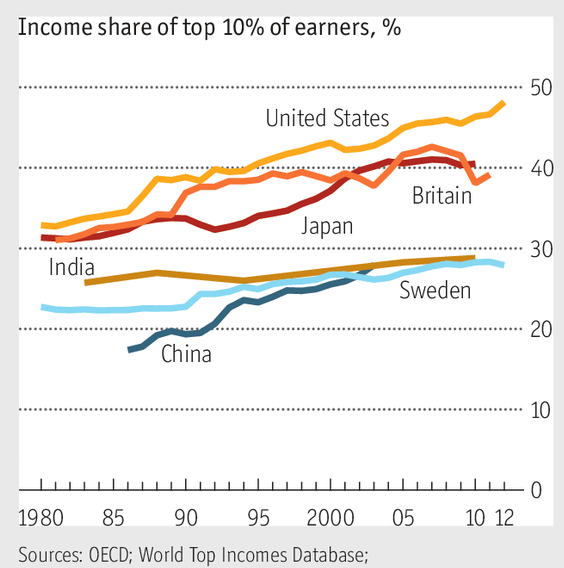
Here’s the experience of the top 10% across the same period:


Their income soared!

The Economist’s article laments the lack of discernible impact of technology on overall productivity so far–thus resulting in a troubling concern that without a significant technology productivity boost to growth, we will have insufficient growth to pull more out of poverty. We know that growth is necessary to alleviate poverty, but is not necessarily sufficient, without some method of assuring fair distribution, or at least in assuring equal opportunity. Opportunity, measured by upward mobility, has declined in the US and is lower than that of many other countries.

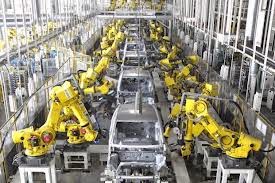
Just consider what we have already seen: Our auto plants have been mechanized, enabling robots to do the work of thousands. Here in my city, the few hundred toll takers for the Golden Gate Bridge have been eliminated. Toll taking is now fully automated.  I remember enjoying the wonderful old hands who operated elevators at the AIG headquarters in New York in the 90s, but I imagine they’re gone now. Many warehouses are now managed by a system of conveyors and automated product pickers. Many larger grocers offer a self service checkout process. Bar codes have eliminated the need for people to take inventory. Most clients of banks seldom need a teller anymore–ATMs handles a high percentage of transactions. I have a small mail weighing machine on my desk, stamps I can buy online, and I can post any package from my home, making the post office irrelevant for me, except for delivery. Actually, most of what used to be mail now comes to me instantaneously via e mail. 

Looking ahead, there is the intention via Amazon to dispense with many of the UPS and FedEx drivers who now deliver something to me several times weekly, already making millions of retail clerks redundant. Amazon promises to deliver via drone. Google has a number of experimental self driving vehicles on the roads around the Bay Area of California. While I imagine some will enjoy continuing to drive, many in my generation will be happy to read and watch the news, confident our safety is better assured than when we were at the wheel–and no need for a driver when we are too old to drive. What’s going to happen to the millions of drivers of taxis? Some have estimated that a significant portion of legal and accounting work can be automated.  What’s going to happen to my accountant when I am actually once again able to file my own return, currently dozens of pages, something I haven’t done since my youth when I only needed the short form 1040. Carl Frey and Michael Osborne have conducted a study which estimates that 47% of US employment is at risk to automation.

Usually comfortable to let the private market solve its problems, even The Economist ends its article with recognition that government must do something: “Most rich economies have made a poor job of finding lucrative jobs for workers displaced by technology, and the resulting glut of cheap, underemployed labour has given firms little incentive to make productivity-boosting investments. Until governments solve that problem, the productivity effects of this technological revolution will remain disappointing. The impact on workers, by contrast, is already blindingly clear.”

It is not certain that these trends will continue. Such is the unpredictable nature of economics. However, isn’t the reality of what we have seen so far in the current technological revolution enough? Aren’t the announced next developments enough? Can’t we see that it is at least highly likely that things will get worse? Technology is bringing benefits, but the profits of technology are going largely to the capitalists. Conservatives can argue that this is their rightful property.  But the picture of the future with the continuance of these trends is not one in which even the rich will want to live. 

Conservatives are urging our government to fight ISIS now, because there is a chance it may become a threat to the homeland. Isn’t increasing inequality already a threat to the homeland?


References:
http://www.economist.com/news/special-report/21621160-labour-steadily-losing-out-capital-those-have-shall-be-given

Carl Benedict Frey and Michael A Osborn, “The Future of Employment: How Susceptible are Jobs to Computerization?”, Sept 17, 2013, http://www.oxfordmartin.ox.ac.uk/downloads/academic/The_Future_of_Employment.pdf


Infrastructure, Growth, and Inequality

Infrastructure, Growth, and Inequality


October 5, 2014

In these pages, I have joined economists and others in arguing that the government should intervene to restrain the growth of increasing inequality–through more progressive taxes and other measures. Some of my Conservative friends have replied that I am overlooking the key point: Growth is the answer. We don’t need to do anything other than do what is necessary to grow faster, they argue. That will take care of the problem. This argument says that if we simply have stronger growth, we will have less poverty, less inequality, and/or at the least we will have everyone enjoying a better living–everyone moving up the ladder. Prescriptions start with less regulation, more open borders, more freedom for the private market to do its work, and less government.

There is much to support this argument. One could cite China as an example–30 plus years of growth averaging about 10%, only recently declining to a still very healthy 7.5%, has resulted in poverty declining across this period from 65% of the Chinese population to less than 10%–1 billion people came out of poverty, defined as living below $1.25 per day.

But, there were other factors involved: education and infrastructure were among the accompanying governmental “interventions” that China invested in during the 30 plus years of phenomenal growth and poverty reduction. As to infrastructure, China viewed it as both necessary for growth and a good way to stimulate the economy, especially when there was any sign of slowdown or disruption, as with the 1997 East Asian Crisis, during which China did not experience a recession, while all its neighbors did. In fact, China has done so much infrastructure development that some say they have built cities in which no one lives, and roads and bridges to nowhere. China builds infrastructure ahead of the need, wherever possible.

It should not be necessary to cite studies to prove that infrastructure is critical to growth. One proof was found during the 90s, when developing debtor countries had IMF conditions imposed which were designed to stimulate growth in their economies. Mostly, growth did not happen and these policies failed. There were lots of reasons, some of which are outlined in an earlier post entitled “Basics of Global Trade.”  One of the reasons was lack of infrastructure. No amount of open borders and reduced regulation can stimulate commerce if the country has poor roads on which to transport its goods, poor railroads, or inadequate port facilities to load those goods onto ships. Good airports are needed. Electricity, telephone and internet services are required. Clean water and sanitation must exist.

Justin Yifu Lin, former Chief Economist of the World Bank, puts it this way in his paper “New Structural Economics: A Framework for Rethinking Development:” […], at each given level of development, the market is the basic mechanism for effective resource allocation. However, economic development as a dynamic process requires industrial upgrading and corresponding improvements in “hard” and “soft” infrastructure at each level. Such upgrading entails large externalities to firms’ transaction costs and returns to capital investment. Thus, in addition to an effective market mechanism, the government should play an active role in facilitating industrial upgrading and infrastructure improvements.”

Lin is arguing that there are stages of growth in the modern world, and government must work with industry to provide the critical infrastructure to best facilitate the continued advancement in development for each stage. For the primary and secondary sectors (raw materials and finished goods), still important to the US, roads, bridges, tunnels, and ports are critical. For  the tertiary sector (services), airports, telephone and internet are important. For the quaternary and quinary sectors (intellectual activities, governance, culture, media, research, home activities and others), internet, communication, and information storage are critical. 


It shouldn’t be necessary to cite sources to show that we are falling behind in all these areas of infrastructure, but here are just two: (1) The American Society of Civil Engineers reports that congestion on our roads is costing $101 billion annually in lost time and fuel, and that we would need to double our annual expenditure of some $91 billion to improve our roads, which are deteriorating at the current expenditure level. They grade our US infrastrucuture as only D+. And (2) Ookla Speedtest reports that the US ranks 26th in the efficiency of its internet service. We’re behind Estonia and Bulgaria now. Hong Kong is #1, and you can bet China is investing to get to the top.


I have two points to make about all this:


(1) Better growth cannot happen without investment in infrastructure on a continuing basis to enable the US to stay the leading economic power in the world. We all agree that economic growth is necessary for poverty reduction. One would think that we could agree on the criticality of infrastructure–Liberals and Conservatives. So, why doesn’t it get approved? The best guess is that the Conservative side of the debate does not want to spend the money. But why? Is it because they are so opposed to something which would increase debt, and certainly would not favor tax increases to fund it? Is it because they are so opposed to anything that looks like stimulus–even if it is designed to fix our infrastructure as opposed to just creating jobs? 


There are times when we should put away the Keynes/Hayek debates about demand or supply side economics and just do the right thing–get our infrastructure back on top!


(2) Also, let’s not forget that there is good growth and bad growth. Just plain unrestrained economic growth will not necessarily result in a societal outcome satisfactory to the people. Return to China for a moment. Yu Xie and Zhang Zhou of the University of Michigan believe China’s Gini coefficient, the common measure on inequality, may now be as high as .55, compared to the US also very high Gini of .45. China’s measure in 1980 was a low .30, reflecting a very egalitarian country. But at today’s level, China is among the most unequal countries in the world. So, while the economic growth has been consistently strong, inequality has risen sharply, and the World Bank now regards the still significant poverty in China as unresponsive to current growth, needing specific government intervention to deal with it. China, unlike the US, is not prejudiced against government vs. the private sector. Government intervenes a lot, so now we’ll see whether their government can fix inequality and other challenges China faces.


Recognizing there is heated debate about permitting any government intervention to restrain inequality, this posting is intended to simply ask that we set all that aside for now and agree that we MUST fix our infrastructure.  Having spent my career in the private sector, with great respect for the amazing power and contribution of that sector, I now fight for a greater recognition that government and industry work together. Just continuing to starve government is not going to benefit the people or even the private sector, in the long run. How about using our private sector prowess and learnings to make our public sector more efficient? I really don’t think that’s beyond the capacities of our talented Conservative leaders.  Other countries have managed to attract private industry leaders into government–why can’t we?


References:
American Society of Civil Engineers Report Card: http://www.infrastructurereportcard.org/roads/

Ookla Speedtest: http://www.netindex.com/download/allcountries/

http://www.worldbank.org/en/news/feature/2009/04/08/poor-areas-poor-people-chinas-evolving-poverty-reduction-agenda

A Quandry

A Quandry

October 3, 2014

If there was a part of the US government which could be re-engineered such as to save perhaps $1 Trillion, one would think the Right would be aggressively pursuing it. And, if such a different process had been proven over the years, elsewhere, shown to deliver such savings consistently, along with quality–wouldn’t that seem to be a no-brainer for all, but especially for Conservatives, at the top of whose list is reducing cost?

I’ve been wondering…if Conservatives hate the current health plan (“Obamacare”) so much, why (to my knowledge) has no one on that side of the table offered an alternative?

The November edition of “Consumer Reports” has an article on health care. They point out that our $3 trillion in health care spending costs the US economy about twice as much as in the rest of the world. I imagine every member of our Congress understands this undisputed fact. Of course, this taken alone, gives good reason to complain from both the Right and the Left. It’s outrageous.

There is a good alternative:  What is also widely known is that the substantially less expensive systems in other countries are single payer systems.  This is where the government pays for health care–as in England (9% of GDP), or in Singapore (5% of GDP). I lived in England recently for a year as a student and enjoyed their excellent health care system. Our system costs us 18% of GDP.  No need to go on about what could be done with the savings of 9% or 13% of our $17 Trillion US GDP….schools, infrastructure, debt reduction, and on.

But the Conservatives are caught in a trap. They hate government, arguing that the private sector is a better solution for most everything except defense. It used to be that they also accepted education as a public sector responsibility, but Paul Ryan’s recent document intended to deal with our growing inequality urges vouchers as the solution for education–another attempt to reduce government and let the free market meet most of our needs.

But, education is only one of the critical areas in which  the free market is not meeting our needs–areas which have historically been better served by government.  Another example is housing for the underprivileged. State and federal resources have been largely withdrawn, and we’re experiencing record shortages of affordable housing. Research and development of large opportunities too expensive and risky for the private sector, such as fusion, have not been funded.  Infrastructure in the US is falling far behind that of other countries–roads, bridges, airports are tired and worn. I believe these are the things we should all use our government to do well, and work together to make government effective in these areas, rather than simply forcing them onto a private sector, a private sector which serves many of our needs extremely well, but is not suited to meeting these particular fundamental and critical needs.

So, it must be painful for the Conservatives. If they really want to save the waste occurring in health care, they need to offer up a single payer system in health care. What a fantastic opportunity for the Republican party to support a clear and proven solution to our health care at perhaps half the cost. With the savings, we could significantly reduce the debt without raising taxes!

But…that would involve making effective use of government!  It would involve eliminating a costly private health care insurance industry.  What a quandry! Finding a way to substantially reduce cost in a private health care system leaves Conservatives unable to offer up anything compelling. I guess reducing government trumps saving money.

When I expressed puzzlement over how we evolved to this crisis in health care costs, a friend who is a health care professional explained it to me in simple terms. Coming out of WWII, European governments were not so opposed to anything seemingly of a socialist nature, desperately recognizing the need to use government to help repair destroyed economies. The US, by contrast, emerged from the War with a strong economy, a highly individualistic ethos, and an abhorrence to anything even remotely resembling socialism.

And, this costly obsession has only strengthened, particularly since 1980.

I argue that the current health care system is better than what we had. And I acknowledge, as has our President, that it most certainly can be improved, such as to better meet its objectives, including reducing costs to some degree–something which needs the ideas, engagement, and support of both sides of Congress to effect.

So, there may be other good alternatives not yet proposed by conservatives who are reluctant to have their proposals subjected to opposing scrutiny, but the big fix, the big savings, is in developing our own American single payer system.

Fox News is Maddening Tonight!

September 22, 2014

Please pardon the frustration that will show in this post–I have been watching Fox news just now!

Tonight they feature retired generals and other “experts,” on the Obama strategy against ISIS. Our President has said there will be no “US boots on the ground.” He is focused on an air war, weapons, advice, and support, from the US and allies, with boots on the ground by local forces who are directly affected by ISIS threats.

Fox and its friends apparently think they are clever to try to put all the focus on whether the “no US boots on the ground” will be effective, with the clear and repeated assertion, “expert” after “expert,” that it will not–i.e., there will definitely need to be US boots on the ground before this war is won–the local boots on the ground will not be sufficient.

What is disingenuous on the part of Fox and friends is this–if all these experts feel we should put US boots on the ground, why are they, each and every one, unwilling to just say that?  It’s certainly implied, but never stated. Isn’t it curious to carefully put all the focus on whether Obama is correct in offering a sufficient strategy? But isn’t it cowardly to avoid taking a position on the issue of American boots on the ground?  I heard none of these experts say they recommend US boots on the ground! None!

Why, just why, are Fox and friends not willing to take a position? Why are all these critics of the “strategy” not willing to courageously say they each recommend putting US troops on the ground?  I argue they are extremely naive to think Americans find criticism of the strategy wins admiration. A proposal of a better strategy is the only way to win true admiration. Too easy, Fox and friends. Same approach you have used for years now with Obamacare–find fault, definitely under no circumstances offer an alternative. A proposal requires courage. There is insufficient courage to put a better plan forward.

I didn’t say they’re not smart. They’re just cowardly. They surely calculate the risks if Fox and friends were to strongly recommend US boots on the ground. First, they might hope to ride a temporary wave of disgust and fear that results in recent polls showing Americans support attacking ISIS. My guess is that they realize the reaction to three beheadings will surely fade when  dozens or hundreds of US forces are returned to the US in body bags, just as we have repeatedly found in Vietnam, Iraq, and Afghanistan.

Consider what’s happening in the Ukraine right now. Russia is riding a record high Putin popularity, fueled by intense nationalism, popularity far higher than any US President has enjoyed in a long time. Yet, Russia has avoided admitting to its own people that their youth are directly engaged in the Ukraine conflict, even to the extent that these young soldiers, fighting in civilian clothing, are being denied proper burials and tribute–all for fear of engendering a sharp reduction in government popularity among Russians, as well as heightening Western resolve to stop Russian incursion in Ukraine. See the BBC report: http://www.bbc.com/news/world-europe-28949582

Isn’t it revealing the the US Congress has been so reluctant to fully debate, discuss, and approve the extent of US engagement in this new war? Why does our Congress seem to hope the President will act unilaterally to decide the extent to which American lives are put at risk?

Yes, indeed–it’s one thing to be on record as saying the Obama strategy will not work, and it’s quite entirely another to be on record as recommending US go to war with American soldiers on the ground. I don’t see any generals, congressmen or other experts anxious to admit they supported a full scale war in Vietnam, Iraq, or Afghanistan.

And, by the way, what is so wrong with a strategy that restrains the danger to young Americans? Why should we offer a nuclear option just because that might be required in the end to win a war? Why shouldn’t we let the strategy evolve? Shouldn’t the locals most directly affected and who understand how to navigate this unfamiliar terrain have a chance to try first?

I thought Bill Maher had made it sufficiently clear that Lindsay Graham and John McCain are off the charts with their fear of ISIS showing up in Arizona: http://www.huffingtonpost.com/2014/09/21/bill-maher-fear-isis-monsanto_n_5857344.html

No matter how many say the current strategy cannot work without US boots on the ground, it’s still far better to start this way.

And, I recognize it isn’t just the Right which enjoys criticizing without recommending an alternative, but wouldn’t it be nice if that was the requirement–no criticism be aired without an accompanying alternative recommendation. It would make television far more educational and meaningful.

One Major Reason Inequality Matters

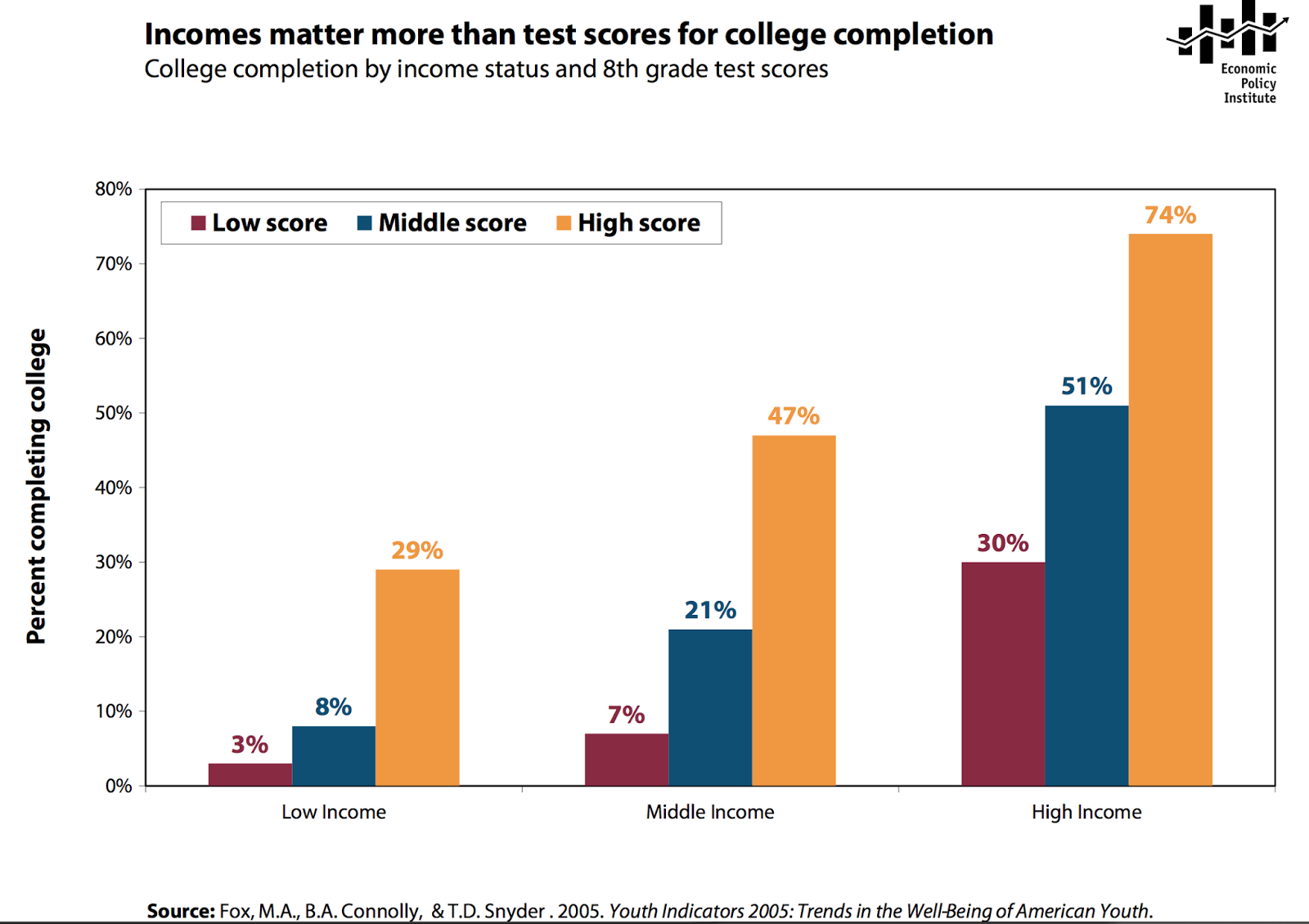
One Major Reason Inequality Matters August 27, 2014 To judge for yourself whether inequality matters, just take a look at this comparison of what happens in college completion for the best scoring of low income kids vs. the lowest scoring high income kids. What happens is that 29% of the low income kids with highest scores complete college, while just about the same percentage (30%) of high income kids complete college. How can this be right?

In asserting that this set of outcomes means that inequality matters, I acknowledge a key assumption, which I believe is solid, but each can decide for herself/himself:

  • I assume we agree that graduating from college is highly determinative for the vast majority in regard to their future opportunity, range of choice in their lives, and success, no matter how each individual defines that. We all recognize there will be a small minority who succeed without college, a few spectacularly, but should this mean we can all bet on such rare proceedings? Business week reports that 19 of the Fortune 500 CEO’s have no college degree at all. But, 100 of them had degrees from just three schools–Harvard, University of Pennsylvania, and Columbia. Ivy League schools had a disproportionate share.

In my post on public and private schools, also dated today, I comment on the exorbitant cost of private schools in Pacific Heights where I live. I believe these kinds of schools garner disproportionate shares of Ivy League admissions, and that an Ivy League degree is usually a ticket to a comfortable life, if not in fact, an outstanding financial success. The New York Times (August 26, 2014) reports that there has been little improvement in the admission of less well off students to selective colleges between 1990 and 2012–only about 15% of admissions are from a poor family background. To be fair, there are lots of reasons for this, and it’s not right to blame the universities for all of them. Some of it stems from the need to educate the students about those possibilities, while they are in high school. Many of the poorer families have a big need for someone with college experience and perspective to advise or even mentor their children, to get them prepared and encouraged to try for the best schools. Cost is not the main problem, since there is financial aid available, but it is also true that many colleges have to balance the low and no pay against the paying kids to achieve financial break-even. One such example of how such support can be availed is described in another NYT article. Communities in Schools operates in 26 states, had 75% success in remedying cases of chronic attendance problems through mentoring and counseling, and claims a cost of only $189 per student per year. This is an example of the kinds of tools we can work with, even within our starved school budgets, with the help of community support organizations. I keep thinking we should have no disagreement between the rich and the poor on the importance of education. Isn’t this piece of it about “equal opportunity,” as distinguished from redistribution? References: Harvard, Columbia, Penn Claim Most Fortune 500 CEOs Generation Later, Poor Are Still Rare at Elite Colleges How to Get Kids to Class

Basics of Global Trade

Basics of Global Trade

September 9, 2014

On September 3, Brookings summarizes a report by Miriam Sapiro, now with Brookings and formerly a deputy US Trade Representative (2009-2014). Sapiro argues strongly for the benefits of increased foreign trade. She’s writing in the context of the Transpacific Partnership (“TPP”), the huge trade alliance the US, Canada, and Mexico are negotiating with 9 Asian countries, including China and Japan. She speaks even more broadly, arguing that more trade is good for the entire global community.

Of course, more free trade sounds good for all–on the surface.  But, for those who have not had the opportunity to study major global failures in this regard, I offer a few observations, while acknowledging that some of the ills I refer to are complex and a host of other country specific factors also contribute to the outcomes I want to point out.

  • First, the direction of Sapiro’s argument is along the lines of open borders, deregulated free trade, elimination of barriers and tariffs–let the free market determine who gets the business. Sounds good on the surface.
  • Second, this trade agreement is between 12 countries. The 11 represent about 44% of US exports at this time. Only one of these countries, Peru, can be seen as early “developing,” unless you consider Mexico and China in that camp. So, the first question is what about the rest of the world? What about sub-Saharan African countries? If trade increases between the 12 in the TPP, does it mean that there is less opportunity for others, especially young developing countries, to sell to these 12? I think it does, to some degree.
  • History has shown that when borders were opened by the influence of the Washington Consensus in the 90s, with the force of IMF lending conditions behind it, foreign investment increased mostly between developed countries, and relatively few western companies made investments in the places conservative economists expected–where wages were lowest. Why? Because of lots of handicaps in those developing countries–absence of rule of law, absence of institutions, absence of infrastructure, absence of sufficiently educated work force, language, customs, etc.
  • As most clearly pointed out by economist Ha-joon Chang in his Kicking Away the Ladder, western nations are duplicitous in their demand for open borders. He points out that when they were young, the US, England, Japan, So Korea and most all developed countries had highly restrictive protections for their infant industries, high tariffs for example, no open borders, for a considerable period of years! So, have we forgotten that, or do we really feel something fundamental has changed such that infant industries of today do not need a similar period of protection to get started? Alexander Hamilton was one of the strongest advocates for that in the case of the United States, in the 18th century.
  • Furthermore, even now, we remain protective of our own. Consider the amount of subsidy we give farmers in the US, raising crops which can far more efficiently be raised in many foreign countries. Doing so, we deny our own consumers the best prices and we also flood foreign agricultural markets with products at prices locals could compete with–without our subsidies–but with those subsidies, they cannot.
  • Many countries forced to open their borders had catastrophic consequences: Along with open border requirements, another imposition was reducing government. Government had been the major employer in many of those countries. The idea was that all those displaced workers would get jobs in the burst of growth produced by opening borders. But, little foreign investment came, foreign agricultural products flowed in at subsidized prices even local wages could not compete with, and there was no way to develop local manufacturing without import tariffs. Many economies which accepted IMF debt with its impositions spiraled downward. Poverty increased.
  • Marco Caceres has a great summary of recent impacts of such policies in Honduras, in the Sept 3, 2014 edition of the Huffington Post. The problems of these policies of the 90s continue to this day, as the Honduran administration is currently negotiating with the IMF over the terms of a new $220 Million loan. The price might involve a forced devaluation of the currency, which improves possible sale of exports, but raises prices for consumers in Honduras. Caceres reports that across the period of 1995 to 2012, US subsidies to US farmers for rice totaled $13 billion and subsidies for corn totaled $84 billion.

Citizens of developing countries are relegated to continued poverty through our agricultural subsidization and our companion political philosophy of imposing open borders on young developing countries.

Citizens of the US are also harmed. We pay higher prices for food products than we would if foreign producers were allowed to sell us rice and corn at prices which would give them a fighting chance at a decent agricultural business outcome for their families. Just those two subsidies (and there are others) total almost $100 billion of our tax dollars–that hurts Americans also. I’d rather we spend it on infrastructure and education.

So, more free trade is something that is good for some, but not always good for all, and our trade negotiations need to take the unique needs of individual trade partners into account, along with their respective stages of growth. And, we need to try harder to look at the world as the realm we must be accountable to, not just our own healthy, wealthy country.

References:

Overview of the Trans Pacific Partnership

Honduras: Beware of Neoliberal Economic Growth Strategies

Why Trade Matters in Four Maps (2014)

Basics of Global Trade

Basics of Global Trade
September 9, 2014

On September 3, Brookings summarizes a report by Miriam Sapiro, now with Brookings and formerly a deputy US Trade Representative (2009-2014). Sapiro argues strongly for the benefits of increased foreign trade. She’s writing in the context of the Transpacific Partnership (“TPP”), the huge trade alliance the US, Canada, and Mexico are negotiating with 9 Asian countries, including China and Japan. She speaks even more broadly, arguing that more trade is good for the entire global community.

Of course, more free trade sounds good for all–on the surface.  But, for those who have not had the opportunity to study major global failures in this regard, I offer a few observations, while acknowledging that some of the ills I refer to are complex and a host of other country specific factors also contribute to the outcomes I want to point out.

  • First, the direction of Sapiro’s argument is along the lines of open borders, deregulated free trade, elimination of barriers and tariffs–let the free market determine who gets the business. Sounds good on the surface.
  • Second, this trade agreement is between 12 countries. The 11 represent about 44% of US exports at this time. Only one of these countries, Peru, can be seen as early “developing,” unless you consider Mexico and China in that camp. So, the first question is what about the rest of the world? What about sub-Saharan African countries? If trade increases between the 12 in the TPP, does it mean that there is less opportunity for others, especially young developing countries, to sell to these 12? I think it does, to some degree.
  • History has shown that when borders were opened by the influence of the Washington Consensus in the 90s, with the force of IMF lending conditions behind it, foreign investment increased mostly between developed countries, and relatively few western companies made investments in the places conservative economists expected–where wages were lowest. Why? Because of lots of handicaps in those developing countries–absence of rule of law, absence of institutions, absence of infrastructure, absence of sufficiently educated work force, language, customs, etc.
  • As most clearly pointed out by economist Ha-joon Chang in his Kicking Away the Ladder, western nations are duplicitous in their demand for open borders. He points out that when they were young, the US, England, Japan, So Korea and most all developed countries had highly restrictive protections for their infant industries, high tariffs for example, no open borders, for a considerable period of years! So, have we forgotten that, or do we really feel something fundamental has changed such that infant industries of today do not need a similar period of protection to get started? Alexander Hamilton was one of the strongest advocates for that in the case of the United States, in the 18th century.
  • Furthermore, even now, we remain protective of our own. Consider the amount of subsidy we give farmers in the US, raising crops which can far more efficiently be raised in many foreign countries. Doing so, we deny our own consumers the best prices and we also flood foreign agricultural markets with products at prices locals could compete with–without our subsidies–but with those subsidies, they cannot.
  • Many countries forced to open their borders had catastrophic consequences: Along with open border requirements, another imposition was reducing government. Government had been the major employer in many of those countries. The idea was that all those displaced workers would get jobs in the burst of growth produced by opening borders. But, little foreign investment came, foreign agricultural products flowed in at subsidized prices even local wages could not compete with, and there was no way to develop local manufacturing without import tariffs. Many economies which accepted IMF debt with its impositions spiraled downward. Poverty increased.
  • Marco Caceres has a great summary of recent impacts of such policies in Honduras, in the Sept 3, 2014 edition of the Huffington Post. The problems of these policies of the 90s continue to this day, as the Honduran administration is currently negotiating with the IMF over the terms of a new $220 Million loan. The price might involve a forced devaluation of the currency, which improves possible sale of exports, but raises prices for consumers in Honduras. Caceres reports that across the period of 1995 to 2012, US subsidies to US farmers for rice totaled $13 billion and subsidies for corn totaled $84 billion.
Citizens of developing countries are relegated to continued poverty through our agricultural subsidization and our companion political philosophy of imposing open borders on young developing countries.
Citizens of the US are also harmed. We pay higher prices for food products than we would if foreign producers were allowed to sell us rice and corn at prices which would give them a fighting chance at a decent agricultural business outcome for their families. Just those two subsidies (and there are others) total almost $100 billion of our tax dollars–that hurts Americans also. I’d rather we spend it on infrastructure and education.
So, more free trade is something that is good for some, but not always good for all, and our trade negotiations need to take the unique needs of individual trade partners into account, along with their respective stages of growth. And, we need to try harder to look at the world as the realm we must be accountable to, not just our own healthy, wealthy country.
References:

http://www.ustr.gov/tpp/overview-of-the-TPP

http://www.huffingtonpost.com/marco-caceres/honduras-beware-of-neolib_b_5758970.html

http://www.brookings.edu/blogs/brookings-now/posts/2014/09/why-trade-matters?utm_campaign=Brookings+Brief&utm_source=hs_email&utm_medium=email&utm_content=14032209&_hsenc=p2ANqtz-8RTZ4df1FfeQusMXE9e5Cxrai3BXUczQyYdcR2J12AJ4A2qMJkLijgrQk5lDg9aQzumMGqXnp3K8eP1WTjT5B2XdjIyw&_hsmi=14032209

One Major Reason Inequality Matters

One Major Reason Inequality Matters

August 27, 2014

To judge for yourself whether inequality matters, just take a look at this comparison of what happens in college completion for the best scoring of low income kids vs. the lowest scoring high income kids. What happens is that 29% of the low income kids with highest scores complete college, while just about the same percentage (30%) of high income kids with low scores complete college. How can this be right?

In asserting that this set of outcomes means that inequality matters, I acknowledge a key assumption, which I believe is solid, but each can decide for herself/himself:

  • I assume we agree that graduating from college is highly determinative for the vast majority in regard to their future opportunity, range of choice in their lives, and success, no matter how each individual defines that. We all recognize there will be a small minority who succeed without college, a few spectacularly, but should this mean we can all bet on such rare proceedings? Business week reports that 19 of the Fortune 500 CEO’s have no college degree at all. But, 100 of them had degrees from just three schools–Harvard, University of Pennsylvania, and Columbia. Ivy League schools had a disproportionate share.

In my post on public and private schools, also dated today, I comment on the exorbitant cost of private schools in Pacific Heights where I live. I believe these kinds of schools garner disproportionate shares of Ivy League admissions, and that an Ivy League degree is usually a ticket to a comfortable life, if not in fact, an outstanding financial success.

    The New York Times (August 26, 2014) reports that there has been little improvement in the admission of less well off students to selective colleges between 1990 and 2012–only about 15% of admissions are from a poor family background.

    To be fair, there are lots of reasons for this, and it’s not right to blame the universities for all of them. Some of it stems from the need to educate the students about those possibilities, while they are in high school. Many of the poorer families have a big need for someone with college experience and perspective to advise or even mentor their children, to get them prepared and encouraged to try for the best schools. Cost is not the main problem, since there is financial aid available, but it is also true that many colleges have to balance the low and no pay against the paying kids to achieve financial break-even.

    One example of how such support can be availed is described in another NYT article. “Communities in Schools” operates in 26 states, had 75% success in remedying cases of chronic attendance problems through mentoring and counseling, and claims a cost of only $189 per student per year.

    This is an example of the kinds of tools we can work with, even within our starved school budgets, with the help of community support organizations.

    I keep thinking we should have no disagreement between the rich and the poor on the importance of education. Isn’t this piece of it about “equal opportunity,” as distinguished from redistribution?

    References:
    Business week: http://www.businessweek.com/bschools/blogs/mba_admissions/archives/2011/01/harvard_columbia_penn_claim_most_fortune_500_ceos.html

    NYTimes Aug 26 2014: http://www.nytimes.com/2014/08/26/education/despite-promises-little-progress-in-drawing-poor-to-elite-colleges.html?hpw&rref=us&action=click&pgtype=Homepage&version=HpHedThumbWell&module=well-region&region=bottom-well&WT.nav=bottom-well&_r=0

    Communities in Schools: http://www.nytimes.com/2014/08/26/opinion/to-keep-poor-kids-in-school-provide-social-services.html?hpw&rref=opinion&action=click&pgtype=Homepage&version=HpHedThumbWell&module=well-region&region=bottom-well&WT.nav=bottom-well

    Let’s Join to Fix Public Schools–A Reflection from Pacific Heights

    Let’s Join to Fix Public Schools–A Reflection from Pacific Heights

    August 27, 2014

    Anyone who questions inequality in our society need only look at schools.
    My perspective reflects my own experience. I went to public schools through high school. My kids went to public schools through college. I’m proud of our public education. 
    School was in the 1950s and 60s for me and the 1970s and 80s for my kids.
    Since then, things have changed and the quality of many public schools has declined. My kids and I were educated before public schools were forced to campaign for donations to sustain even basic programs. 
    Today, within a three block radius of where I live in the Pacific Heights section of San Francisco, there are four private schools. According to their websites, their tuitions are:
    Drew School:              $38,500 plus estimated costs of $2,000
    Town School:              $28,170-29,245
    University High:          $37,200 plus estimated costs of $3,000
    Waldorf School:
          Nursery students:   $14,800
          Grades 1-12:          $21,400-32,400
    Together, these schools enroll 1,539 students.
    One of these schools started in 1973 and another in 1979. That was when income inequality began its steady upward rise, returning the United States to where it was at the end of the Gilded Age. The shift marked a reversal of a roughly 30-year period of egalitarianism in much of the Western world. According to the French economist Thomas Piketty, this period of greater equality reflected massive social policies enacted in response to the Great Depression and the two World Wars. Without such future epic events to serve as catalysts for social change, Piketty forecasts that inequality in wealth and income will continue to widen. I agree.
    The way education fits into the inequality story is plain. Can a family with two workers making San Francisco’s minimum wage get the kind of education for their kids provided by these Pacific Heights private schools? Can even a family making San Francisco’s median household income of about $75,000 afford such educational expense?
    In 1970, the economist Albert Hirschman advanced his “exit voice” theory. He explained that when the wealthy choose to buy high quality private services such as private schools, their exit from public services leaves only the poor to support those services. But the poor do not have much “voice” to influence government, so public services continue to deteriorate. That sets in motion a vicious circle of declining public school resources, rapid school deterioration, and more exits of those with means from the public school system.
    Where I live, enough families have incomes sufficient to pay steep private school tuitions and also contribute generously to capital campaigns.  Three of these schools have had major capital campaigns, and significantly upgraded and expanded within the past 5 years.   But, not far from me live other good parents. Their ambitions for their kids are no different than those of my wealthy Pacific Heights neighbors. However, those less affluent parents mostly cannot touch these feeder schools to Ivy League universities. The gap between the rich and everyone else is perpetuated for another generation.
    I don’t blame these four private schools–they’re all excellent. And, to be fair, they each offer financial support to some students. Nor do I blame the parents who send their children to these schools. They’re good parents and I might do the same if I were in their shoes today.
    But I am increasingly troubled by the growing disparity in quality of education, which translates into differences in job opportunities, social mobility, and prosperity. The sum of say $30,000 per year for these 1,539 private school students compares with approximately $9,000 for each of the 53,000 students in the San Francisco Unified School District. Student/teacher ratios of about 8:1 compare with 18:1 in our public schools.
    I appeal to the wealthy to recognize that quality education like what their children get should be available to all children.  For conservatives who do not believe in redistribution, but do believe in equal opportunity, I appeal especially to you.  You undoubtedly agree that quality education is critical, or as parents you wouldn’t pay these prices. By all means, parents should provide their children with the best. But let’s join together to make sure similar opportunities are available for all by providing public schools the resources they need and restoring excellence to public education.  
    Fixing our public schools will go a long way toward reducing inequality.